


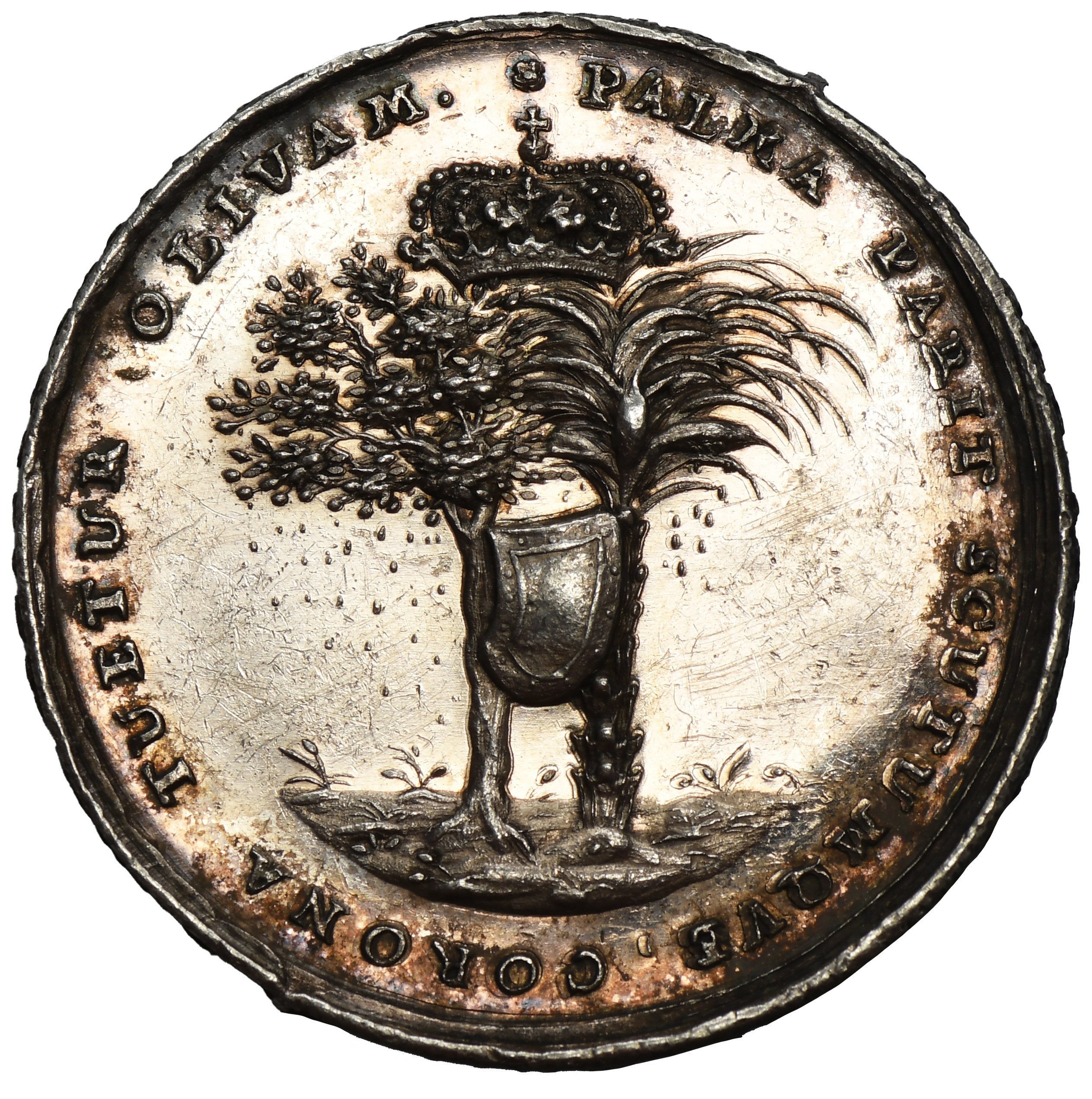
An extremely rare six-ducat medal, struck to commemorate the royal couple’s visit to Gdańsk in 1677.
The medal was designed by Jan Höhn the Younger.
A six-ducat medal struck in silver has never before been listed at auctions in Poland.
A similar piece from the collection of Count Emeryk Hutten-Czapski was recently sold at the 374th Spink Auction on January 16, 2022, for $8,000.
Minor surface nicks, typical of these issues, but a beautifully preserved piece with a deep mirror finish, covered with an aged patina.
An extraordinary combination of rarity and beauty. We highly recommend it—one of the most beautiful lots in the 18th Premium Auction.
Obverse: busts of John III Sobieski and Queen Maria Kazimiera facing right, both wearing laurel wreaths on their heads
JOAN III REX ET MARIA CAS REG POL M D L R P (John III, King, and Maria Kazimiera, Queen of Poland, Grand Dukes of Lithuania, Ruthenia, and Prussia)
Reverse: two crowned trees, a palm and an olive tree, with the Sobieski family coat of arms between them; along the edge, the inscription SIT PAX IN TURRIBUS TUIS ANNO 1677 D 1 AUGUST (May there be peace in your towers, in the year 1677, on August 1)
PALMA PARIT SCUTUMQUE CORONA TUETUR OLIVAM (the palm bears the shield, and the crown protects the olive)
Silver, diameter 34 mm, weight 20.42 g
Edward Raczyński writes the following regarding this item: “John III’s journey to Royal Prussia in 1677 was the reason for the minting of this medal. The King visited this province at the urgent insistence of the city of Gdańsk, where disputes between the city council and the guilds threatened to erupt into a dangerous conflict. On May 23, the King arrived in Toruń, where he was received with great pomp. Upon his departure, the city council presented him with a monetary gift that today would be considered unworthy of royal dignity. For the King received 500 zlotych, the Queen 280, Prince Jacob 100, and Princess Teresa Kunegunda, who was barely one year old, received fruit and flowers.
From Toruń, the King sailed to Gniew, and from there to Malbork; he toured the Żuławy region and arrived in Gdańsk on August 1. However, his hopes of resolving the disputes between the city council and the guilds did not materialize. The settlement proposed by the King satisfied neither side, and a final resolution of the dispute was postponed until a later date.
During his stay in Gdańsk, Queen Mary Kazimiera gave birth to a son, Alexander, on September 10.
The inscription on the reverse side of this medal is convoluted and not particularly well chosen. We surmise, however, that the intention was to express that the olive tree—that is, peace—is supported by the palm branch, symbol of victory, and that this same peace, under the King’s protection, will remain unshaken in its security. Thus, this medal applies both to military success and to the peace treaty concluded with the Turks at Żurawno on October 17 of the previous year; it may also commemorate the Queen’s delivery, who, on March 4 of the previous year, gave birth to a daughter, Teresa Kunegunda, later the Electress of Bavaria, or rather to the Queen’s delivery in Gdańsk in the year 1677, where her son Alexander was born. Note X. by Albertrandi.”











