


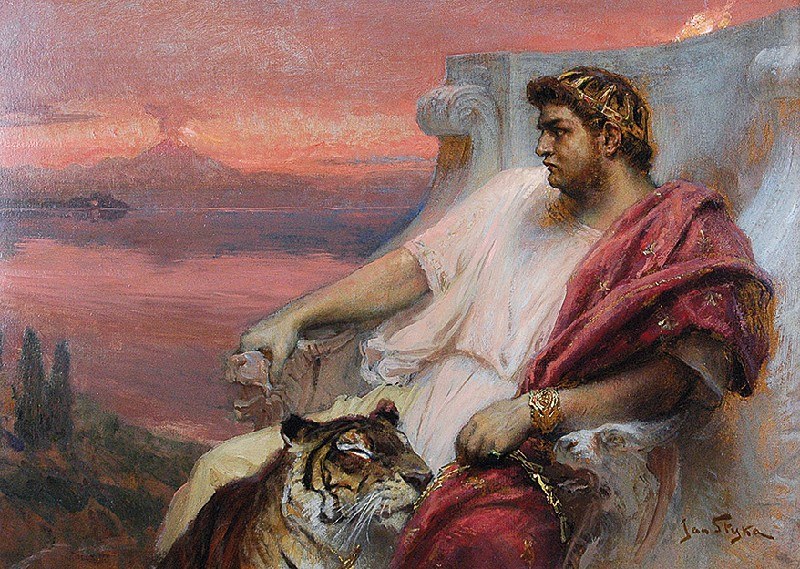
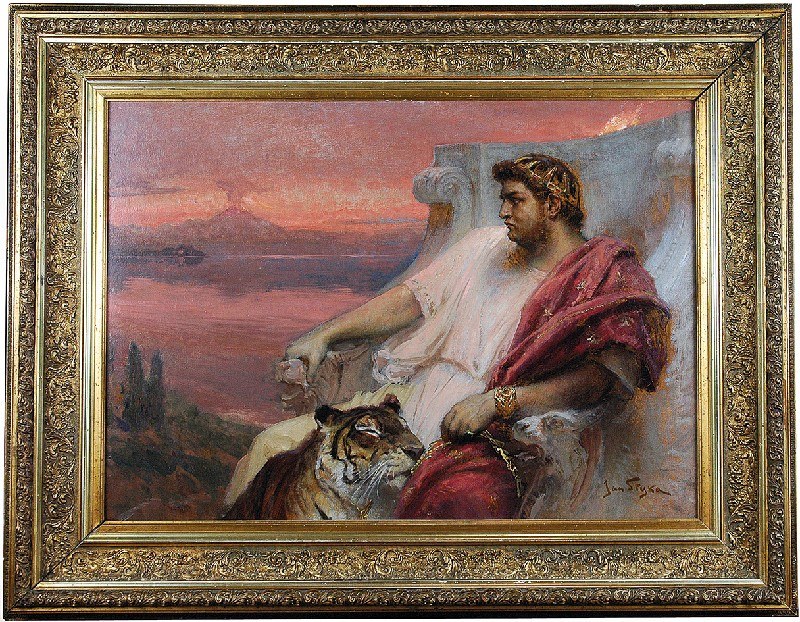
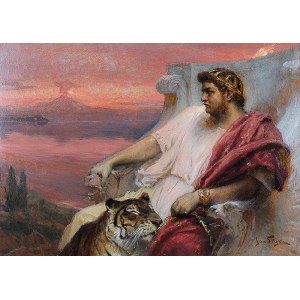
oil, cardboard; 59.5 x 81 cm;
Signed p. d.: Jan Styka.
Image exhibited:
Nerone [presented in the exhibition catalog, ed. Maria Antonietta Tomei, Rosella Rea] - Rome - Milan 12.04 - 18.09.2011 - here a chapter by Jerzy Miziołek "Lux in tenebris. Nerone e i primi Cristiani nelle opere di Enrico Siemiradzki e Jan Styka" pp. 44-61, painting mentioned and reproduced in the text and on the cover of the catalog.
Jan Styka was the creator of the idea of large-format works - panoramas, including being the co-creator of Panorama Raclawicka, the creator of "Panorama of Transylvania" or the monumental canvas "Golgotha" considered at the time to be the largest painting on religious themes. For the exhibition of the latter work, a rotunda was erected at the back of the Bristol Hotel on Karowa Street in Warsaw. The artist studied in Vienna, then stayed in Rome, Lviv, Cracow, Lviv, Paris, among others, and finally, in 1919, settled on the Italian island of Capri. One of the painting series and themes undertaken by Jan Styka were paintings - illustrations to "Quo Vadis" by Henryk Sienkiewicz or "Iliad" and "Odyssey" by Homer. In the case of the latter literary work, the artist traveled in the footsteps of the main character of the poem, making sketches, painting notes. Like Henryk Siemiradzki, Jan Styka also turned his attention to antiquity. However, he seems to have found a more expressive form of painterly expression, abandoning the classical conventions that, for example, characterize the works of Henryk Siemiradzki.
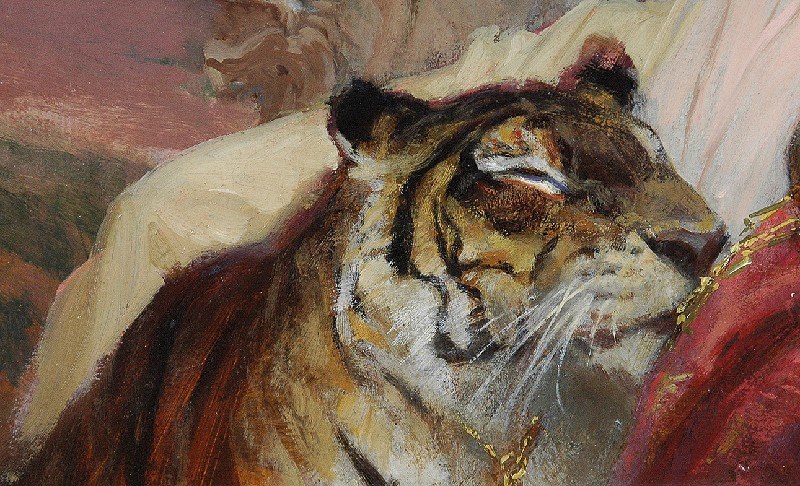
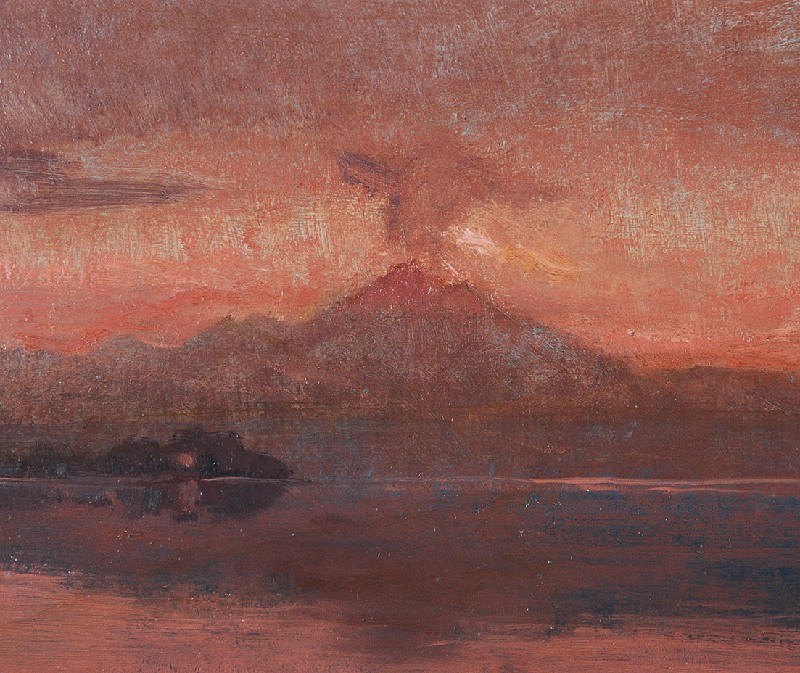
The offered painting is one of the illustrations to the previously mentioned work by Henryk Sienkiewicz, and depicts Nero in the town of Baiae in the territory of Ancium (Antioch) on the present Gulf of Naples. It was a kind of resort to which the mighty of the ancient world like Julius Caesar or precisely Nero went. The most beautiful villas of antiquity were located there. This city was partially destroyed by the waters of the bay after the eruption of the volcano Vesuvius. The offered work by Jan Styka depicts Nero - the Roman emperor - sitting in a stone chair with a tiger at his feet. Visible in the background is the mountain belching fire that destroyed not only Baiae, but also Pompeii. The figure of Nero, in Jan Styka's composition, is shot in profile with an extremely worried expression on his face and an absent gaze into the distance. Thanks to the use of diagonal divisions, determined, for example, by the way the armchair is positioned with the main character of the representation sitting in it, the composition of the offered painting seems full of movement despite the static nature of the figure.
In Henryk Sienkiewicz's work Quo Vadis, which undoubtedly inspired the artist, Nero goes to his villa in Bai several times. This happens, among other things, when he is overcome with emotion after the death of his daughter Augusta. It was also there that the Emperor killed his mother Agrippina. But Nero's most gallant concept in his mind while in Baiae was about setting fire to Rome. The emperor of the Roman empire wished, like Homer, who survived and described the burning of Troy, to experience emotions so moving as to match the Greek's epics in his poetry.








Nylig sett
Logg deg inn for å se en liste over objekter
Favorittobjekter
Logg deg inn for å se en liste over objekter