



[KRASIŃSKI, Zygmunt] *
* (Unfinished)
POEM
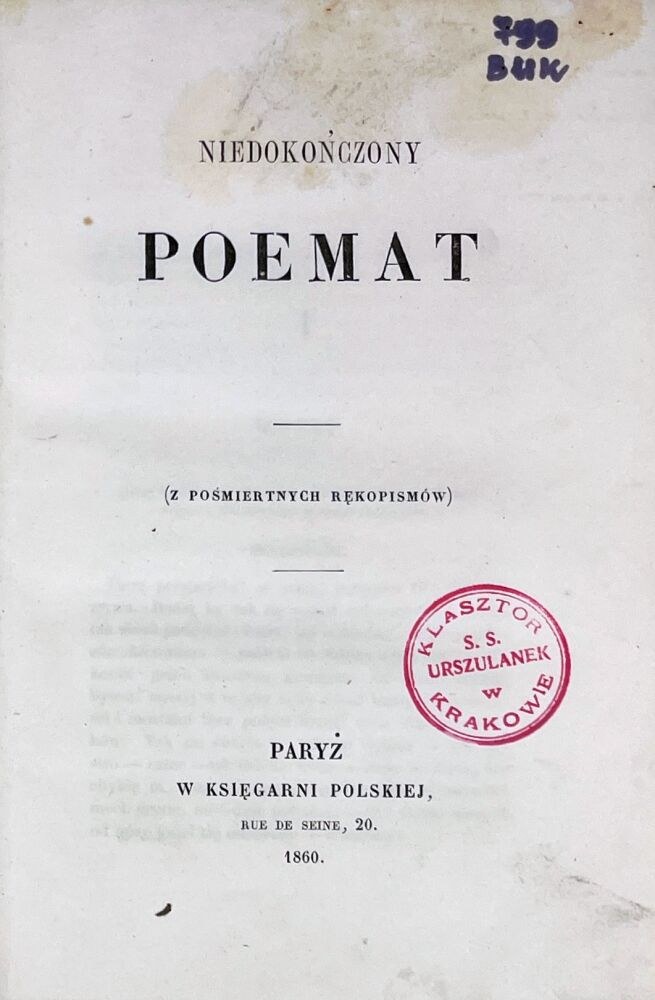
(From posthumous manuscripts)
Paris 1860, at the Polish Bookstore, p. 188, size 13x21 cm
1st complete edition.
Published under the title “The Un-Divine Comedy. Part 1. Introduction and Fragments of the First Act.” The work was written between 1838 and 1852. See NK 8, item 237.
The story of a young man’s initiation into the world—the discovery of his own place and the mechanisms governing history and politics.
A young man, also referred to in several places as Count Henryk, is the main character here. He is accompanied by a guide, teacher, and friend—the spiritual and devout Aligier—who watches over the young man’s initial development. This work, titled *The Unfinished Poem*, was written between 1838 and 1852. The author intended it to serve as a prelude to *The Un-Divine Comedy*, the first part of which was added later. This is what Zygmunt Krasiński wrote about it to Delfina Potocka on March 20, 1840, from Mola di Gaeta in Italy:
“The first part of this poem already exists; on its own, it means nothing, but it will become significant only when it is joined by the first part and the third, final part. This part (…) is called The Un-Divine Comedy. (…) The character who represents humanity—the archetype of man—Count Henryk, is barely a young man at the beginning of the first part. This first part will be a poem of youth. An older friend is by his side. This friend is a guardian angel, visible as long as a person is a child, as long as the struggle of life has not yet begun, and vanishing as soon as it begins. The scene opens in the mountains near Venice. The young man frolics and hunts there, while his friend remains atop a cliff, praying to God for this soul, which will soon begin to live in the real world and struggle amid the turmoil of the world. He asks God to reveal the truth to him through a fantastical dream. In the evening, in a valley shrouded in mist, he is overcome, and suddenly a heavy sleep falls upon his eyes. As the young man falls asleep, he dreams that his friend’s face transforms into that of Dante. The dream begins. Dante’s spirit guides the young man. In this world lies the truth of our age. Our age is one of transition. Every such age bears the predominant hue of evil; it is often a hell on earth, for on the one hand, old beliefs have fallen, and new ones have not yet taken root. Just as violently and inexorably, some people stand by the laws of the past, while others stand by the hopes of the future! Yet the former are already wrong, and the latter are not yet right; thus, there is strife everywhere. In other eras, when there are strict, certain, and unfailing beliefs—defined heavens, rituals, and religions—hell may be somewhere, but not here. In our times, hells are not beyond the earth or beneath it, but they are right here on earth. In this dream, then, Dante leads the young man across the earth, to the barracks, where the army—that is, people turned into beasts!—resides; to the secret police, where people are demonized; to the stock exchange, where people are degraded. To clubs, where there are mad people; to factories, where people are suffocated by misery, reduced to a state worse than that of animals! Everywhere he shows him the Good Life (which is a just and powerful means) taken as an end in itself, and thereby transformed into wickedness and baseness. In short, this fantastical dream is nothing more than the introduction of an actor onto the stage and a description of the scenery on that very stage. When the young man awakens, filled with revulsion and magical terrors, where will he awaken? Why, in the city you love, in Venice! (…)
You know what happens in the second part—the one you’ve read. It’s a man’s world: politics, personal interests, the clash of aristocratic and democratic ideals, finally the apparent defeat of the former, Henry’s death, the victory of the people—and yet, in the end, the death of the leader of democracy and the dying words uttered by him: “Galilaee, vicisti”” (Z. Krasiński, Letters to Delfina Potocka, ed. Z. Sudolski, vol. I, pp. 200–201).
A rarity!
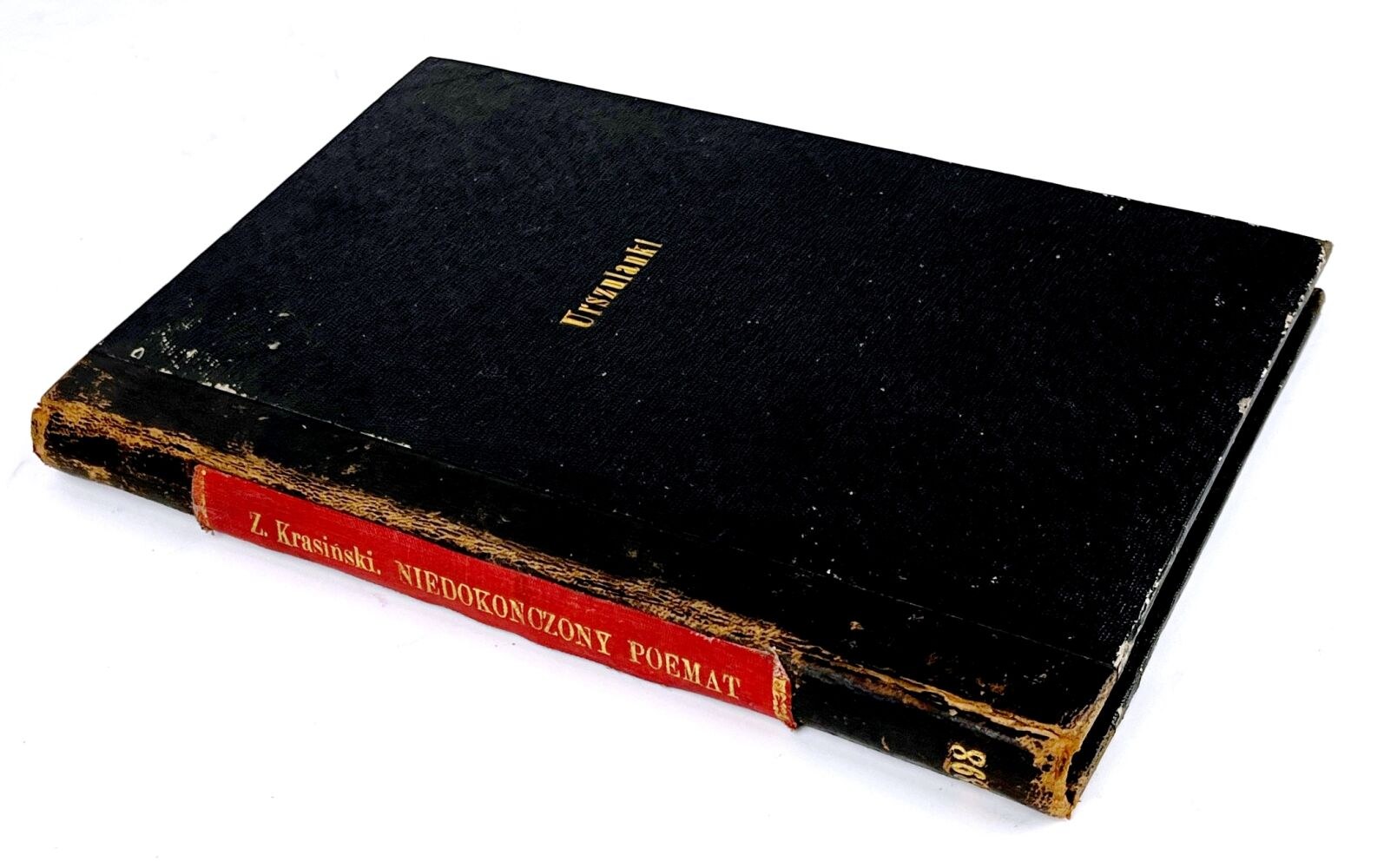
PERIOD HALF-LEATHER HARDCOVER, GILDING ON THE SPINE
Condition: Very Good / minor edge scuffs, worn spine, stamps, and ownership inscriptions on the title page and half-title page.











