


56,5 x 79,5cm - oil, canvas
Signed along the right edge at the bottom: J. Malczewski 1922
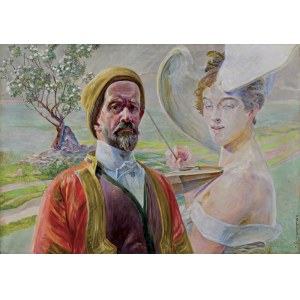
Among Jacek Malczewski's most famous works are his self-portraits. Undoubtedly among the most beautiful - self-portraits with the Muses. These women, taking the forms of chimeras, harpies or Medusa, are the epitome of strength. Irresistible, vital, as Andrew Yakimovich writes. A force that reveals itself in the creative act, while transformed into a work of art, it has the power to influence reality.
Self-Portrait with Medusa was created in 1922, and at the same time the artist created the monumental Prządka, a work that is the culmination of his reflections on the fate of man, art and creativity, and the homeland (Agra-Art auction, March 21, 2021, cat. item 19). In both canvases we recognize his friend and confidante of the time - Michalina Janoszanka (photo). As Prządka, who takes the place of the master in his studio - Janoszanka embodies the power of art and the new generation of artists in reborn Poland.
In the presented Self-Portrait, which is one of Malczewski's last "classical" compositions - she stands by the artist's side as his Muse. Behind them stretches a native spring landscape with a road and a blooming apple tree, under which sits a country girl watching the couple. The painter, clad in his famous women's blouse, studded with a gold pin with an emerald, looks directly at the viewer. A melancholy, somewhat absent-minded, but oh-so-magnetizing gaze is directed in the same direction by Muse, who is facing him, playing the goose, that is, endowing him with inspiration. However, the wings sprouting from her head, between which vipers can be seen entwined, make one see Medusa in her form: one of the most terrifying creatures of Greek mythology, who is also the mother of Pegasus, who embodies inspiration.
As Jadwiga Puciata-Pawłowska writes, in dealing with the subject of Medusa Malczewski shows independence and originality, as it happened with other motifs appearing in his paintings (J. Puciata-Pawłowska, Jacek Malczewski, Wrocław-Warszawa-Kraków 1968, p. 105). Thus, sometimes Medusa in Malczewski's paintings is repulsive, more often - a beautiful, charming woman. More than once - she has the physiognomy of the beloved Kini Bal.
Discussing Self-Portrait with Medusa, it is impossible not to mention the famous Finis Poloniae (1905, privately owned), where the artist depicted himself surrounded by harpies entwined with snakes. According to Marek Rostworowski, these are personifications of Prussia and Austria, the partitioning states that, together with Russia, plundered Poland. Agnieszka Ławniczakowa, on the other hand, saw in them seductive powers of the senses, joy and temptations of life - forces antagonistic to the artist's spiritual mission. According to this interpretation, the work expresses the artist's inner conflict between his personal needs and the duties imposed on him by his social role.
Writing about Finis Poloniae, on the other hand, Teresa Grzybkowska proposes an interpretation of the snakes as attributes of Asklepios - the patron of the art of medicine: Snakes here represented the dynamics of life. The snake sheds its skin to be reborn, symbolizing the very essence of life. The touch of a snake in Greek art meant healing. Thus, the snake symbolized inner energy, the transformation of life (T. Grzybkowska, Jacek Malczewski's Finis Poloniae. Revolution of 1905 or confession of love?", "Roczniki Humanistyczne", T. XLVII, 1999, z. 4, p. 324). It should also be recalled here that Medusa herself had a dual nature: the blood flowing in her veins from the left side of her body was poison, but that which flowed on the right side - had the power to restore life.
Taking into account the time of the creation of the offered Self-Portrait, as well as the context of Prządka and Finis Poloniae with their symbolism, one can look at the Self-Portrait with Medusa as an image of a reborn Poland and art. The latter is created as a result of the artist's internal struggles, and at the same time as a necessary will to create, which is the meaning of human existence. The work, therefore, primarily expresses Malczewski's belief in the performative power of art, which has the real ability to transform reality. It can be as powerful as the legendary destructive gaze of Medusa.
Jacek Malczewski (Radom 1854 - Krakow 1929) - a prominent representative of Polish modernism painting, began his artistic studies at the School of Fine Arts in Krakow, where in 1872-1875 he studied under Feliks Szynalewski, Władysław Łuszczkiewicz and Jan Matejko, whose studio he attended again in 1877-1879. He then studied at the Paris École des Beaux Arts under E. Lehmann (1876-1877).
In 1880, he traveled to Italy. In 1884-1885, he took part - as a draughtsman - in Karol Lanckoroński's scientific expedition to Pamphylia and Pisidia in Little Asia. At that time he was also in Greece and Italy. In 1885-1886 he stayed in Munich for several months. Upon his return, he settled permanently in Cracow, from where he made further trips to Munich and Italy. In 1896-1900 he taught at the School of Fine Arts in Cracow, and from 1911-1922 he was a professor and twice rector of the Cracow Academy. He spent the years 1914-1915 in Vienna, and in 1916 returned to Cracow. In the last years of his life he stayed mainly in Luslawice and Charzewice near Zakliczyn. He was a co-founder of the Society of Polish Artists "Art" (1897) and a member of the "Zero" group (1908).
In the early period of his career, he painted portraits, genre scenes and - above all - paintings with themes related to the martyrdom of Poles after the January Uprising (Death of Ellenai, Sunday in the Mine, On the Stage, Christmas Eve in Siberia). Later, from the 1890s, he created paintings with symbolic content with intermingled patriotic, biblical, fairy-tale, literary and allegorical-fantastic themes.













Nylig sett
Logg deg inn for å se en liste over objekter
Favorittobjekter
Logg deg inn for å se en liste over objekter