


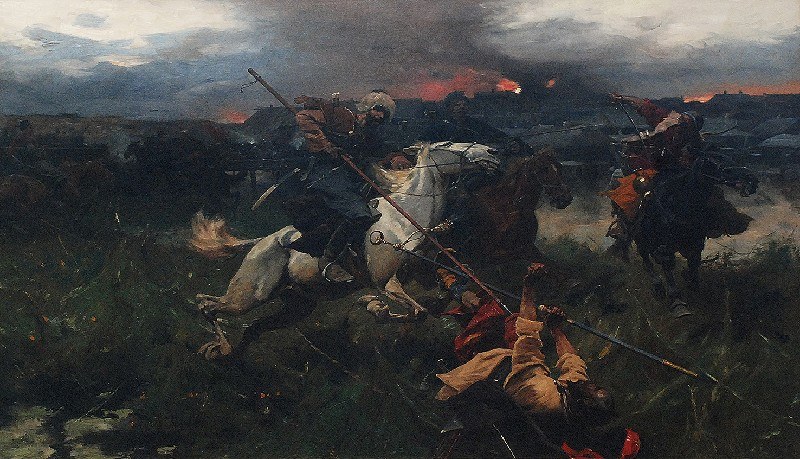

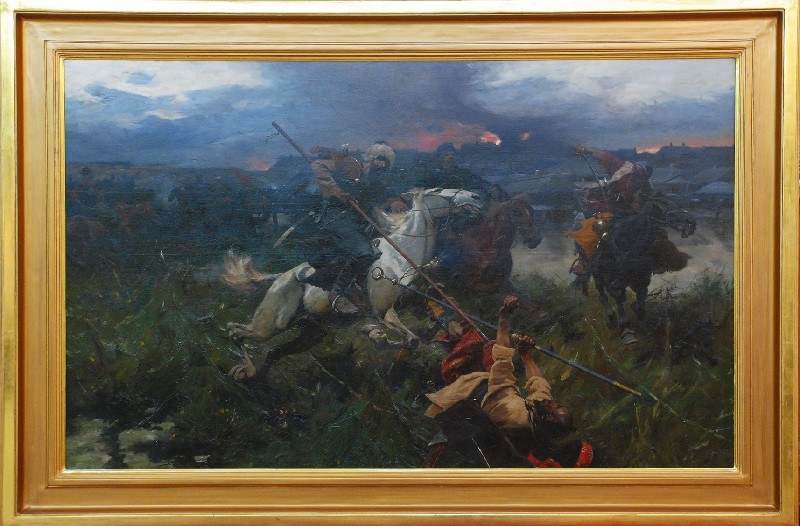
Other titles: Battle; Tatar attack; Tatar driveway; melee; melee with Tatars
oil, canvas, 119.5 x 200.5 cm;
signed l.d.: Józef Brandt / from Warsaw / Munich
On the reverse: stickers:
1. 4479 / Rev. (rev.)
2. National Museum / in Warsaw / inv. no.: 189055 (inventory)
3. 9426 / 2 / 75 (inventory)
provenance: Collection of Andrzej Rotwand, purchased at the 5th Salon at the Society for the Encouragement of Fine Arts (1908/9) - see J. Wiercińska,
Catalog of works exhibited at the Society for the Encouragement of Fine Arts in Warsaw from 1860 to 1914, Wroclaw 1969, p. 33.
from September 1988 at the Polish Sculpture Center in Orońsko (exhibited in the palace of Józef Brandt) Reproduced in:
"Tygodnik Ilustrowany" vol. 1, 1902, p. 105
Exhibited, letter: Józef Brandt 1841-1915, ed. Nauk. Ewa Micke-Broniarek, Catalogue of a monographic exhibition, National Museum in Warsaw, vol. 2, p. 281,
item cat. I.240, here color reproduction, bibliography of the painting
Jozef Brandt, an outstanding representative of historical and battle painting, came from a well-known family of Warsaw doctors. In 1858, while preparing to become an engineer, he began studying at the Ecole des Ponts et Chaussées in Paris. Where he became friends with Juliusz Kossak. It was under his influence that he became interested in painting. For several months he attended the studio of Léon Cogniet, and it was Kossak and Henryk Rodakowski who gave him valuable advice. Soon after returning to Warsaw in 1860, he traveled with Kossak to Ukraine and Podolia. The area and lifestyle there had a strong influence on his work. In 1862 he went to Munich to study at the Academy of Fine Arts there. He took lessons from Franz Adam, Theodor Horschett and Karl von Piloty, among others. Beginning in 1875, he ran a private painting school, becoming the leader of an art colony in Munich that included Aleksander Gierymski, Alfred Wierusz-Kowalski and Leon Wyczółkowski.
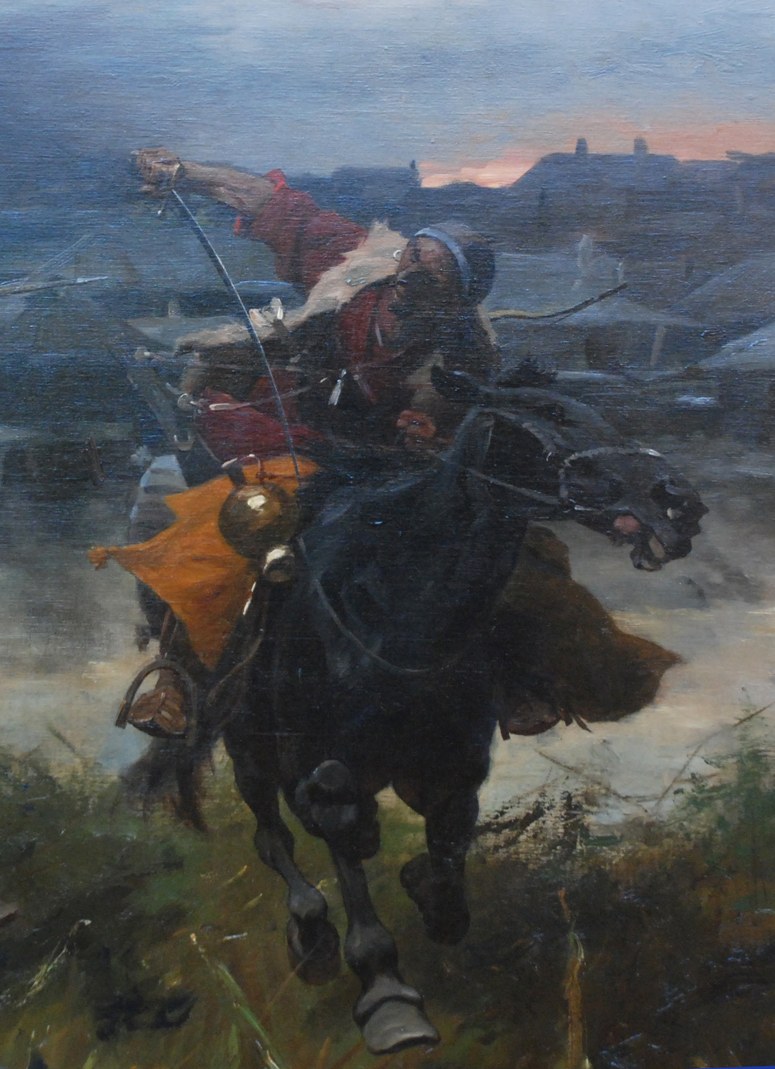
The impetuous, monumental painting, dating from the artist's mature period, is a showcase of Jozef Brandt's painterly talent, his compositional panache, drawing proficiency, narrative imagination and fantasy. In the work on display we find all the characteristic motifs of his battle scenes, which are a painterly tale of the times when the former Republic waged wars in the southeastern frontiers. What was included in the novels by Henryk Sienkiewicz was painted by Jozef Brandt in his paintings, all for the sake of "heartening" and supporting national pride.
An additional attraction of the offered work is that it was in the excellent collection of Andrzej Rotwand, personally selected by him for his collection.


![Józef BRANDT (1841-1915), Szkic do obrazu „Czarniecki pod Koldyngą” [Nokturn - pochód Kozaków], ok. 1869](https://img1.one.bid/img/1420/240303_1w.webp)


![Józef BRANDT (1841-1915), Szkic do obrazu „Czarniecki pod Koldyngą” [Nokturn - pochód Kozaków], ok. 1869](https://img1.one.bid/img/742/123419_1w.webp)










Nylig sett
Logg deg inn for å se en liste over objekter
Favorittobjekter
Logg deg inn for å se en liste over objekter