


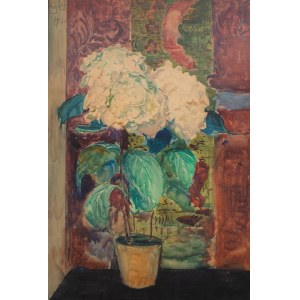
watercolor, paper, 100 × 70 cm
Signed and dated l. g.: L.Wyczółkowski/1913
On the back, a fragment of a sticker from TPSP in Krakow from an exhibition in 1937.
Deposit at the Leon Wyczółkowski District Museum in Bydgoszcz from 2020 to 2021.
Provenance:
- Collection of Ida Fussmanowa
- Private collection, Warsaw
Exhibited and described:
- "Leon Wyczółkowski" [posthumous exhibition] June 1937, Society of Friends of Fine Arts in Cracow, p. 22.
As Teodor Grott, the artist's favorite student, recalled: "flowers Wyczół loved, with flowers he was lavished, swarmed in his studio with beautiful specimens of roses, anemones, carnations, rhododendrons, azaleas and even orchids." [...] "they were knocking over every painting, almost every sketch; thousands of crowns were paid for a small floral study." [Leon Wyczółkowski, Letters and Memoirs, compiled by M. Twarowska, Wroclaw 1960, pp. 271, 272].
He painted flowers with absolute passion, virtuosity and panache: "Wyczółkowski usually painted "in one breath and one day" (...) "He did not tolerate exhaustion, sawing, he emphasized pure, fresh color" (Twarowska 1960, pp. 104, 94). "The enormity of his talent was manifested both in the rich repertoire of subjects depicted and in the wide range of means of expression, in the experimental passion leading to mastery in the use of various artistic media and techniques. Initially the artist perfected his technique in oil painting, around 1904 he concentrated on drawing with pastels reaching perfection in this field" (Irena Kossowska, IS PAN, January 2003, source: www. culture.pl) (emphasis removed). "In his work, he tried to pour onto canvas or paper the intensity of colors, strong light, deep shadows and variability of nature. He painted freely with small spots of color, thanks to which he achieved wonderful effects of flickering and spilling light" (Leon Wyczółkowski, MN Krakow, source: https://mnk.pl/ collections/leon-wyczolkowski)










Nylig sett
Logg deg inn for å se en liste over objekter
Favorittobjekter
Logg deg inn for å se en liste over objekter