


140,4 x 120,4 cm - oil, canvas
Signed p.g.: Sztencel 1892 | Varsovie
On the reverse on the g. strip of the loom no. (in crayon): N 34 [...] 6; also on p. loom strip auction stickers.
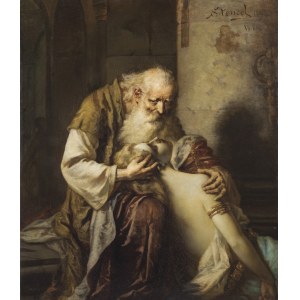
The artist's depiction of the finale of Shakespeare's tragedy King Lear, presents an interesting compositional solution. Maurycy Sztencel approached the scene of mourning his lost daughter as if it were a religious motif - the Pieta. A bearded old man with an aggrieved expression leans towards the girl's half-naked body, supported by his cradles. The painting is an excellent example of academic painting, maintained in a narrow scale of browns, grays and greens.
Maurycy Sztencel
Maurycy Sztencel (Częstochowa1856 - Warsaw1930 ) came from the Częstochowa Jewish community. He initially studied painting at the Warsaw Drawing Class under Rafał Hadziewicz and Aleksander Kamiński. For further artistic studies he went to Munich, where from 1874 he studied at the Academy with Ferdinand Barth, Alexander Wagner and in the composition class with Andreas Müller. During his studies he was repeatedly awarded medals for his work. In the Warsaw magazine "Opiekun Domowy" of 1875, we find mention of the painter's success, among other things: "(...) we can (...) congratulate our young artists, studying at the Munich Academy, on their decorations at this year's Academic Exhibition. P. Sztenzel, under Professor Barth, received a bronze medal. In the school of painting, Piatkowski and Alchimowicz received silver medals, Szwojnicki and W. Kossak received commendatory mentions...". After returning to Poland in 1879, he settled in Warsaw. Until 1917 he exhibited at the Warsaw Society for the Encouragement of Fine Arts. He also collaborated for many years as an illustrator, including with the "World" magazine.
In the first period of his work, he mainly took up genre and historical subjects. Later, he also painted scenes from Shakespeare's plays (including "King Lear and Cordelia" in 1892). He also made portrait studies, for which he was awarded a medal in 1887 at the national art exhibition in Krakow. The portraits of his brush are a testament to his immense talent as a painter - they are psychological studies of figures that show the spiritual depth of the portrayed.













Nylig sett
Logg deg inn for å se en liste over objekter
Favorittobjekter
Logg deg inn for å se en liste over objekter