


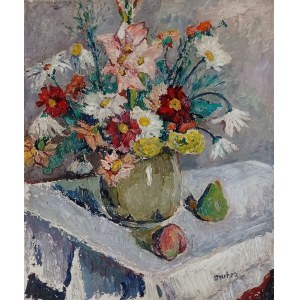
oil, plywood, 73 × 60 cm
Signed p. d.: Muter
Provenance:
- Private collection, Poland
- Family collection in Avignon (purchase from the Artist)
After the outbreak of World War I, Mela Muter left for the French town of Concarneau, then at the same time she stayed in Brittany, and Switzerland. It was from this period that she produced numerous still life paintings. As Mela herself recalled: "At that time no one had either the time or the patience to pose for me. Still lifes - seafood, shellfish and fish, insensitive to human dramas, to human follies, replaced my models. One of these still lifes particularly reflected my mental state at the time. It was tragic through the black of the writhing giant eels, the red of the crustaceans, the bruised white of the paper. I think it was the best canvas of its kind I have ever created."
The motif of still lifes had already appeared in the artist's ouvre before, but much less frequently; often being only the hero of the background of her compositions. It is the still lifes, along with a whole plethora of portrait galleries, that put Mela Muter on the pedestal of the most prominent painters of the École de Paris. Canvases depicting still lifes show the artist's strong fascination with the work of Paul Cézanne. These paintings show fresh fruits, vegetables, fish, seafood, kitchen utensils, or the flowers just presented in the auction catalog set on a piece of cloth thrown as if out of the blue, or on a spread, newspaper, with often visible headlines from the Parisian press. The arrangement of the objects is only seemingly random. The entire composition is overly deliberate. The paintings show an absolutely masterful rendering of color. The color palette is expressive, juicy. The contour of the objects appears as if jittery, not obvious. To ordinary objects from everyday life, the painter gave a painterly nobility, depth.










Nylig sett
Logg deg inn for å se en liste over objekter
Favorittobjekter
Logg deg inn for å se en liste over objekter