


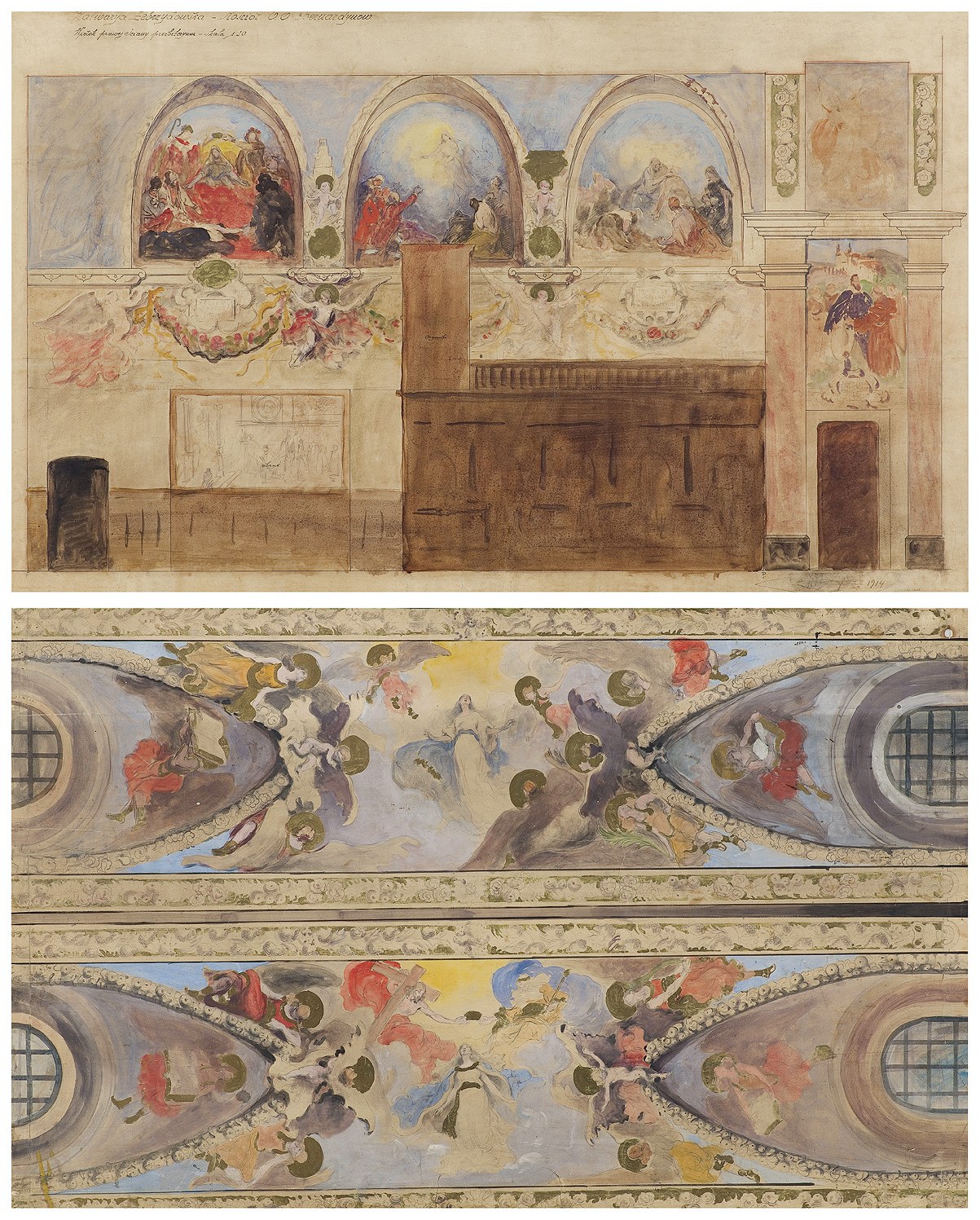


70,5 x 116,5cm - tempera, paper glued on cardboard
POLYCHROME DESIGN FOR THE CHURCH OF THE BERNARDINE FRIARS IN KALWARIA ZEBRZYDOWSKA, 1914
PRESBYTERY - SOUTH WALL
tempera with powdered stencil, pencil, ink, paper pasted on two layers of cardboard, 70.5 x 116.5 cm
signed p.d.: WłTetmajrer 1914 | April
at the top edge author's description: Kalwarya Zebrzydowska - Church of the Bernardine Fathers | View of the right wall of the chancel - scale 1: 20.
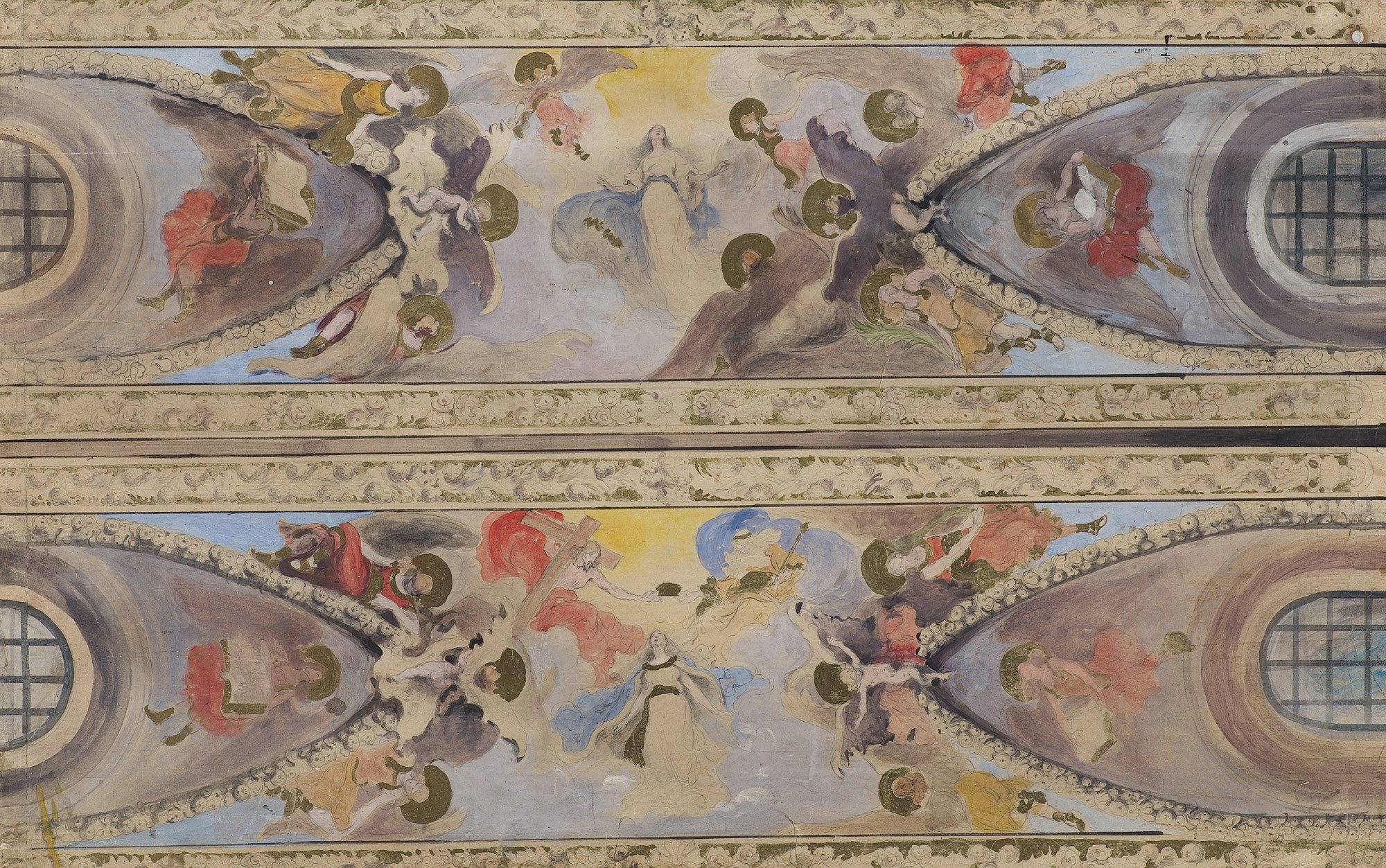
FRAGMENT OF THE VAULT OF THE NAVE
upper strip - Assumption of the Blessed Virgin Mary
lower strip - Coronation of the Blessed Virgin Mary
tempera with powdered stencil, pencil, ink, paper glued on two layers of cardboard, 69.6 x 110 cm
Signed p.g.: WTetmajer [signature rubbed off].
However, while most of his contemporaries leading Polish painters (except Wyspianski and Mehoffer) limited themselves to easel painting, he became known as a much more versatile artist. He showed that he was equally comfortable with mural painting as he was with easel painting. He was not afraid of large planes, Gothic vaults, and a variety of architectural details difficult to reconcile with the unified concept of the work. One can venture to say that among his contemporaries he won more recognition and fame as a creator of church polychromies than as an easel painter. Much more in the consciousness and artistic memory of Tetmajer's contemporaries were his Wawel, Sosnowiec or Calvary polychromies than his easel paintings. We should add that in his polychromes he was able to create his own style, separate colors and ornamentation, and at the same time give the viewer of his works a very strong message of skillfully captured sacred, patriotic and folk elements.
J.A. Nowobilski, Włodzimierz Tetmajer..., p. 52
In the Calvary Basilica, Tetmajer made polychromy of the vault and decoration of the wall of the rainbow arch with the scene of the Burial of the Mother of God. As J.A. emphasizes. Nowobilski, only these parts are the authentic work of the artist, who did not complete the entire polychrome. The failure to preserve any cardboard, prevents us from fully assessing the entire work, Nowobilski wrote in his book (p. 62).
Undoubtedly, therefore, in addition to their high artistic value, the two sketches on offer also have considerable historical value, providing a source for research into the work of one of the most famous Young Poland painters.
Literature:
- Józef Andrzej Nowobilski, Włodzimierz Tetmajer (1861-1923), Krakow - Włodzimierz Tetma- jer Foundation, Czuwajmy Publishing House, Krakow 1998, pp. 61-63, il. 104, 105, 106.
Włodzimierz Przerwa-Tetmajer (Harklowa near Ludźmierz in the Podhale region 1862 - Kraków 1923), half-brother of the poet Kazimierz, began studying painting at an early age; as early as 1875 he attended classes at the School of Fine Arts in Kraków, where he then studied (with breaks) until 1895 - initially with Franciszek Cynk, Leopold Loeffler and Władysław Łuszczkiewicz, and after 1889 with Jan Matejko. At the same time he studied classical philology at Jagiellonian University. In 1882 he still studied at the Vienna Academy, and in 1886-89 at the Munich Academy under Alexander Wagner. He supplemented his studies at the Académie Colarossi in Paris. An imperial scholarship enabled him to travel to Rome. Upon his return, he lived in Cracow. In 1890 he married Anna Mikołajczykówna, daughter of a farmer from the village of Bronowice near Krakow, where he himself often stayed, and in 1895 settled permanently. In 1901 he founded and then ran a painting school for women for several years. Since 1899 he was a member of the Society of Polish Artists "Art"; in 1901 he was one of the founders of the Society "Polish Applied Art"; in 1908 he co-founded the "Zero" group. He was a prominent representative of the "folklore" trend, a painter of customs, labor and landscapes of the countryside near Krakow. In his earlier period he created in the spirit of academic, Munich realism. Later he developed his own original style - the composition of his paintings was free, he painted with broad brushstrokes and used bright, vivid colors. In 1892-1894 he collaborated with Wojciech Kossak and Jan Styka on Panorama Raclawicka. He designed stained glass windows, did illustration and mural painting, including a polychrome of the Queen Sophia Chapel at Wawel Cathedral in 1902. The artist was the prototype for the character of the Host in S. Wyspiański's drama The Wedding.







![Włodzimierz TETMAJER (1861 - 1923), Drzewa nad rzeką - szkic, [1907]](https://img1.one.bid/img/459/65298_1w.webp)








Nylig sett
Logg deg inn for å se en liste over objekter
Favorittobjekter
Logg deg inn for å se en liste over objekter