copperplate engraving, paper, sheet size 46x28.5 cm
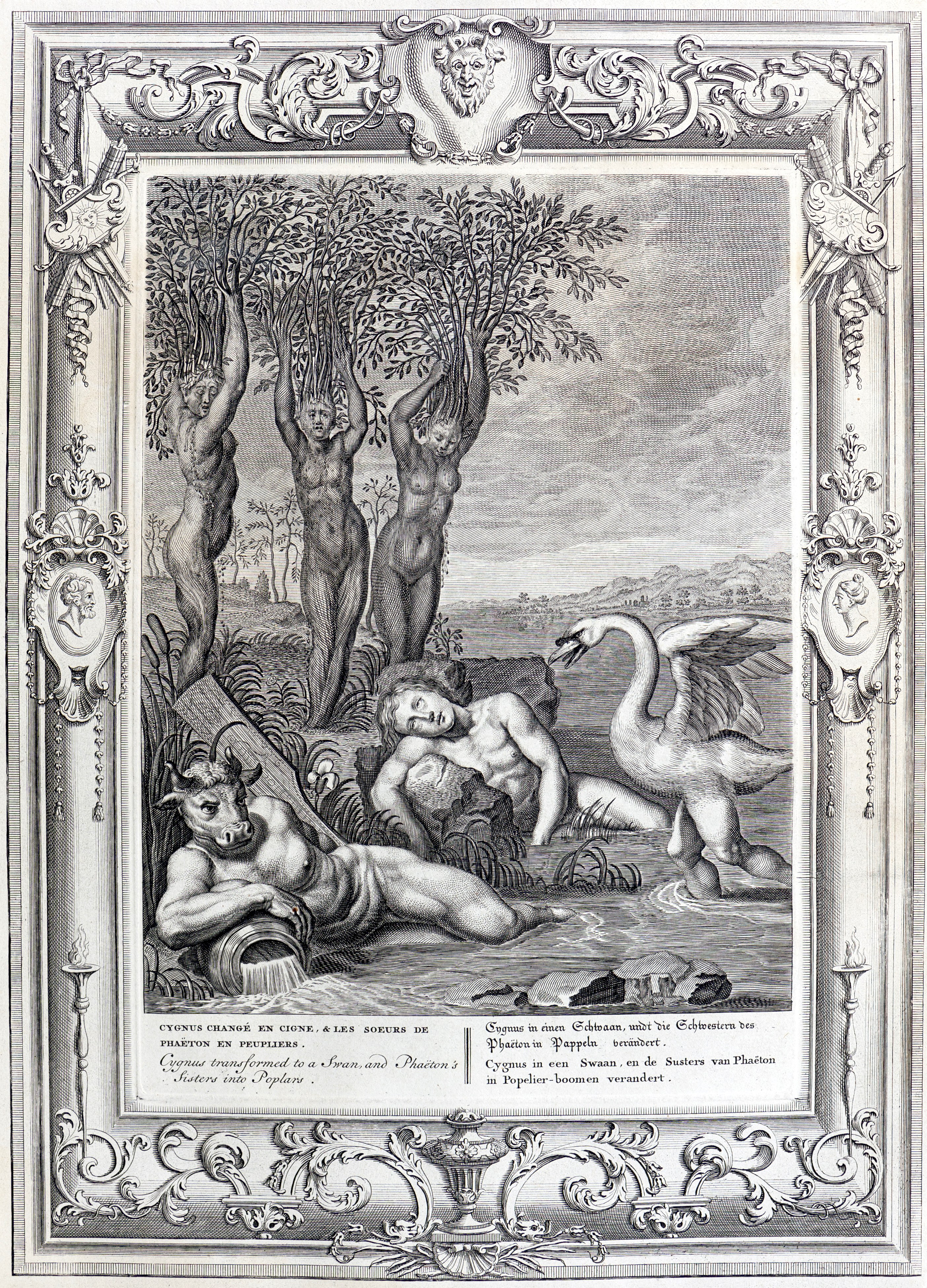
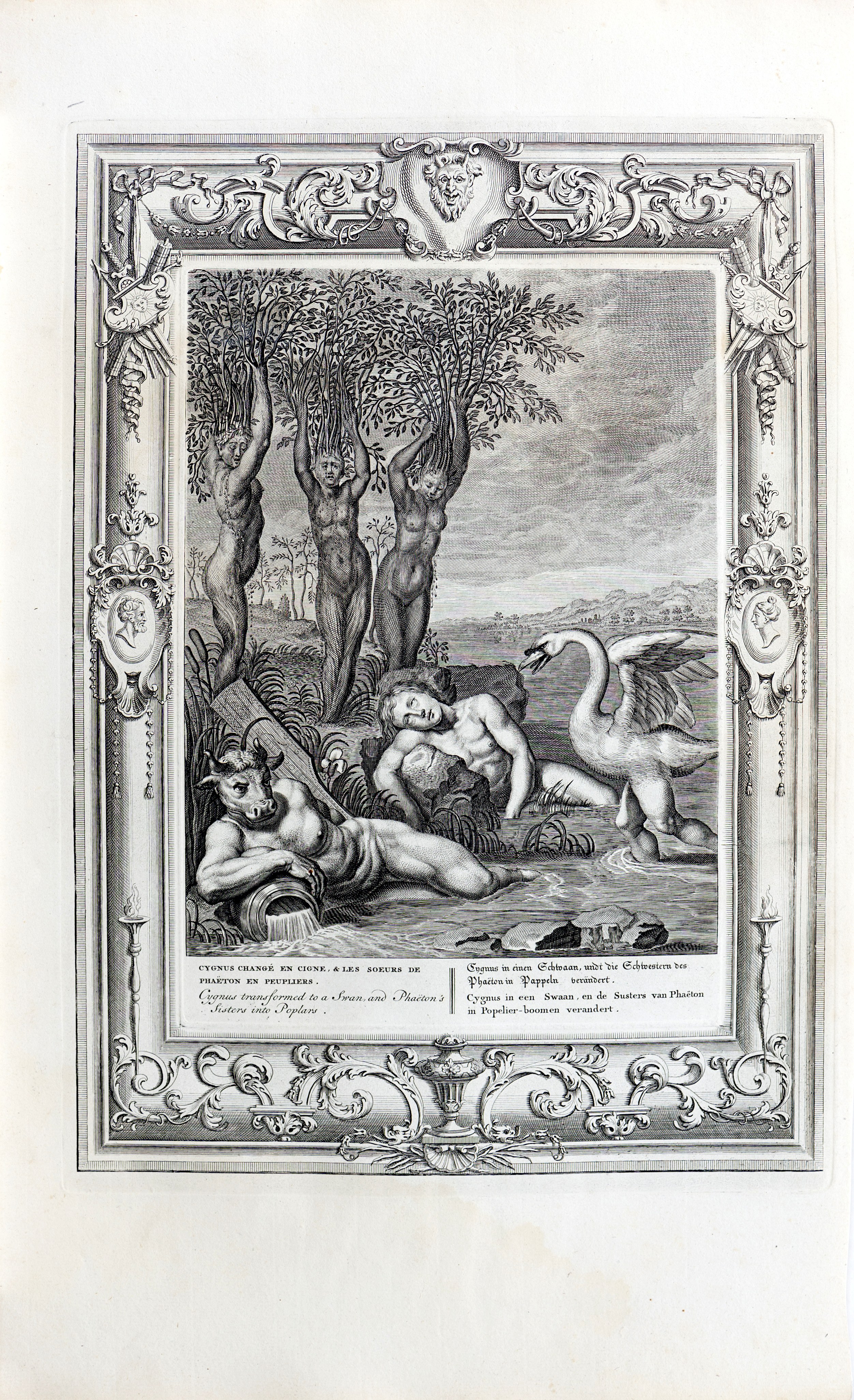
This print directly illustrates the dramatic events from Ovid’s *Metamorphoses*, occurring immediately after Phaeton’s tragic death. The three weeping, naked women are the Heliades—Phaeton’s sisters—who grieved so deeply over their brother’s death on the riverbank that the gods turned them into trees (poplars). The artist captured the very moment of the metamorphosis: their feet are already taking root in the ground, their bodies are stiffening into trunks, and leaves and branches are sprouting from their raised hands and hair. According to the myth, their tears, flowing into the water, turned into amber. In the water , we see a giant, outstretched swan that still retains some human features. This is Cygnus (Kyknos), king of Liguria and Phaeton’s faithful friend. Unable to come to terms with the loss of his companion, he wept for him ceaselessly by the water until, out of pity, Apollo transformed him into a swan and raised him to the heavens as a constellation.
The series, published in Amsterdam in 1733 by the bookseller Zacharias Chatelain, was not an entirely new artistic project, but rather a brilliant, luxurious remake. The entire visual concept was based on the 17th-century edition of *Tableaux du Temple des Muses* (Paris, 1655), for which the drawings were created by the Flemish Baroque master Abraham van Diepenbeeck and engraved by the legendary Cornelis Bloemaert. Bernard Picart took van Diepenbeeck’s compositions as his starting point and infused them with new expression. Interestingly, the prints in this series were produced using two separate copperplate engravings: Bloemaert’s central plates were cleaned and supplemented, while Picart designed and engraved entirely new, exceptionally rich, ornamental frames (borders) that surround each scene.
Bernard Picart (1673–1733) was an outstanding French copperplate engraver, draftsman, and illustrator who became one of the key figures of the European Enlightenment. He was born in Paris into an artistic family—his father, Étienne Picart, was a renowned royal engraver. Bernard studied at the Royal Academy of Painting and Sculpturein Paris , under Charles Le Brun, among others. Although he initially worked in Paris, as a Huguenot (Protestant) he faced religious restrictions in France. After the tragic death of his first wife and children in 1710, he decided to leave the country permanently and settle in Amsterdam. There, he remarried Anna Vincent, who helped him manage his business affairs. He became one of the most prolific and highly regarded illustrators of his time, collaborating with leading publishers. Picart gained fame for his monumental series of prints, which combined artistic precision with encyclopedic ambitions. His most famous work is *Cérémonies et coutumes religieuses de tous les peuples du monde* (1723–1743), created in collaboration with Jean-Frédéric Bernard. It consisted of hundreds of engravings depicting religious rites from around the world (including, unique for that time, objective depictions of Jewish and Islamic rituals). Equally famous is the series *Le Temple des Muses* (The Temple of the Muses) (1733). It is a series of 60 engravings illustrating mythological scenes from Ovid’s*Metamorphoses *.