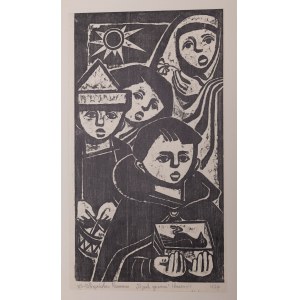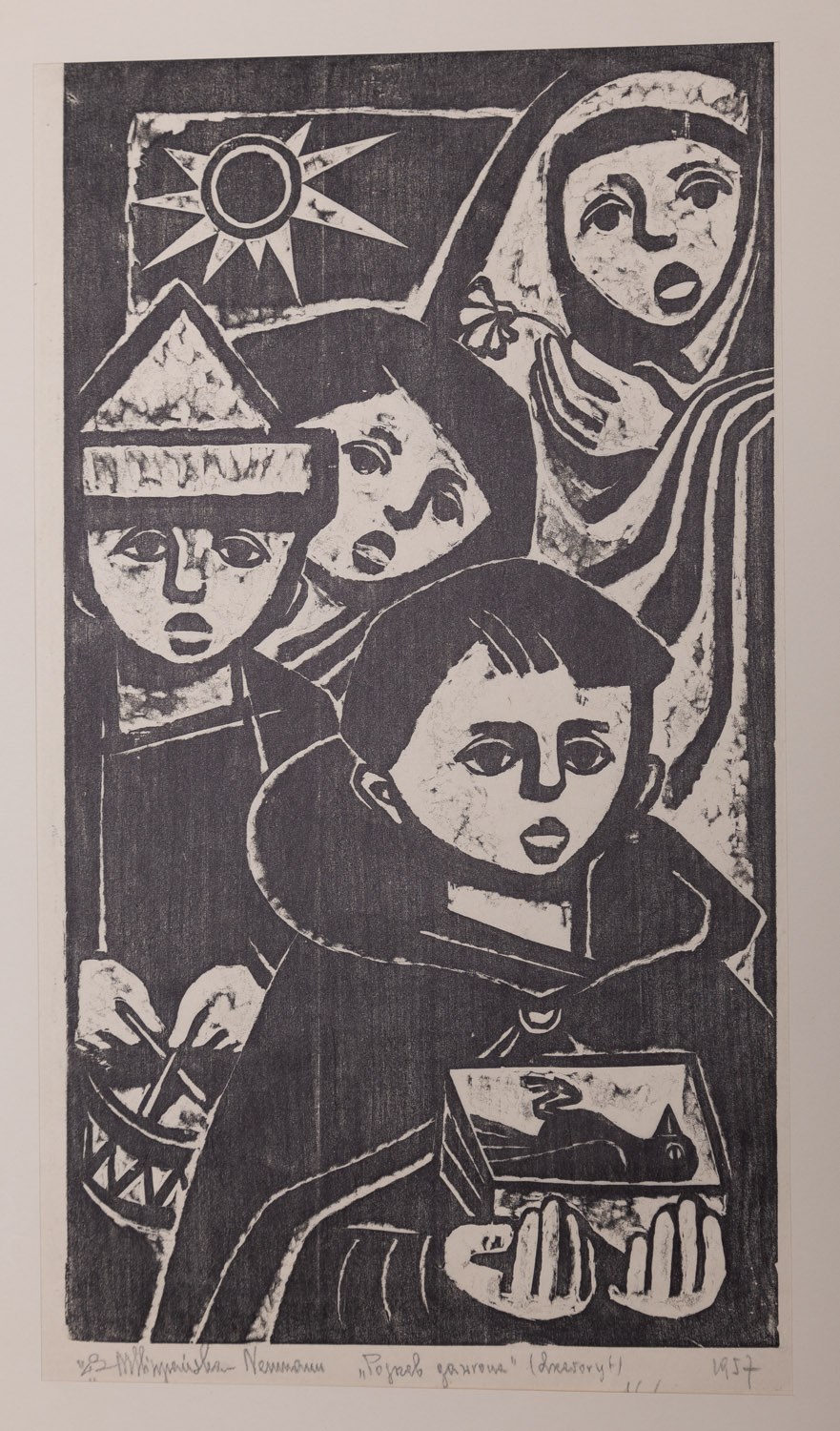
Dimensions: 45 x 24.5 cm
signed, dated and described in pencil at the bottom: '[mouse - graphic mark of the artist] MHispanska Neumann "Funeral of a rook" (woodcut) 1957'.
Literature
Jan Białostocki, Maria Hiszpańska-Neumann, Warsaw 1963, p. 12, ill. 20
Biography
Studied from 1935 at the Academy of Fine Arts in Warsaw with professors Karol Tiche, E. Czerwiński, Stanisław Ostoi-Chrostowski and Wacław Waśkowski. Maria Hiszpanska's father was killed in a bombing on September 25, 1939. During the occupation she became a member of the Union of Armed Struggle. On June 19, 1941, Maria was arrested along with the family of Professor Jozef Jan Siemieński and imprisoned in Radom, then in Pinczow. On April 10, 1942 she was deported to the Ravensbrück camp where she was given the number 10219. During her stay in the camp she made many drawings. She worked as a forced laborer at the Neubrandenburg armaments plant, escaped during the evacuation in April 1945 and lived to see liberation in the forest. In the summer of 1945, Maria Hiszpanska returned to Warsaw. She mainly engaged in book graphics. She created a number of woodcuts, mainly in the easel technique. She cooperated with the publishing house "Wiedza", then "Książka i Wiedza". In the 1950s she collaborated with "Tygodnik Powszechny". She created many drawings on life in the concentration camps, some of which are in the collection of the Ravensbrück museum. In 1954-1955 she traveled to Bulgaria. An album of woodcuts "Tyrnovo" was created from sketches made there. In 1960, in connection with a solo exhibition, she stayed in Egypt for several months. Since there was a lack of interest in cooperation with Maria Spain-Neumann from Polish publishing houses in the 1960s, she decided to cooperate with East German publishing houses. The 1961 edition of Gottfried von Strassburg's "Tristan and Isolde" in German with Spanish illustrations was named the most beautiful book of the year. Beginning in 1965, she took up mural painting, especially in sacred objects. She signed her works with a drawing of a mouse. She was buried in the Sluzev cemetery on Walbrzyska Street in Warsaw.