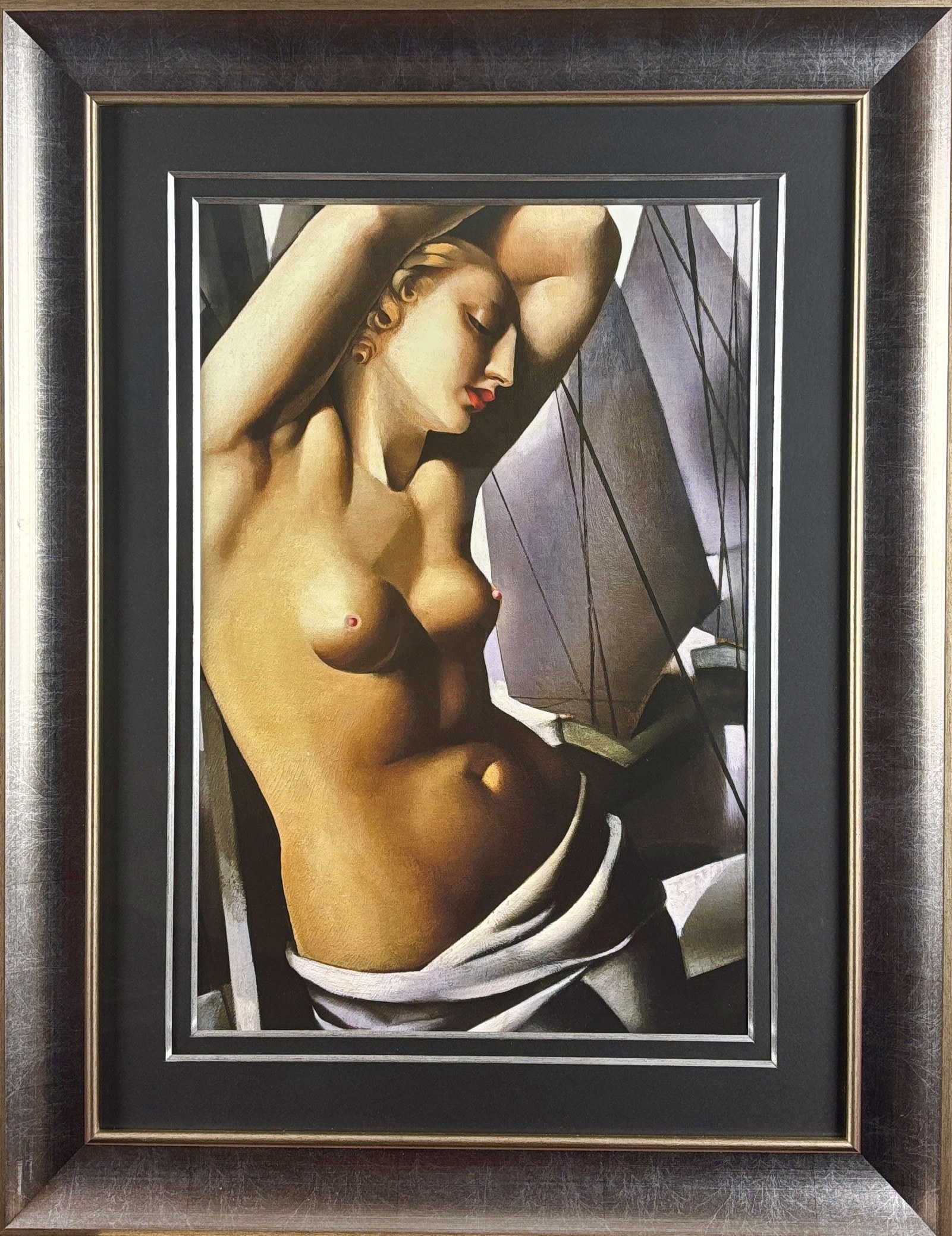
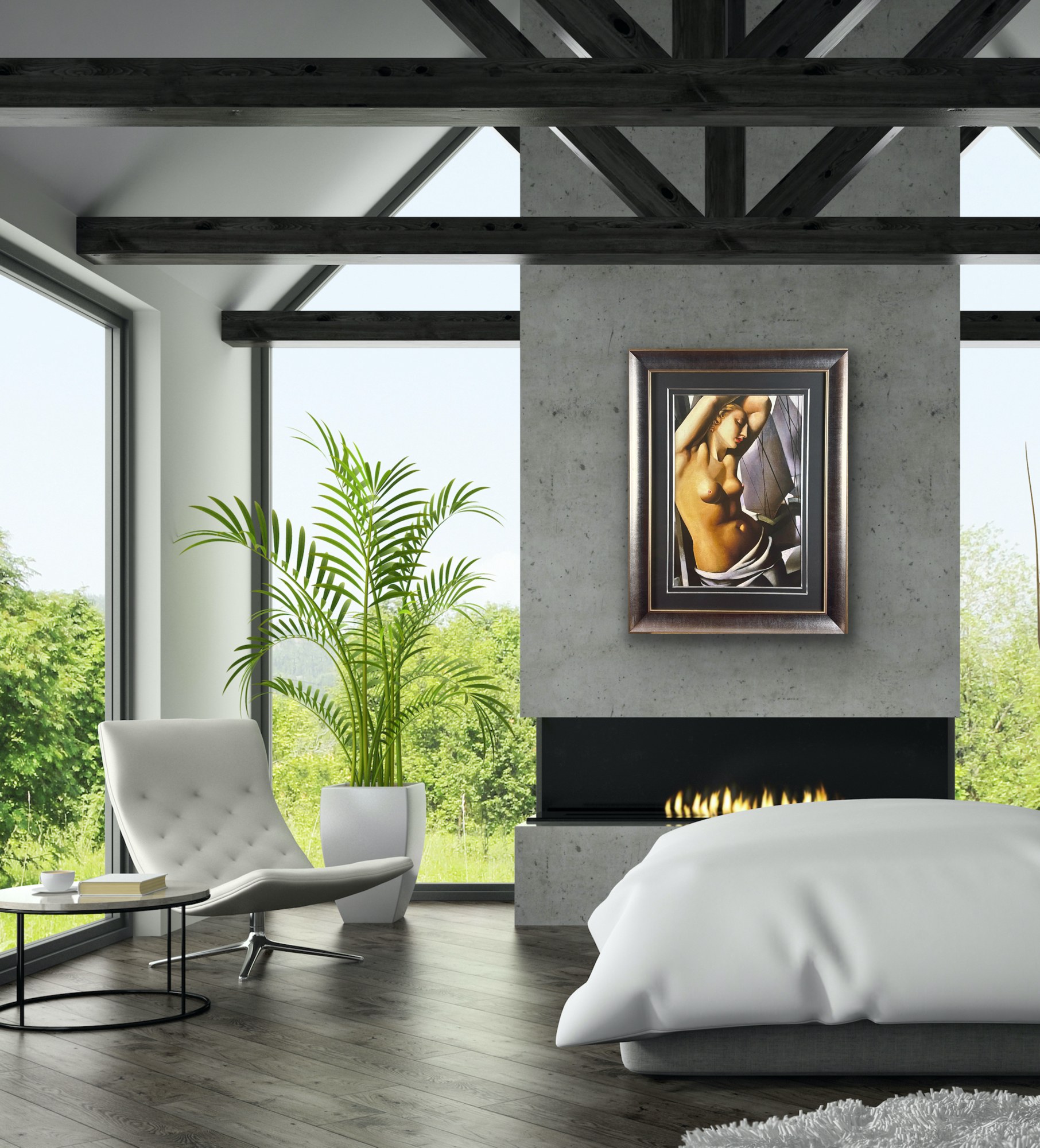
Giclee, Arches velin paper, 77 x 59 cm, framed and double passe - partout with gold slips.
Publisher - Felix Rosenstiel's Widow & Son.
References - A. Blondel, Tamara de Lempicka, Catalogue raisonné, 1921-1979, Lausanne, 1999, no. B.93, illustration p. 171
The model for Tamara Lempicka's work " The Blue Hour" also known under another title " Woman against the Sails" was most likely Ira Perrot (owner of Ira de Perrot) a close friend and great muse of Tamara Lempicka and for some time also her lover. It is Ira Perrot's portraits that are among the artist's most sensual and intimate works of the 1920s. Lempicka often painted her in a statuesque manner, almost "frozen" in motion, which is perfectly evident in this painting. The title "Blue Hour" refers to the time of day just before dawn or just after sunset, when the light takes on a specific, gray , cool hue. This can be seen in the background tones and shadows on the model's body. Geometric forms behind the woman's back resemble the sails of a ship, which adds dynamism to the composition and a modern, traveling character, so beloved by the elite of the 1920s. This is early Art Deco - you can still see some influences of Cubism (simplified solids), but already combined with Tamara's typical smoothness and elegance.
Literature:
T. de Lempicka, Annotated Photo Albums, Houston, 1923, no. 63 (illustrated).
K. de Lempicka-Foxhall & C.L. Phillips, Passion by Design, the Arts and Times of Tamara de Lempicka, New York, 1987.
E. Thormann, Tamara de Lempicka, Kunstkritik und Künstlerinnen in Paris, Berlin, 1993, no. 59.
Catalog of the retrospective exhibition Tamara de Lempicka / Tra eleganza e trasgressione (Villa Medici, Rome 19 Catalogue of the retrospective exhibition Tamara de Lempicka / Tra eleganza e trasgressione (Villa Medici, Rome 1994).
Tamara de Lempicka was a Polish-born painter known for her distinctive Art Deco style, which combined elements of Cubism and Neoclassicism with a modern sensibility. She gained notoriety in the 1920s and 1930s, particularly in Paris, where she became part of bohemian and aristocratic circles. .
Her paintings often feature elegant, stylized portraits of wealthy and fashionable people, as well as nude figures, executed with a high gloss, almost sculptural. Her work epitomized the wealth and hedonism of the interwar period, and she earned the nickname "Baroness with a brush" due to her aristocratic connections and lavish lifestyle.