


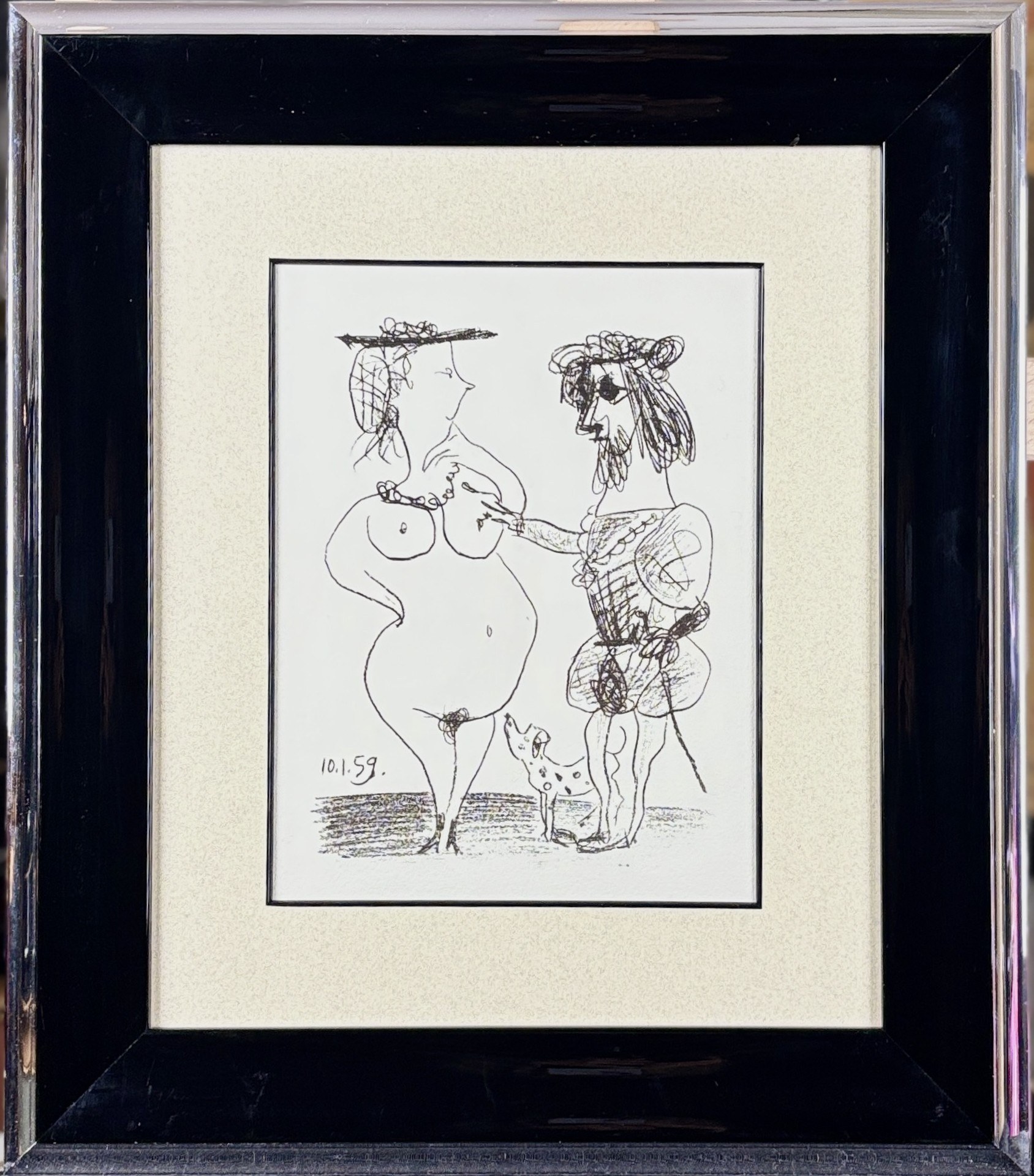
Lithograph on Arches vellum paper, dimensions: 25 x 20 cm (inside the double mat), mounted in a frame measuring 46 x 41 cm;
Limited edition, unnumbered,
Signed on the stone in the lower right corner “Picasso,” date in mirror image “9.8.68. II l.g.”
Publisher: Galerie Louise Leiris (Paris) (copyright), produced by: C.J. Bucher AG in Lucerne (Switzerland)
Ref: Bloch Catalogue Raisonné 1732, series no. 347; Baer 1749;
Picasso’s Series 347, created in 1968 when the artist was 87 years old, is one of the most remarkable and prolific undertakings of his late career. The series consists of 347 prints and etchings that Picasso created in just seven months, which is an astonishing achievement given his age.
During this period of his life, Picasso felt completely free from any conventions or expectations. He was able to create whatever he wanted, in the way he deemed most appropriate.
The series is full of bold, often provocative erotic scenes that explore human sexuality and the act of voyeurism. Picasso often depicted himself as an observer—sometimes as a clown or an old man—admiring young, beautiful models. This reflects his own relationships with younger women, despite his age.
Due to its subject matter and form, Picasso’s “347” series received a mixed—and often controversial—reception from both critics and the public. At the time, even though Picasso was already an established artist, this openness and directness—especially coming from someone of his age—shocked and outraged many viewers. Some critics interpreted these works as a sign of an old man’s obsession with sex and youth, and even accused Picasso of misogyny.
In certain circles, the series was viewed as an example of degenerate art, failing to address “serious” social or artistic themes.
The 347 Series is considered one of the key works of Picasso’s late period, demonstrating his unwavering vitality, creativity, and mastery in the field of printmaking.










Nylig sett
Logg deg inn for å se en liste over objekter
Favorittobjekter
Logg deg inn for å se en liste over objekter