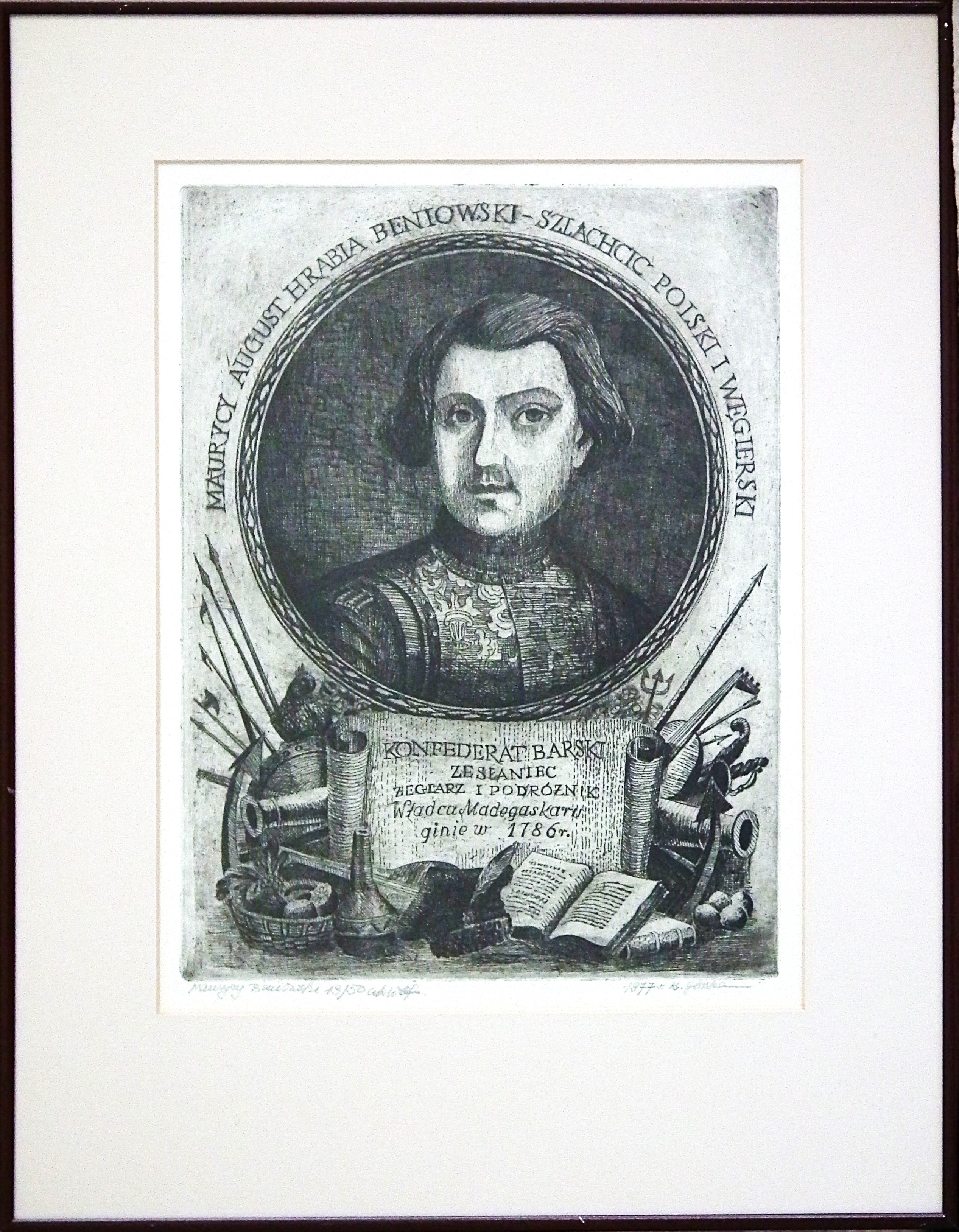
etching, 32x24.5 cm print format,described in pencil by the author on the bottom bar, 19/50, framed in passe-partout and frame
Krystyna Gorska was born in Stara Wieś (1921) near Bielsko Biała. She began her artistic studies at the Academy of Fine Arts in Cracow, already managed by the Germans at that time in the early 1940s, (Staatliche Kunstgewerbeschule). After the war, she married and continued her studies at the Academy of Fine Arts in Sopot in 1948. She was one of the first students to receive a diploma in graphic design; a little later she specialized in artistic printmaking, but in the 1950s, heavily involved with advertising label designs, she produced work in woodcut, linocut and etching. The artist came from the noble Starowieyski family, whose representative was the well-known Polish painter Franciszek Starowieyski, and she herself spent her childhood years in the Iwierzyce manor near Robczyce, owned by her great-grandparents, the Michałowskis. The walls of the manor were densely hung with magnificent watercolors by Piotr Michałowski.
One of the major exhibitions of her works was presented at the ZPAP Gallery in Gdansk. The works came from the private collection of René Patrick Burakowski.
Staatliche Kunstgewerbeschule Krakau (Staatliche Kunstgewerbeschule Krakau) - an art vocational school established by German authorities during the Nazi occupation to replace the closed Krakow Academy of Fine Arts, initially as a continuation of the pre-war Institute of Visual Arts in Krakow. The school's students included many later prominent Polish artists and intellectuals active in the post-war period. A significant number of participants in Tadeusz Kantor's Underground Independent Theater also came from the circle of Kunstgewerbeschule students. It existed until March 31, 1943.The director became the pre-war two-time rector of the Academy of Fine Arts in Cracow, Professor Fryderyk Pautsch, under the supervision of the German director. In addition to lecturers from the Institute of Visual Arts (including Witold Chomicz, Wieslaw Zarzycki, architects Waclaw Krzyzanowski and Ludwik Wojtyczko), prominent professors of the pre-war academy were hired. These included Władysław Jarocki, Stanisław Kamocki, Józef Mehoffer, Fryderyk Pautsch, Ignacy Pieńkowski, Stanisław Popławski, Alfred Terlecki.