


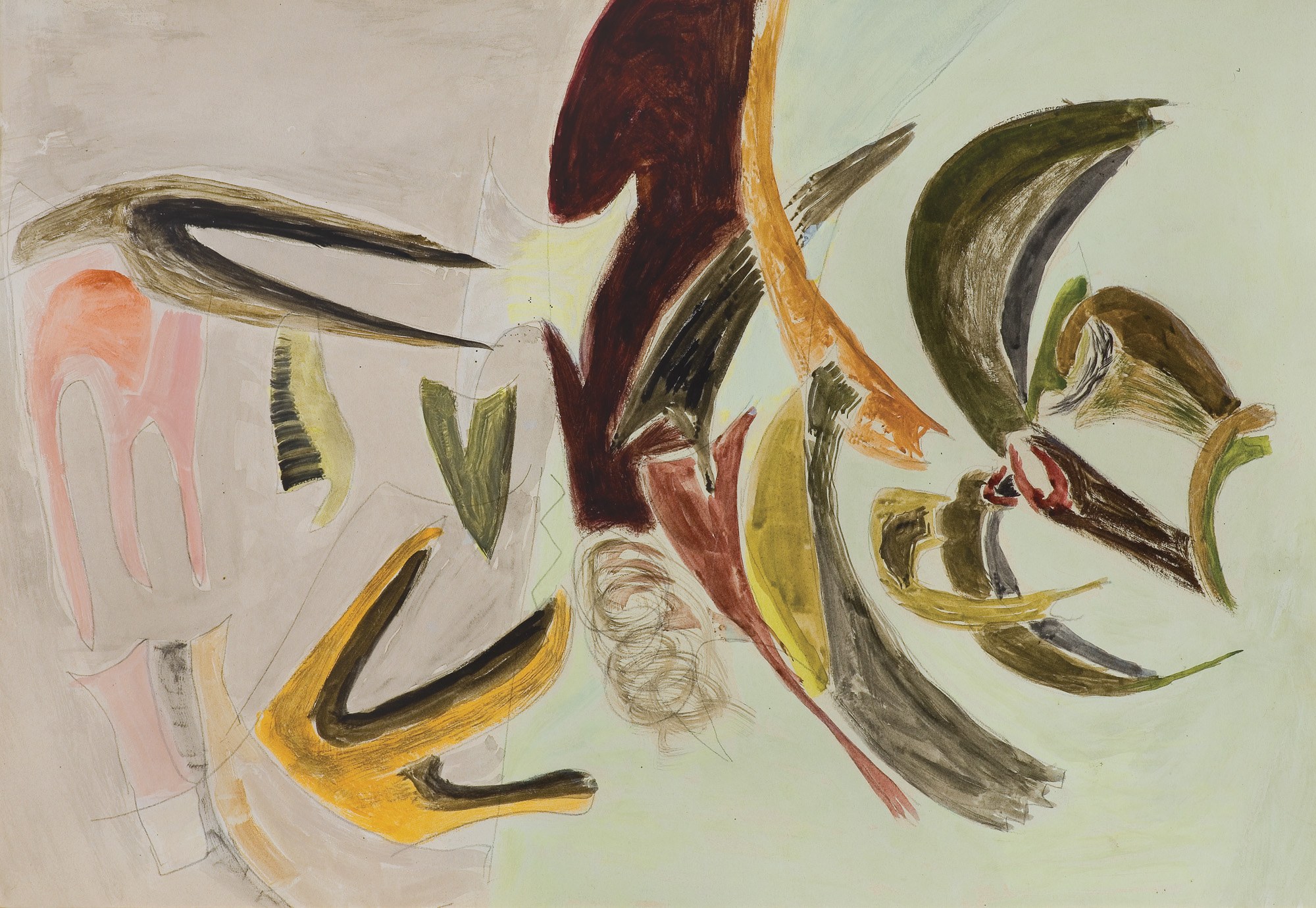
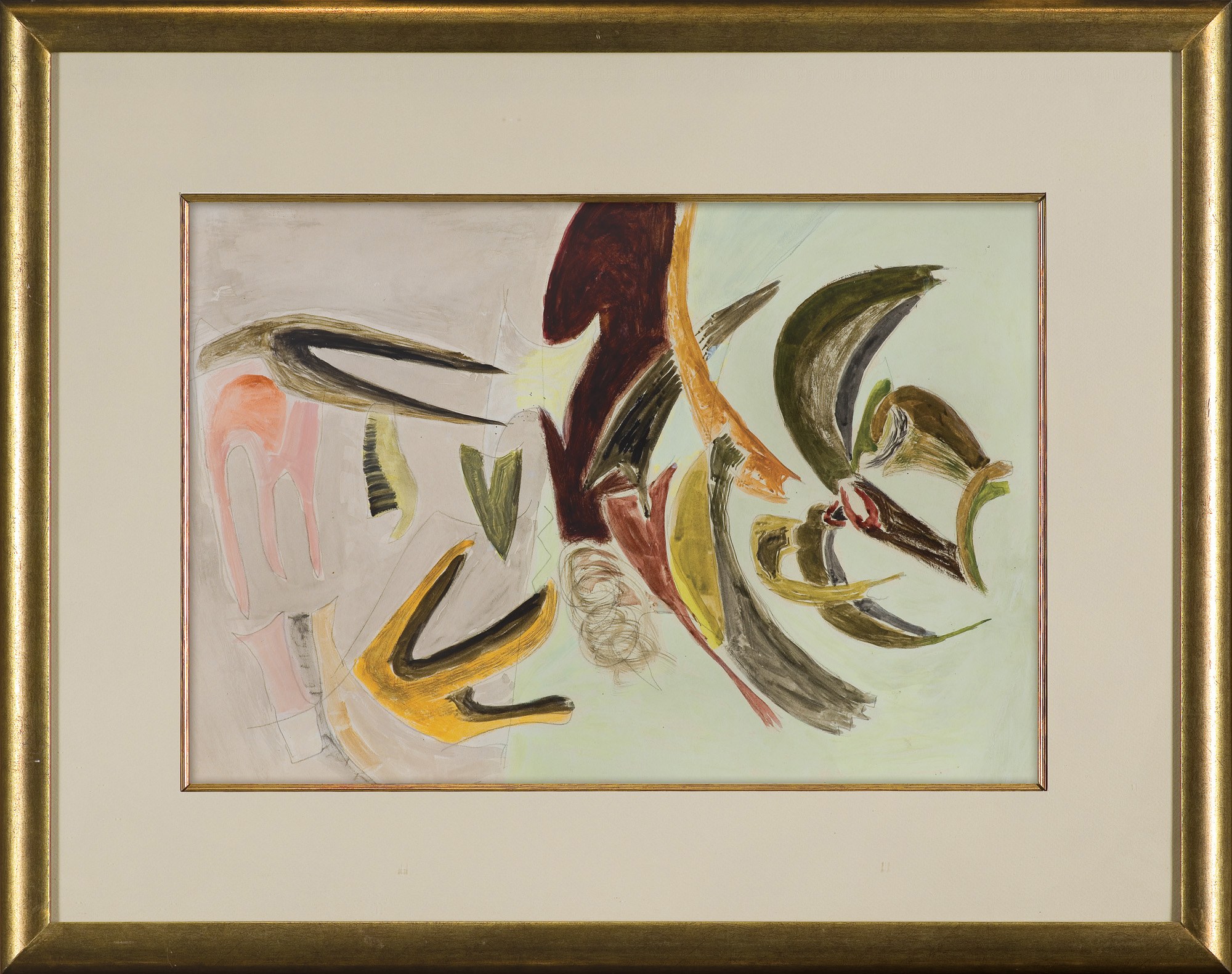
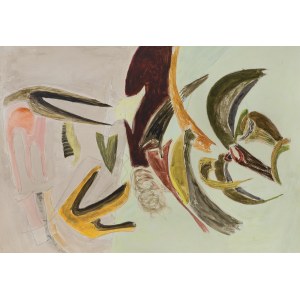
35.5 x 49.5 cm - gouache, watercolor, pencil, cardboard
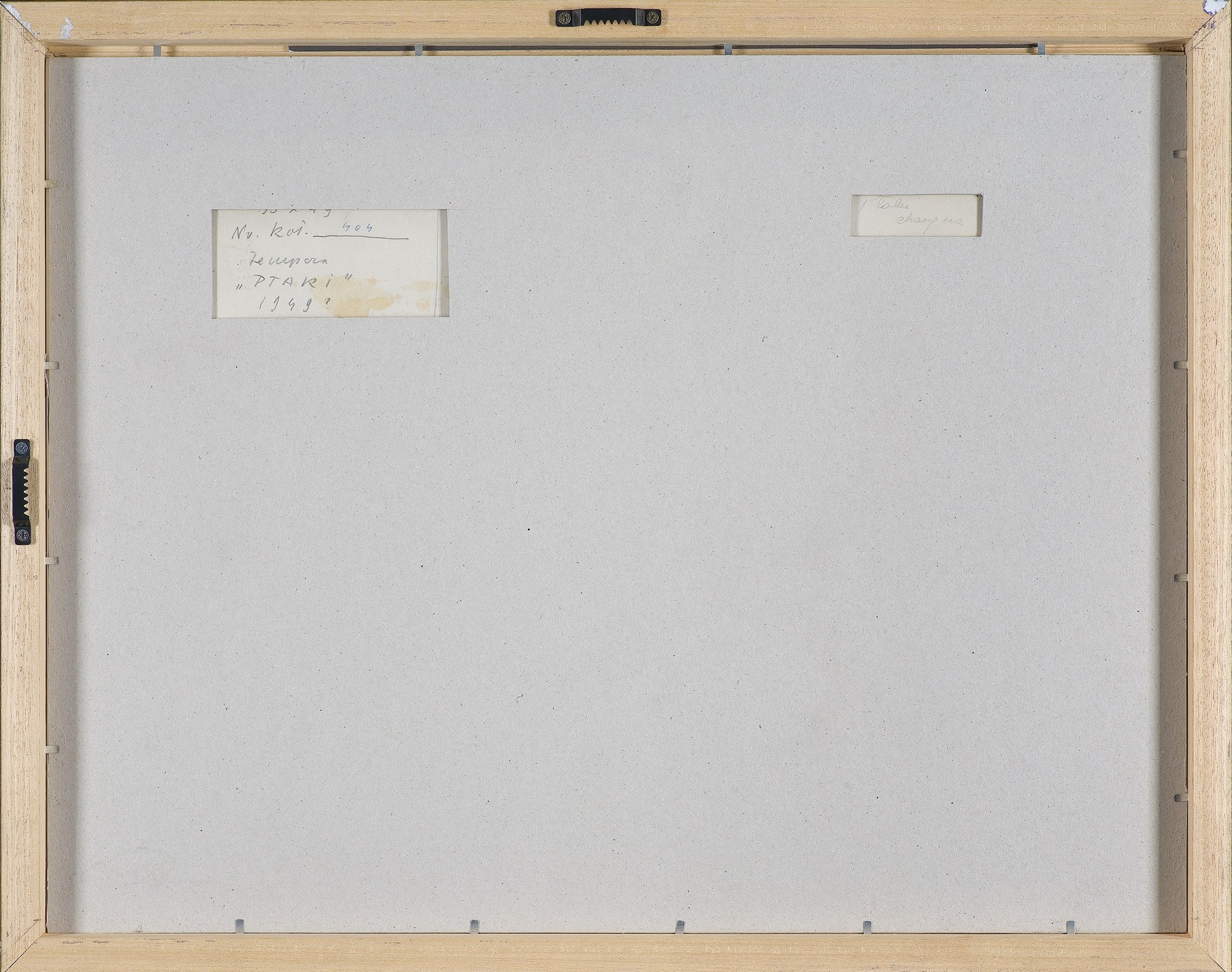
on the reverse, inscription in pencil: 35 x 49 | Cat. No. 404 | tempera | “Birds” | 1949? | owned by Wanda Jarema
Although the gouache painting *Birds* still bears a title referring to a specific motif from the natural world, it is in fact an abstract work. By the late 1940s, the artist was moving away from figurative compositions and those that, though with difficulty, could be “read” in a way typical of conventional depictions of people, scenes, and objects. She focused more on the composition and structure of the painting rather than on appearances. The impending change also had a purely technical aspect. Traditional gouaches were to give way to works combining painting with monotype—these came to dominate the artist’s oeuvre in the 1950s.
Looking broadly at the texts devoted to Jarema’s art, one can discern a certain dominant theme—movement, dynamism, rhythm, and dance have become the main categories of description. [...] Indeed, constant movement is a key feature of the vast majority of Jarema’s works. The question, however, is what purpose it serves, how it manifests itself within the pictorial space, and what effect it has on the figures. Everything suggests that Jarema was fascinated not so much by movement itself as by its form-creating power, the dynamics and agency of matter, and the process of development “from stillness to an ever-faster rotation”—as Przyboś put it. Undoubtedly, the artist gradually moved away from imitating the movement of real objects: in the sketches and gouaches from the 1930s and 1940s, it is still evident that the vehicles of movement are specific figures—human and animal silhouettes, inanimate objects, and landscape elements; however, from the early 1950s onward, the forms presented by Jarema lose their referential connection to objects outside the image. The source of all movement—dynamics, physical shifts, tensions, and sensations—is the process of forms confronting one another. [...]
Natural processes—genetic reproduction with its infinite repertoire of heterogeneous forms, duplications, shifts, and mutations—were Jarema’s greatest source of inspiration. Importantly, it was not a matter of imitating their effects, but of creating art according to analogous mechanisms. It was likely this very aspiration that some critics sensed, including Jonasz Stern, who argued: “Jarema surrendered to the rhythm of nature; she identified with nature.” Kornel Filipowicz added: “She seemed to work as if, through her art, she wanted to achieve what is characteristic of nature (though she never imitated nature in the literal sense): its diversity and uniqueness. After all, in nature there are no identical shapes or individuals; there are only similarities between them. An individual can be identical only to itself.”
Porębski, for his part, offered an intriguing analysis: “Jarema constructs forms from fragments, segments resembling rhizomes. With their help, she creates living and vibrant organisms, endowed with their own logic—the logic of growth, change, and surprises...”
Agnieszka Dauksza, “Tissue Sensitivity: Maria Jarema’s Plastic Materialism,” in Maria Jarema. Reinventing Art, ed. A. Dauksza, Słowo/obraz terytoria, Terytoria Książki Foundation, Museum of Modern Art in Warsaw, Gdańsk-Warsaw 2022, pp. 107–108
The painting has been exhibited, mentioned, and reproduced, among others, in: The work is listed in the artist’s catalogs of works:
– Maria Jarema. Exhibition Catalog, Pałac Sztuki, Krzysztofory Gallery, Kraków, November 1962, unnumbered entry, p. 40;
– Barbara Ilkosz, Maria Jarema 1908–1958, Institute for the Promotion of Art, National Museum in Wrocław, Warsaw–Wrocław 1998, cat. no. 140, ill.
The work is reproduced as an illustration for Gabriela Gierejko’s text, “Maria Jarema: Art That Gives Form to Thought,” on the Mood Scent Bar website, https://moodscentbar.com/pl/module/xipblog/single?page_type=post&id=77&rewrite=maria-jarema-sztuka-ktora-uplastycznia-myslenie [not discussed in the text].
♣ Droit de suite: ♣ An additional fee will be added to the Purchase Price, arising from the right of the artist and their heirs to receive compensation in accordance with the Act of February 4, 1994, on Copyright and Related Rights (droit de suite).
Maria Jarema studied sculpture under Xawery Dunikowski at the Academy of Fine Arts in Kraków from 1929 to 1935. During her studies, she joined the “Kraków Group,” the so-called first group (1933–1937). Because of her left-wing views and political activities, she, along with other members of the group, was persecuted by the authorities; among other things, she was temporarily stripped of her membership in the Artists’ Union. In the 1930s, she worked as an actress and set designer at her brother Józef Jarema’s “Cricot” theater and at Adam Polewka’s puppet theater. In 1937, she traveled to Paris for the World’s Fair and stayed there for four months. During World War II, she worked as a coat check attendant at the Artists’ House café; she later worked in the artistic puppet workshop of the Central Welfare Council in Kraków. After the war, she became involved with the Group of Young Artists, centered around Tadeusz Kantor, which in 1957 was formally established as the new (second) “Krakow Group.” During the period of Socialist Realism, she did not participate in official artistic life. She collaborated as a set designer with Kantor’s “Cricot 2” theater (1956–1957). In 1957, she won the City of Kraków Award, and in 1958, she received the Francesco Nullo Award from the Italian-Polish Friendship Society at the 29th Venice Biennale. She initially worked in sculpture; after the war, she focused mainly on painting, often combined with printmaking (tempera with monotype). Her abstract compositions, which explore the concepts of movement and space, are organized into series (“Figures,” “Expressions,” “Grips,” “Penetrations,” “Rhythms,” and others). These works are among the most significant achievements of Polish art in the 1950s, predating similar explorations in kinetic art and Op Art around the world (including those of Victor Vasarely, whom she met in Paris in 1956). The artist was also active in set design and commercial art (posters, book and press illustrations) as well as journalism.













Nylig sett
Logg deg inn for å se en liste over objekter
Favorittobjekter
Logg deg inn for å se en liste over objekter