


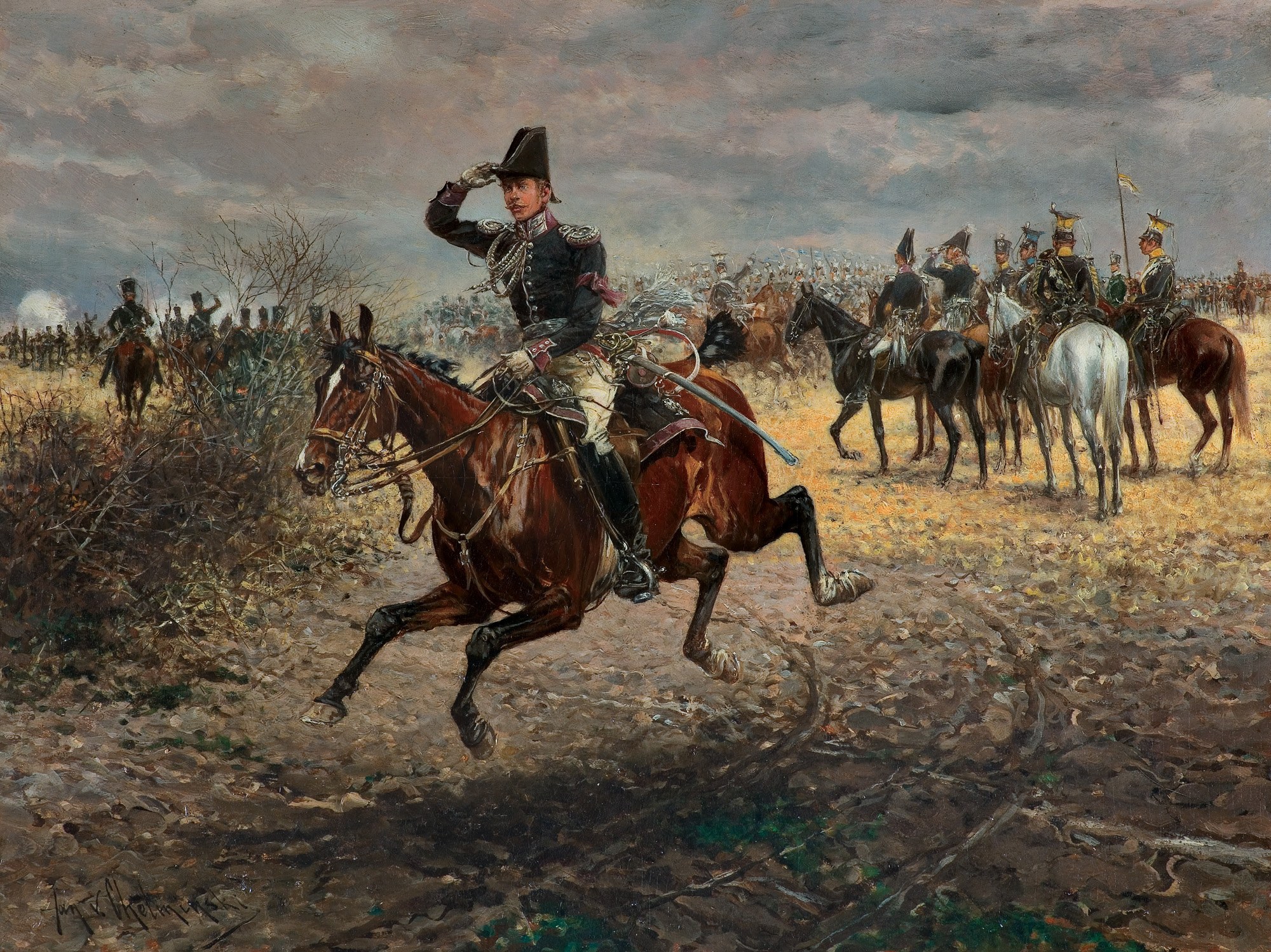
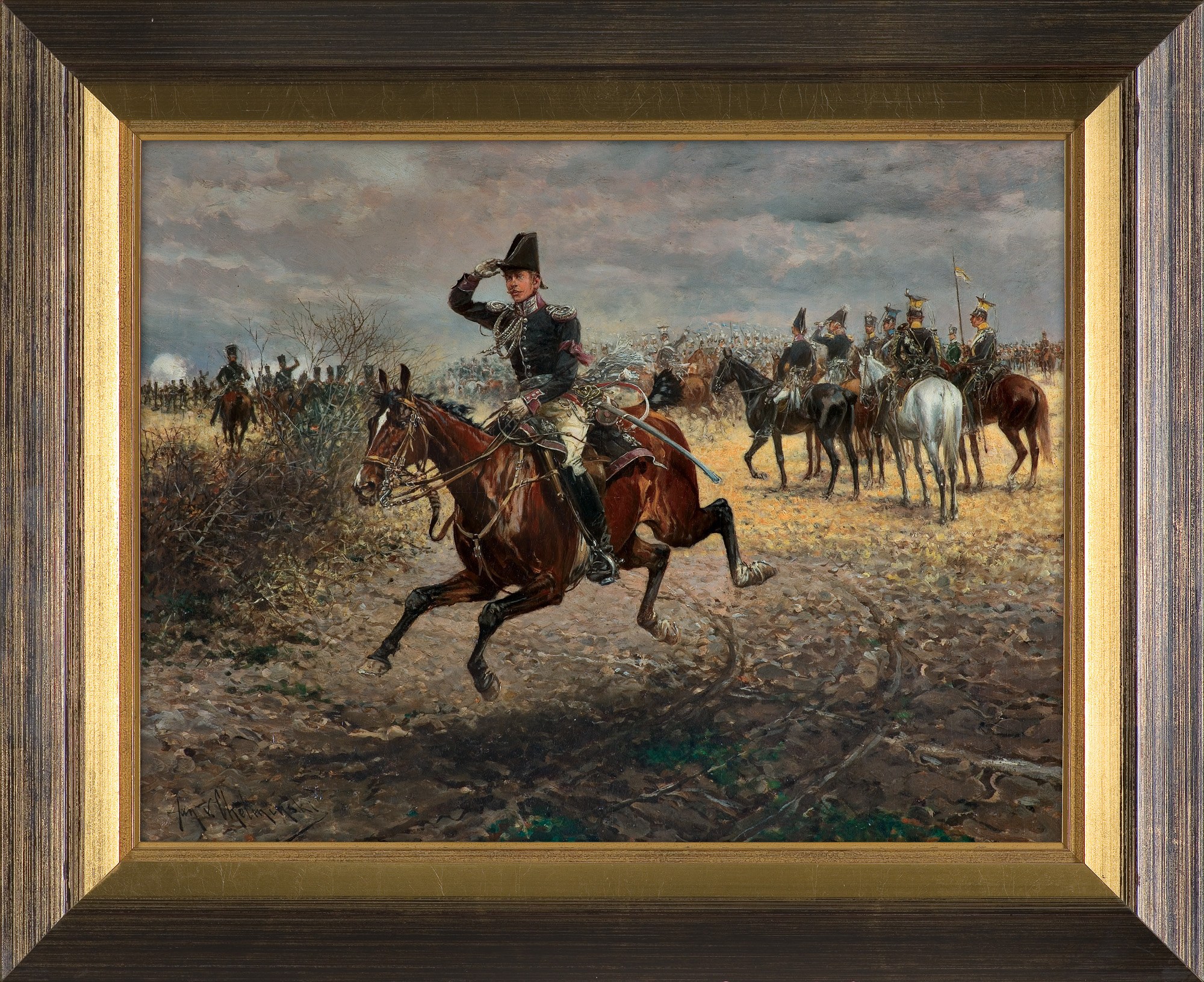
34.8 x 45.8cm - oil, mahogany board
signed l.d.: Jan v. Chelminski
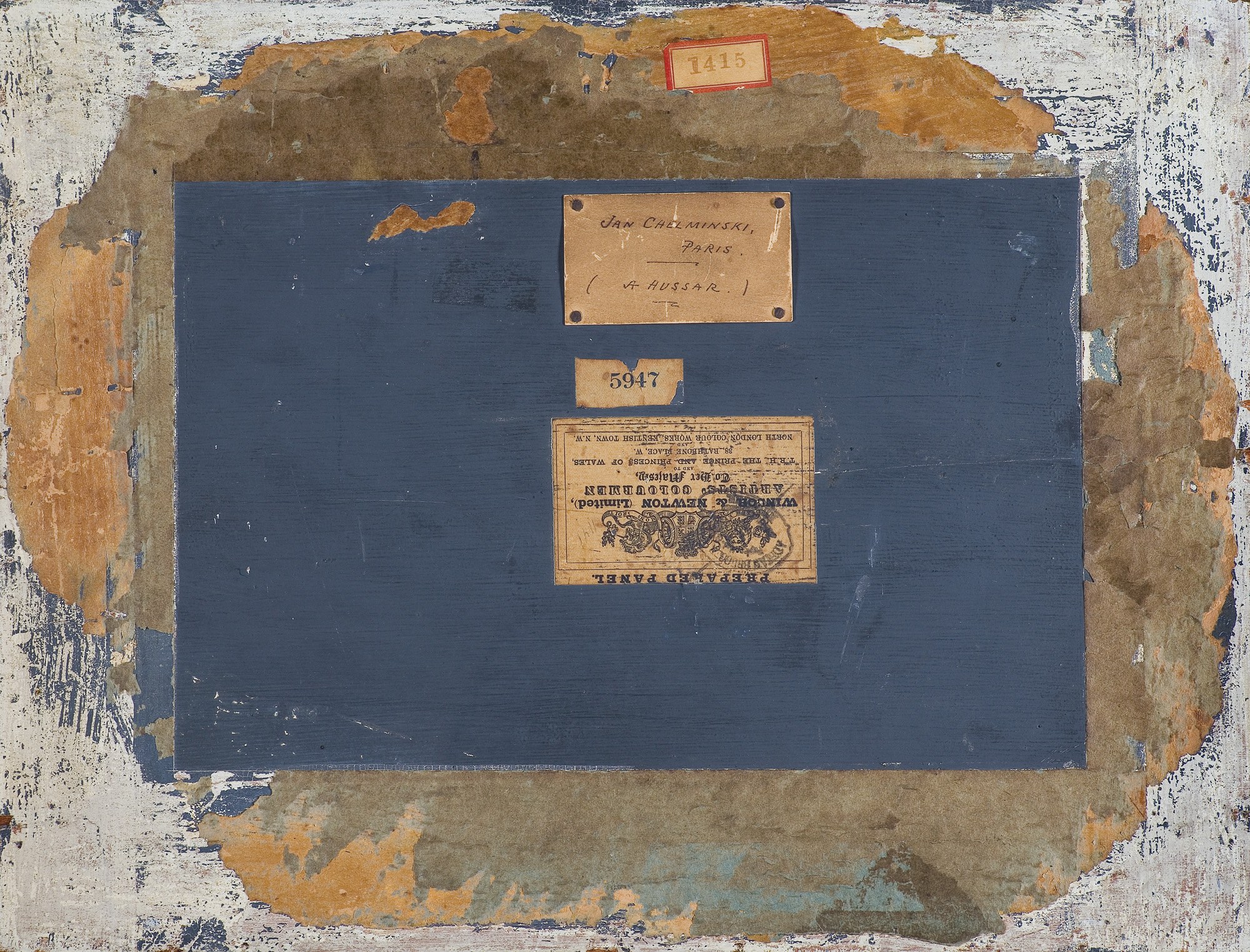
On the reverse, sticker with the number (stamp): 1415; below, nailed with four nails, slip of paper (in ink): JAN CHELMINSKI | PARIS. | (A HUSSAR.); below, sticker with number (print): 5947; below, opposite the composition, a sticker of a London firm offering painting materials: PREPARED PANEL | [drawing: lion-herb-unicorn] | WINSOR & NEWTON, | ARTISTS' COLOURMEN | To Her Majesty | AND TO | T. R. H. THE PRINCE AND PRINCESS OF WALES, | 38, RATHBONE PLACE W. | AND | NORTH LONDON COLOUR WORKS, KENTISH TOWN, N.W.; on it the stamp of Adrian Brugger's Munich firm of painting materials in the shape of a palette with a brush.
From his earliest years, Jan Chelminski was passionate about painting scenes of rides, hunting and dynamic battle compositions, in which horses invariably took center stage. After graduating from the Munich Academy of Fine Arts, he made his debut at a Kunstverein exhibition with the painting Ride, depicting couples in Rococo costumes. The work immediately found a buyer, paving the way for the artist to a significant career. In time, Chelminski became very popular with American art dealers and collectors, and his paintings were perfectly suited to the tastes of a wealthy clientele from overseas. This is what Henryk Piatkowski wrote about his popularity as early as 1894 in the pages of "Tygodnik Ilustrowany": For more than a dozen years now, paintings by Polish painters have been traveling across the ocean to adorn the private collections of American moneylenders, and even public galleries and museums there. This fate usually befalls the works of artists permanently settled in Munich and Paris, since these two great centers of art are in constant contact with American dealers and amateurs, who often visit them and know well the way to the more outstanding studios. But if the names of Brandt, Maks Gierymski, Chelmoński, Kowalski, Czachórski, to name the more illustrious ones, are highly respected in the art markets of the United States, it is safe to say that only one of our painters has been able to gain real popularity among a wide circle of the American public. That painter is Jan Chelminski.
Over the years, the artist's work, inspired by the achievements of his masters Juliusz Kossak and Jozef Brandt, increasingly focused on battle themes, especially scenes related to the Napoleonic era and the participation of Polish military formations. Following in Brandt's footsteps, Chelminski amassed an impressive collection of weapons, mainly from the Napoleonic period, which allowed him to reproduce historical details of armaments, uniforms and equipment with exceptional precision. The work on display is an excellent example of this meticulousness, combining painterly dynamism with attention to historical credibility.
One of the most distinctive elements of his painting was his extraordinary attention to the details of his uniforms. Thanks to his own collection of historical weapons and military memorabilia, Chelminski reproduced the uniforms of Polish formations with great precision: navy blue jackets, decorative epaulettes, shamrocks, caps, pennants and military insignia. Every element of the outfit - from buttons to horse rows - was painted with almost documentary accuracy.
An excellent example of this is the painting on display, which shows an adjutant general at full gallop moving With Command. It was this meticulousness that made his paintings serve not only an artistic function, but also a historical one, preserving the visual memory of the Polish military.
Origins: The painting, through Munich publisher Theodor Stroefer, was purchased by New York gallery Knoedler & Co. Entered in the record book on November 19, 1887 with a notation that it arrived in New York on November 14. Then, on February 28, 1889, the painting was purchased by Washington Butcher Thomas, who lived in Boston at 285 Commonwealth Avenue. Thomas was a manager at his father's company, Standard Sugar Refinery, and later became president of the American Sugar Refining Company. He was also a well-known investor in the Boston real estate market and president of the American Golf Association.
Image exhibited, mentioned and reproduced in, among others:: - M. Knoedler & Co., Painting stock book 4: 4369-8799, 1883 April - 1899 April, p. 99, inv. no. 5947 (purchased by W.B. Thomas in Boston);
- M. Knoedler & Co., Sales book 6, 1885 December - 1892 June, p. 198, inv. no. 5947 (Patrol).
Jan Chelminski (Brzustow near Opoczno 1851 - New York 1925) a popular painter from the circle of "Polish Munich painters," began his education with Juliusz Kossak, and then studied at the Warsaw Drawing Class and in Munich - at the Academy under Alexander Strähuber and Alexander Wagner (1873-1875) and the private studios of Jozef Brandt (1875) and the battle painter Franz Adam (1876). After his studies he was already permanently abroad - in Munich, London (years 1882, 1888-1899), Paris (1899), traveled to St. Petersburg (1889) and New York (1884), where he later settled permanently around 1915. However, he did not break contacts with the country, and often sent his works to Warsaw exhibitions. His paintings enjoyed great success. He painted mainly military and battle scenes, most often from the times of the Duchy of Warsaw and the Napoleonic Wars, as well as genre paintings and hunting episodes. He was involved in book illustration; among other things, he illustrated a volume of hunting stories by Theodore Roosevelt. He was a collector of old weapons and an outstanding expert on soldier uniforms. Many of the artist's paintings are still abroad - in England, Germany or the United States. Few of them appear in antiquarian sales, constantly arousing keen interest among collectors.













Nylig sett
Logg deg inn for å se en liste over objekter
Favorittobjekter
Logg deg inn for å se en liste over objekter