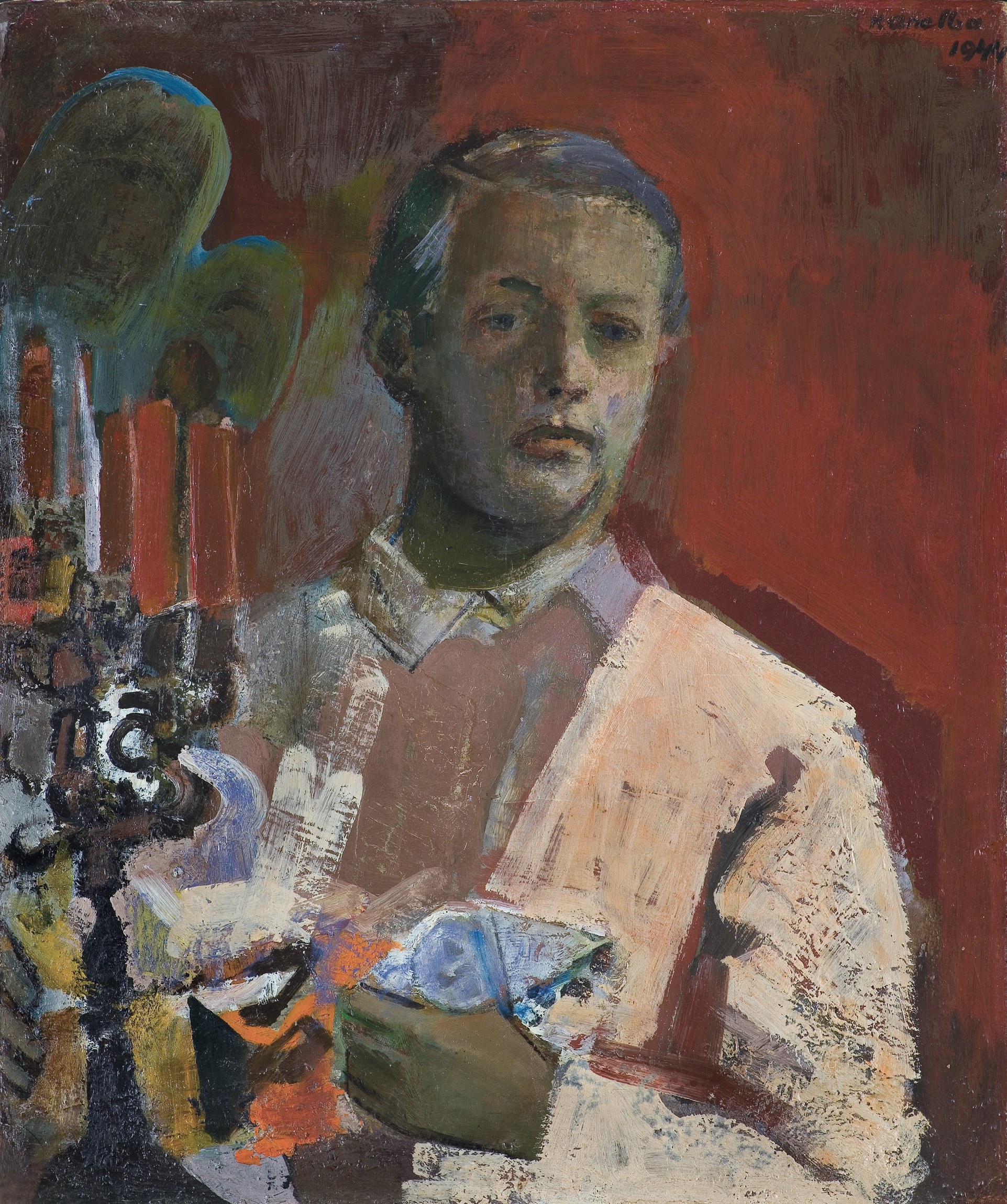
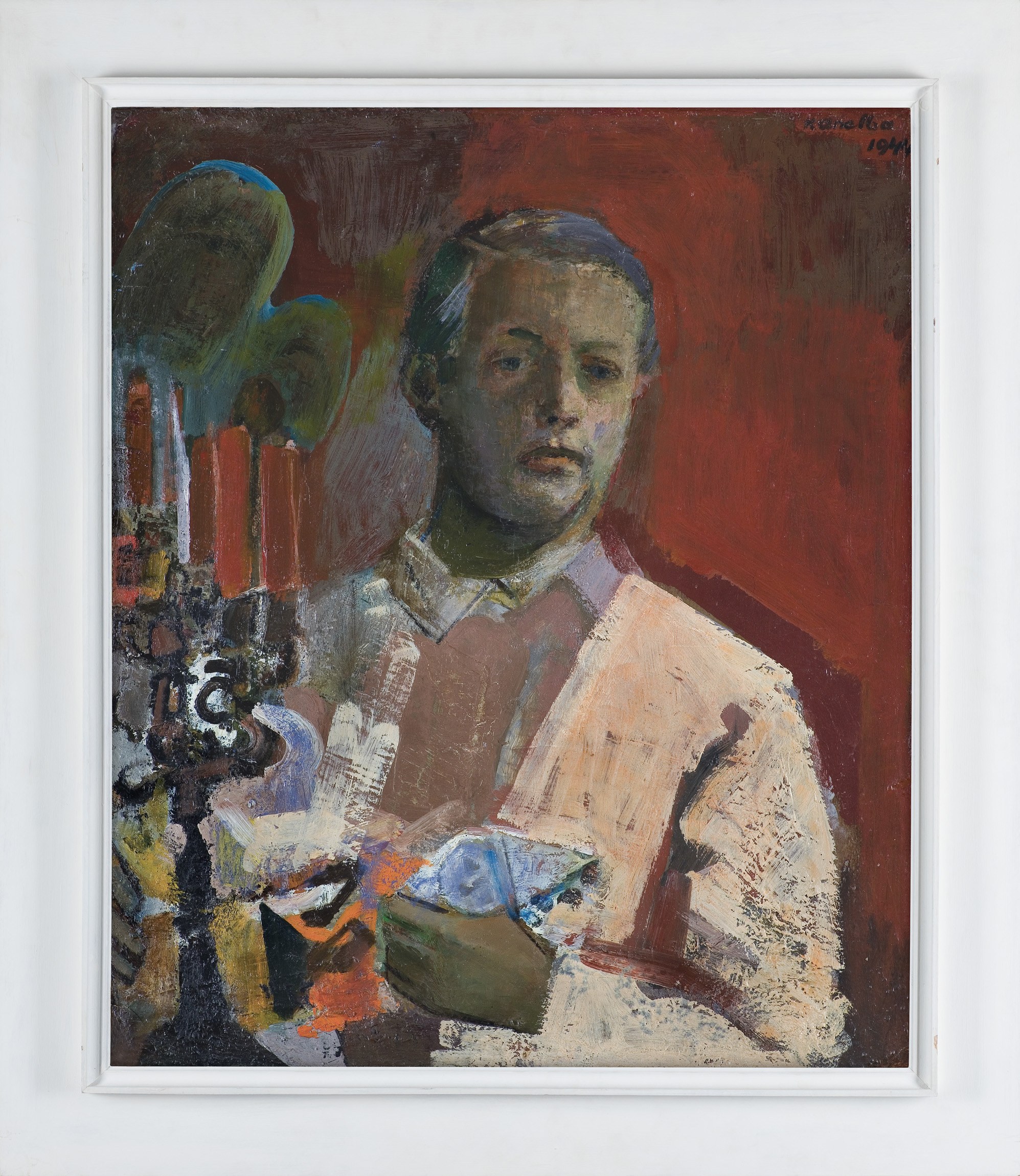
74.50 x 62.50 cm - oil, cardboard
Signed p.g.: Kanelba | 1944
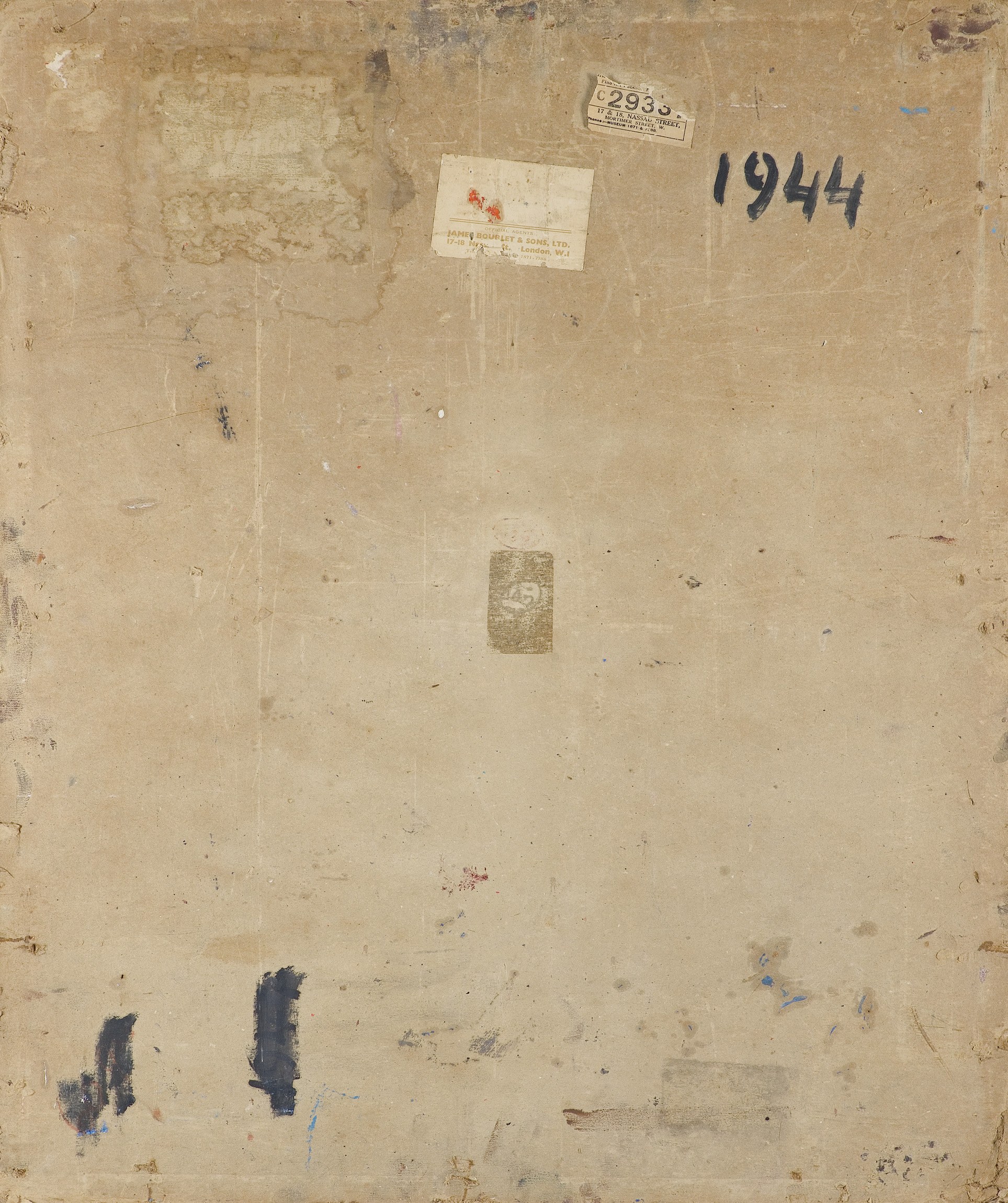
On the reverse, inscription in black paint: 1944.
Also, two stickers of the London framing firm James Bourlet & Sons.
Provenance:
- Property of Maria Kanelba.
- Property of George Kanelba
- Private collection.
-Raymond Kanelba, Victor Hammer Gallery, New York 8 - 12 I 1952, cat. no. 8 (Self Portrait,owned bythe artist's wife);
-Raymond Kanelba, 1897-1960: revisting a modernist: a retrospective exhibition (text by Brian Roughton), 28 I - 27 II, 2003, Dallas, Roughton Galleries, 2003, p. nlb;
-Kanelba (text from: André Salmon, Kanelba, Paris XI 1933), Dallas, Roughton Galleries 2003, p. nlb. il. (color).
The painting was at Roughton Galleries in Dallas in 2003 (see catalog below), and is reproduced in the exhibition's accompanying publication quoting a text from a book (Paris 1933) on Rajmund Kanelba by André Salmon, a prominent French poet, writer and art critic.
Rajmund Kanelba was an accomplished and much sought-after portraitist. His canvases are distinguished by a synthetic approach to form and soft chiaroscuro modeling. The artist never aspired to photographic literalism. For him, the face and silhouette of the model were primarily a pretext for building color harmony and the mood of the painting. He often operated with a subdued range - grays, muted blues, greens and warm browns - which gave the compositions an elegant, muted character. Many of his portraits show inspiration from French painting of the first half of the 20th century. - especially Post-Impressionism and Colorism. Kanelba is one of the most interesting Polish painters associated with the École de Paris circle. In 1928, French art critic François Thiébault-Sisson wrote about him in "Le Temps" as follows: Of all the young people from abroad who come here to educate themselves through contact with our artists, I know no one more talented than this Pole, Kanelba. His vision is as delicate as it is subtle, and his eye is extremely sensitive to all modulations of color and all variations of atmosphere.
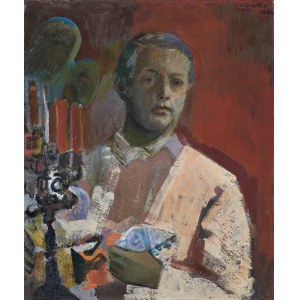
The featured Self-Portrait in Red is one of the most expressive works in the painter's oeuvre. In this painting Kanelba uses intense, saturated red, which dominates the composition and builds its emotional tension. Here the red plays the role of not only a background, but becomes a symbol of creative energy. The composition of the self-portrait is compact, focused on the bust of the artist. The artist holds in his hand a doll wearing a pointed headdress. She resembles the children in his portraits dressed in paper hats. The painter's gaze is directed directly at the viewer, establishing a dialogue with him and telling him about his work.
Rajmund Kanelba's portraits combine elegance of form with refined color culture. The artist was able to bring out the model's individual characteristics making the canvas become a dialogue between the painter and the model - a dialogue conducted primarily through color.
Self-Portrait in Red is an expressive, bold work - both formally and emotionally - proving that for Kanelba, portraiture was not just a painting genre, but a space for self-reflection and artistic experimentation.
Rajmund Kanelba /Kanelbaum (Warsaw 1897 - London 1960)-began his painting studies in 1918 at the Warsaw School of Fine Arts under Stanislaw Lentz and Tadeusz Pruszkowski.
He then studied in Vienna and Paris, where he settled permanently from 1926, joining the circle of artists of the so-called École de Paris. Starting in 1924, he exhibited a lot at home and abroad, taking part in the Paris Salons and presenting his works in London, Edinburgh, Glasgow, Berlin, Bordeaux, Brussels, New York, Chicago, Philadelphia, Florida, among others. During World War II he stayed mainly in England, later living periodically in Paris, London and New York. He painted landscapes, still lifes, nudes and portraits, including, especially characteristic for him, "lyrical in mood, freely and sketchily treated studies of women and children" (SAP). In the 1950s he portrayed, among others, Britain's Queen Elizabeth II.