


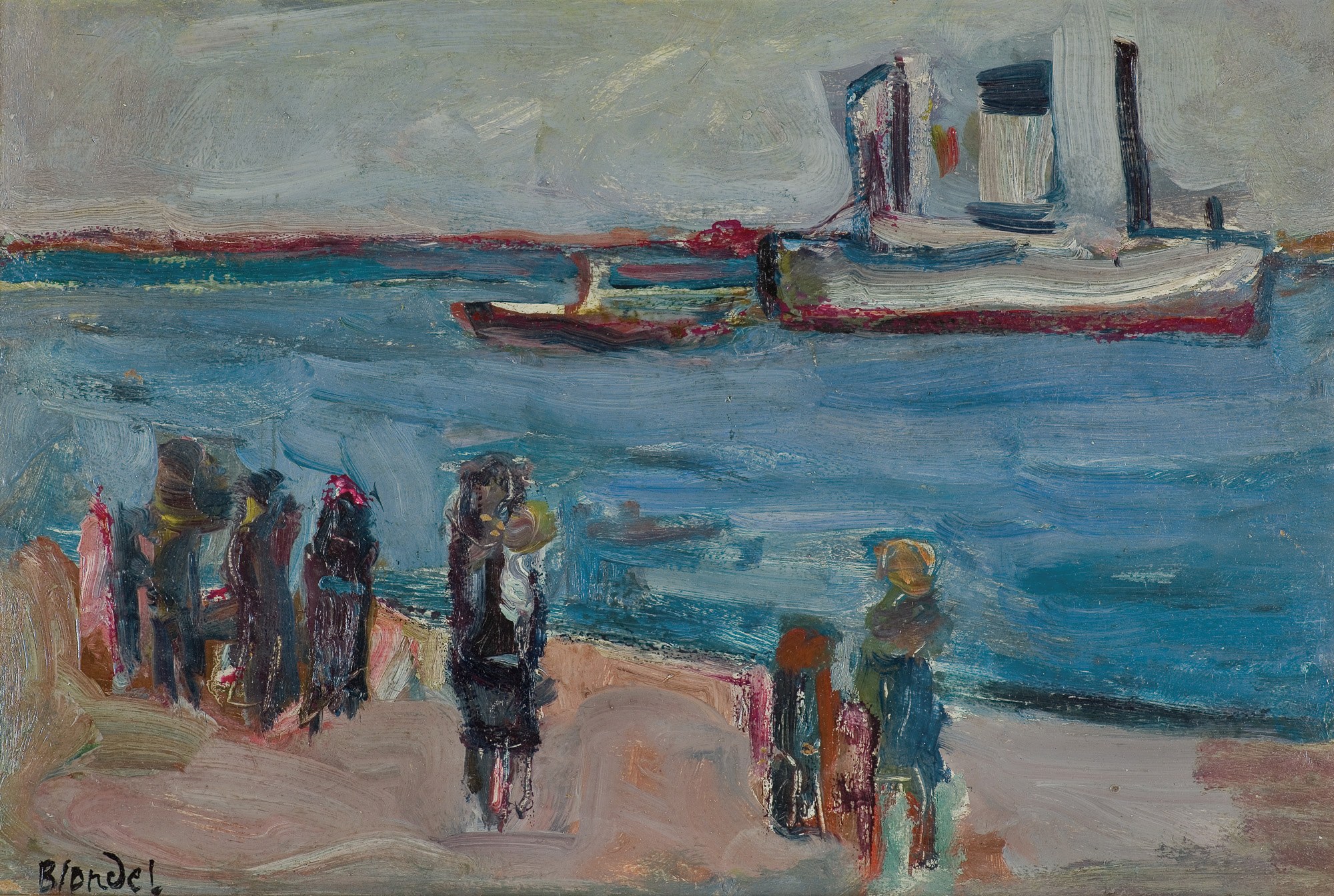
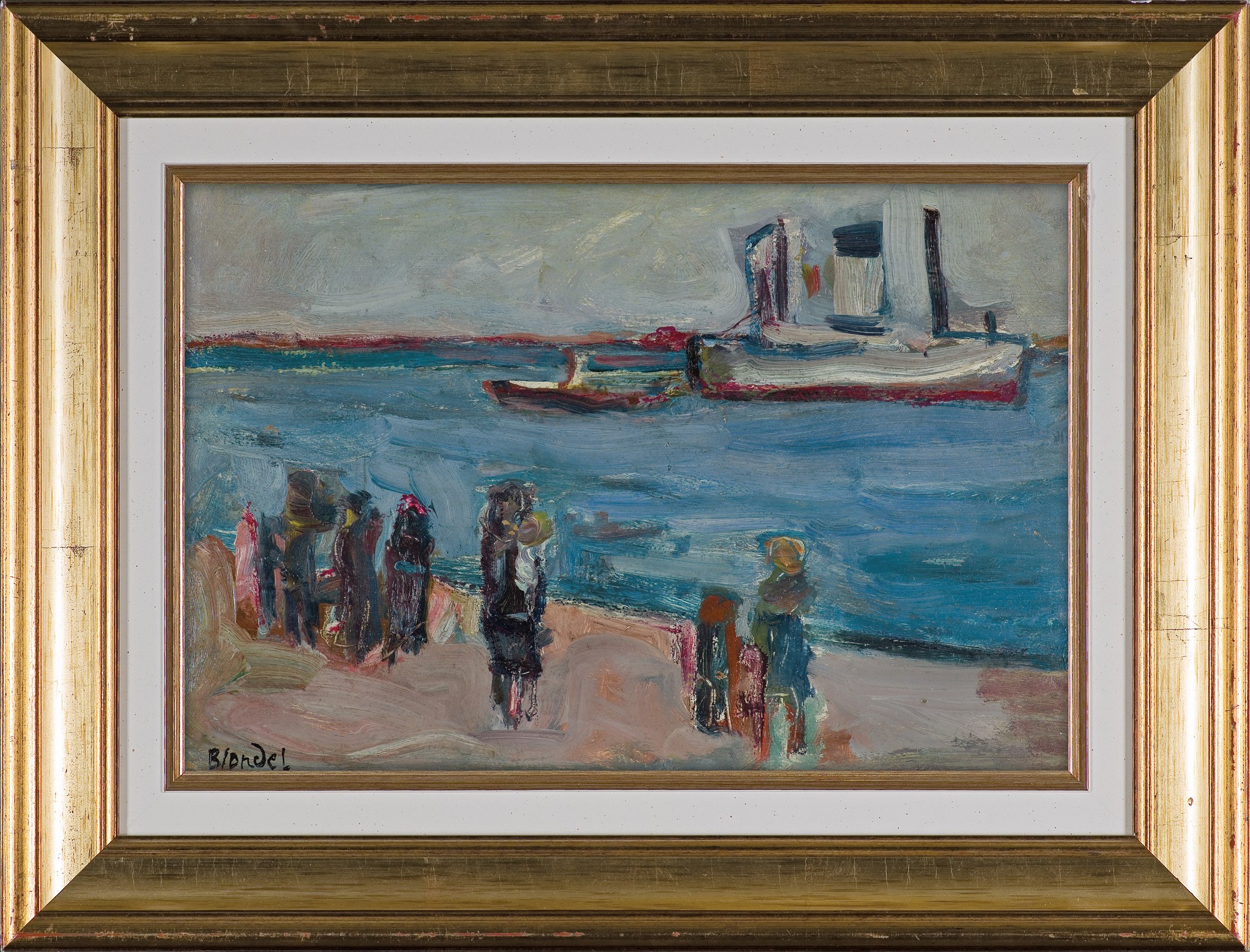
23.2 x 34.8 cm - oil on panel
signed lower left: Blondel
♣ Droit de suite: ♣ An additional fee will be added to the purchase price pursuant to the right of the artist and his heirs to receive remuneration in accordance with the Act of February 4, 1994, on Copyright and Related Rights (droit de suite).
Aleksander (Sasza, Szaje, Andre) Blonder (Blondel)—in 1931–1932, he studied architecture at the École Nationale Supérieure des Beaux-Arts in Paris; at the same time—until 1934—he studied at the Academy of Fine Arts in Kraków under Teodor Axentowicz, Władysław Jarocki, and Fryderyk Pautsch. In Kraków, he became involved with leftists from the Communist Union of Polish Youth and the Socialist Youth Union “Życie.” He was a member of the artistic group Żywi. Blonder’s early work was greatly influenced by the art of the École de Paris and the expressive paintings of Stanisław Wyspiański. In 1933, he became a co-founder of the avant-garde Krakow Group, with which he exhibited from 1933 to 1937. A series of abstract paintings dates from this period, reflecting the textural variation of geometric fields employed by Władysław Strzemiński. In these compositions, a dense network of interpenetrating, minute forms fills the entire picture plane, bringing to mind Leon Chwistek’s aesthetic theory of “zonism.”
In 1937, he was expelled from the Union of Polish Visual Artists for communist activities; that same year, he left for Paris on a scholarship. During World War II, he participated in the French Resistance. From 1942 onward, he went by the pseudonym André Blondel. In 1943, he took a position as a teacher at a high school in Carcassonne. In 1945, he settled in Paris, from where he often traveled to Sète in southern France, where he painted luminous, sun-drenched landscapes. Also representative of this period are his schematically rendered still lifes, which provided an opportunity for coloristic experimentation.
He was a member of the Artistes Méridionaux group in Toulouse. He exhibited at the Institute of Art Propaganda in Warsaw (1936–1937) and held his first solo exhibition at Henryk Koterba’s Salon in Warsaw in 1937. He subsequently exhibited in Toulouse (1946), Paris (1949), and Perpignan (1949). Retrospective exhibitions were held at the National Museum in Kraków (1970), Narbonne (1959), Sète (1959), and Carcassonne (1980).
In addition, he worked as an illustrator (illustrations for Doëtte Angliviel’s poem “Le Cheval fou,” Narbonne, 1947).













Nylig sett
Logg deg inn for å se en liste over objekter
Favorittobjekter
Logg deg inn for å se en liste over objekter