


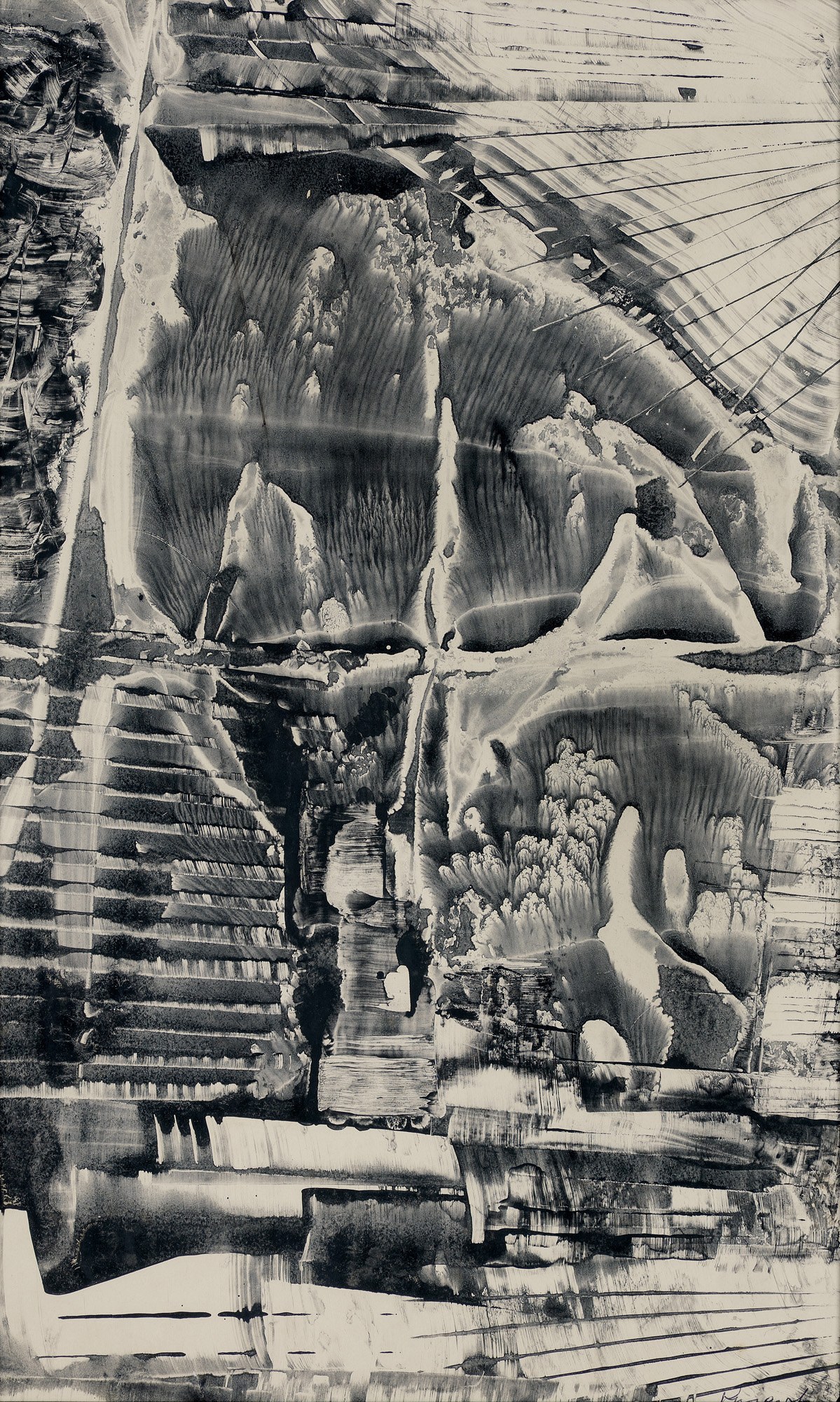
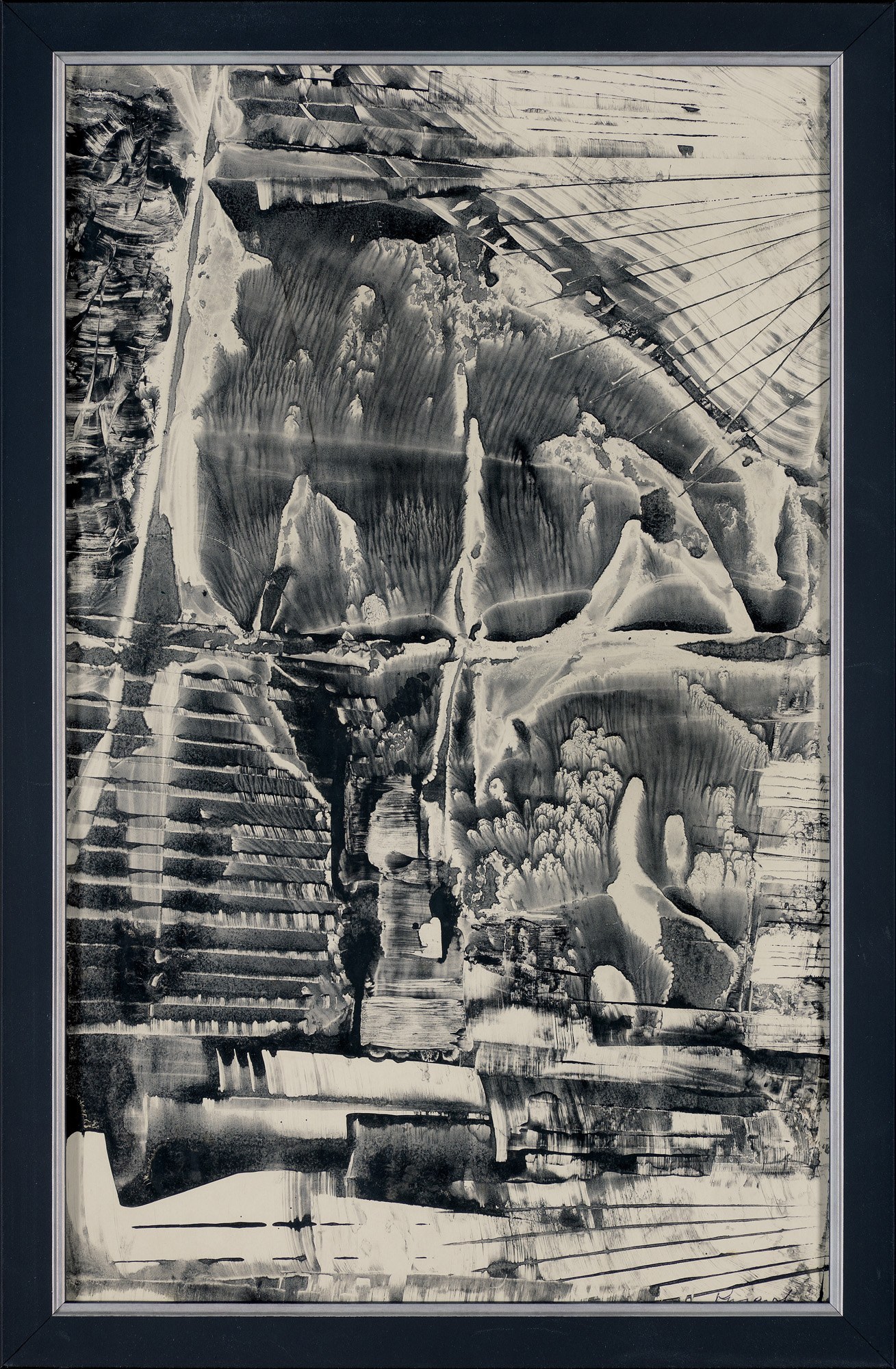
45 x 28 cm - ink, decal, paper
signed in ink on the lower right: Kujawski
In the 1950s, Kujawski practiced Informel abstract painting, making full use of the automatism and randomness permitted in this style. He particularly appreciated and made full use of those techniques that allowed him to achieve effects unattainable through traditional brushwork: free splashes of paint, dripping, decalcomania, and frottage.
♣ Droit de suite: ♣ An additional fee will be added to the Purchase Price pursuant to the right of the artist and his heirs to receive compensation in accordance with the Act of February 4, 1994, on Copyright and Related Rights (droit de suite).
Jerzy Kujawski (b. 1921, Ostrów Wielkopolski – d. 1998, Paris)
He was born on April 28, 1921, in Ostrów Wielkopolski. Displaced from Greater Poland during the war, he lived alternately in Warsaw and Kraków. He studied at the Academy of Fine Arts in Kraków. After the war, he settled in Paris. He established contacts with the Parisian avant-garde, particularly with André Breton. In 1947, he exhibited at the famous international Surrealist exhibition at the Maeght Gallery in Paris. From late 1949 through the second half of the 1950s, Kujawski was a practitioner of gestural abstraction and painted works in which he challenged the principles of figurative composition, emphasizing chance, automatism, the free arrangement of shapes and colors, and uncontrolled expression. In 1957, he held his first solo exhibition in Poland at the Krzywe Koło Gallery in Warsaw’s Old Town, where he presented an entire series of Informel paintings. The early 1960s in Kujawski’s art were marked primarily by an interest in the painting of matter. In the second half of the 1960s, he abandoned abstraction and returned to figurative imagery, though filtered through the iconosphere of the media world. He drew inspiration from his contemporary surroundings and clichés drawn from mass culture. He increasingly turned to monotype, decal, and silkscreen—that is, the image-building techniques used by Pop Art artists. This type of work, in its various forms—closely related to fin-de-siècle art—would dominate his oeuvre until his final works of the 1990s. Jerzy Kujawski died on June 28, 1998, in Paris.













Nylig sett
Logg deg inn for å se en liste over objekter
Favorittobjekter
Logg deg inn for å se en liste over objekter