


Very rare issue.
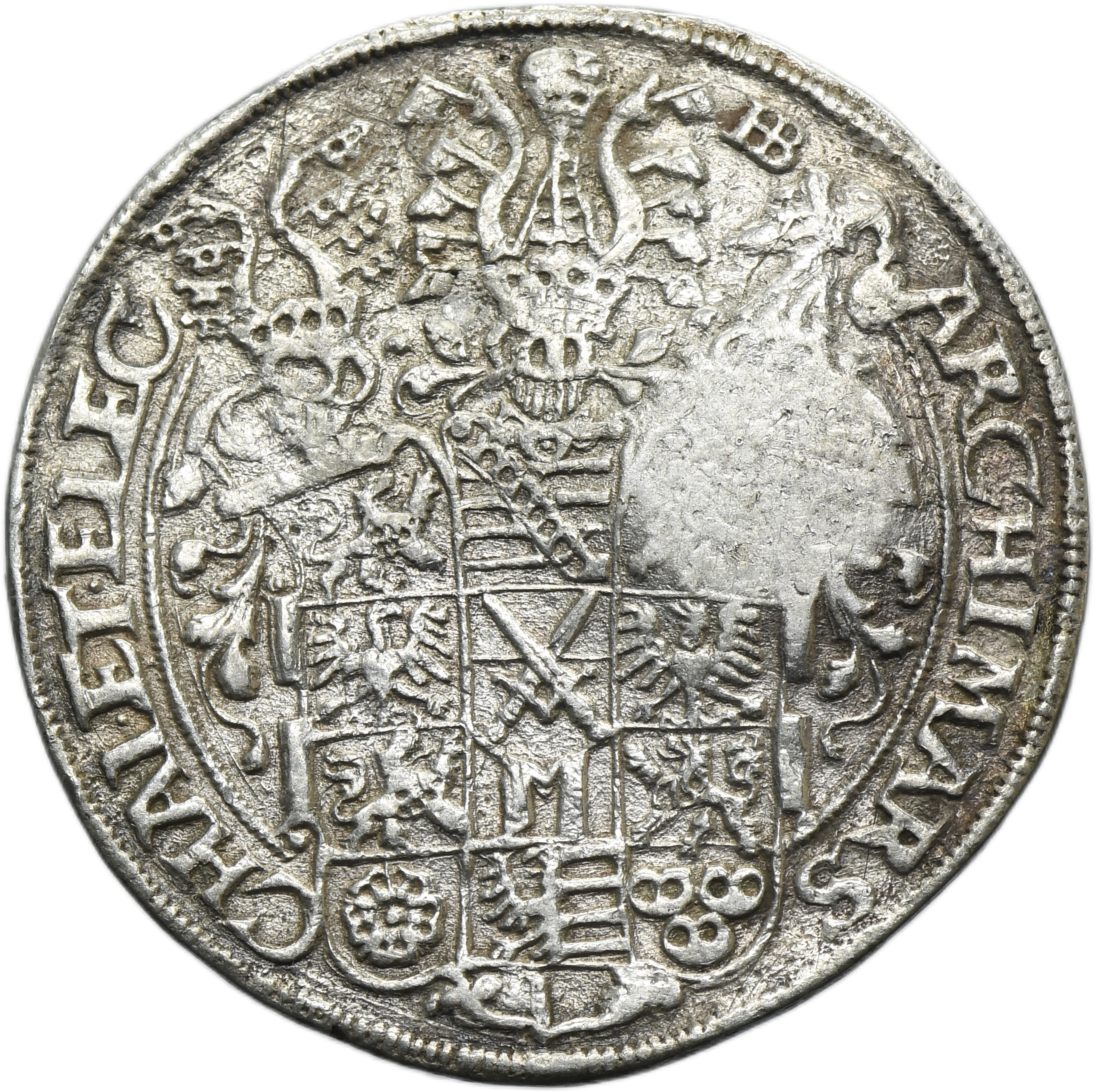
Saxon silver thaler of Augustus from the years 1553–1586, with a countermark made by MAJNERT, bearing the monogram of Sigismund II Augustus and the date 1564.
The coin, as a Saxon thaler, is an original piece, but thanks to the countermark Majnert falsified it as the so-called Neapolitan Sums.
Bona Sforza, the wife of Sigismund the Old and the mother of Sigismund Augustus, left Poland in 1556 with an enormous amount of money. Before her death she lent Philip II, the King of Spain and Naples, the astronomical sum of 430,000 silver ducats. Recovering this money was not easy; negotiations between Sigismund Augustus and Philip II lasted a long time. As a result of these negotiations, the King of Spain returned part of the debt in the amount of 100,000 ducats; the remaining part of the loan was never repaid. The repayment came at a moment when the Polish king very much needed cash. The war with Russia over Livonia generated enormous expenses, and paying the mercenary army was a priority. Various options for using the sum sent by Philip were considered, but due to the urgent need to pay the troops, the idea of melting the coins down and recoining them into Polish currency was abandoned. It was decided to countersign the coins and put them into circulation at a fixed compulsory rate.
The amount sent by the King of Spain was paid in silver half-ducats of Charles V (Philip’s father) and silver half-ducats and ducats of Philip II. On each of these coins a circular countermark with the crowned royal monogram splitting the date 1562 was struck. This process took place at the Vilnius mint, and the universal signed on 16 May 1564 in Knyszyn imposed on the silver ducats with countermarks a nominal value of 60 Polish groszy. The nominal value differed significantly from the real value of the coins, as the silver ducats contained silver worth 33½ groszy. The king promised to exchange the countersigned coins for full-value money after the end of the Muscovite war. The king kept his word, and the Neapolitan Sums are today extremely rare numismatic items.
Their rarity and collector’s value were already appreciated in the 19th century. It was also noticed by one of the most famous Polish forgers, Józef Majnert. He produced a die of the countermark of Sigismund Augustus, which he then struck on coins of other countries. The main problem was acquiring silver half-ducats of Charles V and silver half-ducats and ducats of Philip II, since these coins were rare even by themselves. Therefore he used coins of Western states, including Saxon ones. Tadeusz Kałkowski in his work “A Thousand Years…” described the process of falsifying the Neapolitan Sums as follows:
“Józef Majnert, who knowing the desires of collectors, made an excellent copy of the Sigismund counter-stamp and decorated with it a multitude of foreign thalers and half-thalers, then sold them at prices of increased demand. It is interesting, however, that these ‘Majnerts’, despite their illicit origin, are still highly valued.”
This statement is also true today; Majnert’s products are highly valued and sought after by collectors. We are pleased to offer you a “Majnert” described above by Kałkowski — a forgery of the Neapolitan Sums of exceptional rarity and beauty. Zagórski, in his work “Fałszerstwa monet polskich” (“Forgeries of Polish Coins”), described three types of this forgery: a cast from an original, and two types of punches created by Majnert and struck on thalers of German states. On the offered specimen we see a countermark struck on a Saxon thaler of Augustus from the years 1553–1586.
Specimen of extraordinary rarity; based on available online archives, we were unable to find any auction records of this type of numismatic item.
As for the countermark itself, it differs from the original in the different connection of the letters S and A in the monogram, as well as a differently shaped ending of the letter A. Additionally, the spacing between the digits 6 and 4 of the date is different than in the original. Zagórski, in his work under item 20, presents a countermark struck also on a Saxon thaler of Augustus; one may assume that Majnert mainly used Saxon coins for producing this forgery. This is a well-known forgery which already in the 19th century had many admirers and was present, among others, in the Collection of ……………, and today is extremely sought after like most “Majnerts”. The offered specimen is distinguished by its very good state of preservation, which confirms Kałkowski’s words that these types of numismatics were highly valued by collectors. An interesting fact is that one of the punches used to create the false Neapolitan Sums has survived to this day and is held in the Czapski collection.
Numismatic piece for the finest collections. Such an item may not appear on the auction market again for many years.
Diameter 40 mm, weight 27.54 g











