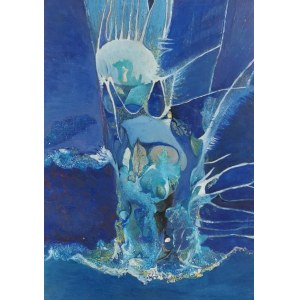
Signed and dated on the reverse: Erna Rosentein / Sea Composition / 1967.
Erna Rosenstein was a graduate of the Academy of Fine Arts in Cracow. Prior to that, she studied at the Frauenakademie in Vienna. The artist was also a member of the first and second Cracow Group, the Cricot 2 theater and the circle of artists associated with the Krzywe Koło Gallery in Warsaw. However, the most significant artistic milieu for Erna Rosenstein seems to be the Group of Nine, founded in 1949, which included Tadeusz Brzozowski, Tadeusz Kantor, Jadwiga Maziarska, Maria Jarema and the artist's friend Jonasz Stern. This group, rebelled against the art of socialist realism, including programmatically not taking part in the exhibitions organized at the time (1949-1955).
At the same time, it adopted Surrealist poetics as a form of artistic expression, often treating abstract form only as a means of artistic expression. As Anda Rottenberg writes, "Traditionally, surrealist art was practiced by Erna Rosenstein, and to some extent by Jonasz Stern. The former, prone to poeticism, often reached for Dadaist, non-Marxist means of expression (...)" [A.R., Art in Poland 1945-2005, Warsaw 2006, p. 69]. It seems that it is precisely "poetization" that could be the starting point for exploring Erna Rosenstein's work, since she was not only a painter, she also wrote poetry. Her debut volume entitled. "Trace" was published in 1972. It can be assumed that Erna Rosenstein decided on an artistic path in the form of a record understood in a broader context - her achievements are a kind of emotional diary of the artist, consisting of, drawings and paintings of often small formats (with meaningful titles) - as if torn from a memory notebook, collages from everyday objects saved from being thrown away, and written words. Her art seems personal, almost intimate.
Despite belonging to one of the most active artistic circles of the 1950s and 1960s, Erna Rosenstein's works were rarely shown in solo exhibitions. One of the major presentations, held at Warsaw's Zachęta Gallery in 1965, was an exhibition for which the exhibition design was prepared by Tadeusz Kantor. The arrangement, unusual for the time, surprised the art critic community and dominated the discussion of the artist's work. Thanks to the efforts of Dorota Jarecka and Barbara Piwowarska, Erna Rosenstein's artistic oeuvre was elaborated, and the research culminated in the exhibition "Superimposition", held at the Królikarnia branch of the National Museum in Warsaw in 2014. The exhibition treatments suggested by Tadeusz Kantor for the earlier presentation were used there.
At the same time, it adopted Surrealist poetics as a form of artistic expression, often treating abstract form only as a means of artistic expression. As Anda Rottenberg writes, "Traditionally, surrealist art was practiced by Erna Rosenstein, and to some extent by Jonasz Stern. The former, prone to poeticism, often reached for Dadaist, non-Marxist means of expression (...)" [A.R., Art in Poland 1945-2005, Warsaw 2006, p. 69]. It seems that it is precisely "poetization" that could be the starting point for exploring Erna Rosenstein's work, since she was not only a painter, she also wrote poetry. Her debut volume entitled. "Trace" was published in 1972. It can be assumed that Erna Rosenstein decided on an artistic path in the form of a record understood in a broader context - her achievements are a kind of emotional diary of the artist, consisting of, drawings and paintings of often small formats (with meaningful titles) - as if torn from a memory notebook, collages from everyday objects saved from being thrown away, and written words. Her art seems personal, almost intimate.
Despite belonging to one of the most active artistic circles of the 1950s and 1960s, Erna Rosenstein's works were rarely shown in solo exhibitions. One of the major presentations, held at Warsaw's Zachęta Gallery in 1965, was an exhibition for which the exhibition design was prepared by Tadeusz Kantor. The arrangement, unusual for the time, surprised the art critic community and dominated the discussion of the artist's work. Thanks to the efforts of Dorota Jarecka and Barbara Piwowarska, Erna Rosenstein's artistic oeuvre was elaborated, and the research culminated in the exhibition "Superimposition", held at the Królikarnia branch of the National Museum in Warsaw in 2014. The exhibition treatments suggested by Tadeusz Kantor for the earlier presentation were used there.


![Erna ROSENSTEIN (1913-2004), Bez tytułu [II], 1958](https://img1.one.bid/img/8134/2409628_1w.webp)