


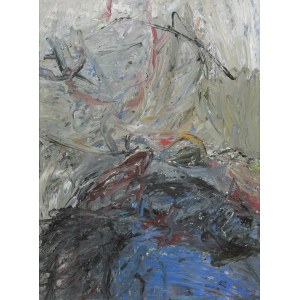
88,7 x 66,5 cm - oil, cardboard
signed obliquely p.d.: 1963 M. Stangret
on the reverse, long. p.d.: 607, l.d.: stamp of the Municipal Conservator of Monuments with number, date and signature
The featured painting belongs to a group of the artist's early works inspired by the informel trend (French: art informel - formless art): In the late 1950s and early 1960s, while still a student at the Academy of Fine Arts in Cracow, Maria Stangret painted paintings in the informel style, which she herself calls "gestural paintings." She was introduced to the world of avant-garde painting tendencies by Tadeusz Kantor, who in 1955 returned from a stay in Paris, where he had the opportunity to get acquainted with abstract modern painting. Stangret, too, embarked on an artistic journey to France in the late 1950s and early 1960s, where she encountered the work of artists such as Dubuffet, Wols and Mathieu. The artist had her first exhibition in 1963 at Stockholm's Brinken gallery. In 1965 she once again traveled abroad, to the USA (California, New York) and there she became interested in Pollock's action painting and the art of Dine, Segal, Oldenburg and Rauschenberg. Maria Stangret's paintings from that period are characterized by spontaneity and lightness of gesture combined with painterly virtuosity of matter. These works, full of color tensions that build the compositions of the canvases, present a vast range of moods in which they resemble "inner landscapes." The artist was eager to reach back to the world of childhood, emphasizing in an interview with Piotr Skrzynecki: I am fascinated by the poetics of school, childish, almost playing with paint, ink, pouring and rubbing paper.
Ewa Gorządek, Maria Stangret - Kantor, 2020 [https://culture.pl].
♣ to the auctioned price, in addition to other costs, will be added a fee resulting from the right of the creator and his heirs to receive remuneration in accordance with the Act of February 4, 1994 - on Copyright and Related Rights (droit de suite)
Maria Stangret studied at the Academy of Fine Arts in Cracow under the direction of, among others, Jan Świderski, receiving her diploma in his atelier at the Department of Graphics in 1960. Since 1956 she was an actress at the ""Cricot 2"" theater, and participated in all the happenings of her husband, Tadeusz Kantor. She most often exhibited
at the Krzysztofory Gallery in Cracow and the Foksal Gallery in Warsaw. She has been a member of the "Krakow Group" since 1976. Her early paintings from the 1950s represented the informel abstraction trend, which she had the opportunity to get acquainted with during her stay in Paris. In the 1960s, she incorporated various readymade objects or natural elements, such as wood, leaves, etc., into the structure of her paintings. In the 1970s she moved closer to conceptual art, constructing objects that were exaggerated replicas of objects such as a linear sheet of paper. After this period, she returned to gestural painting, creating sensitive, spontaneous paintings inspired by nature.













Nylig sett
Logg deg inn for å se en liste over objekter
Favorittobjekter
Logg deg inn for å se en liste over objekter