


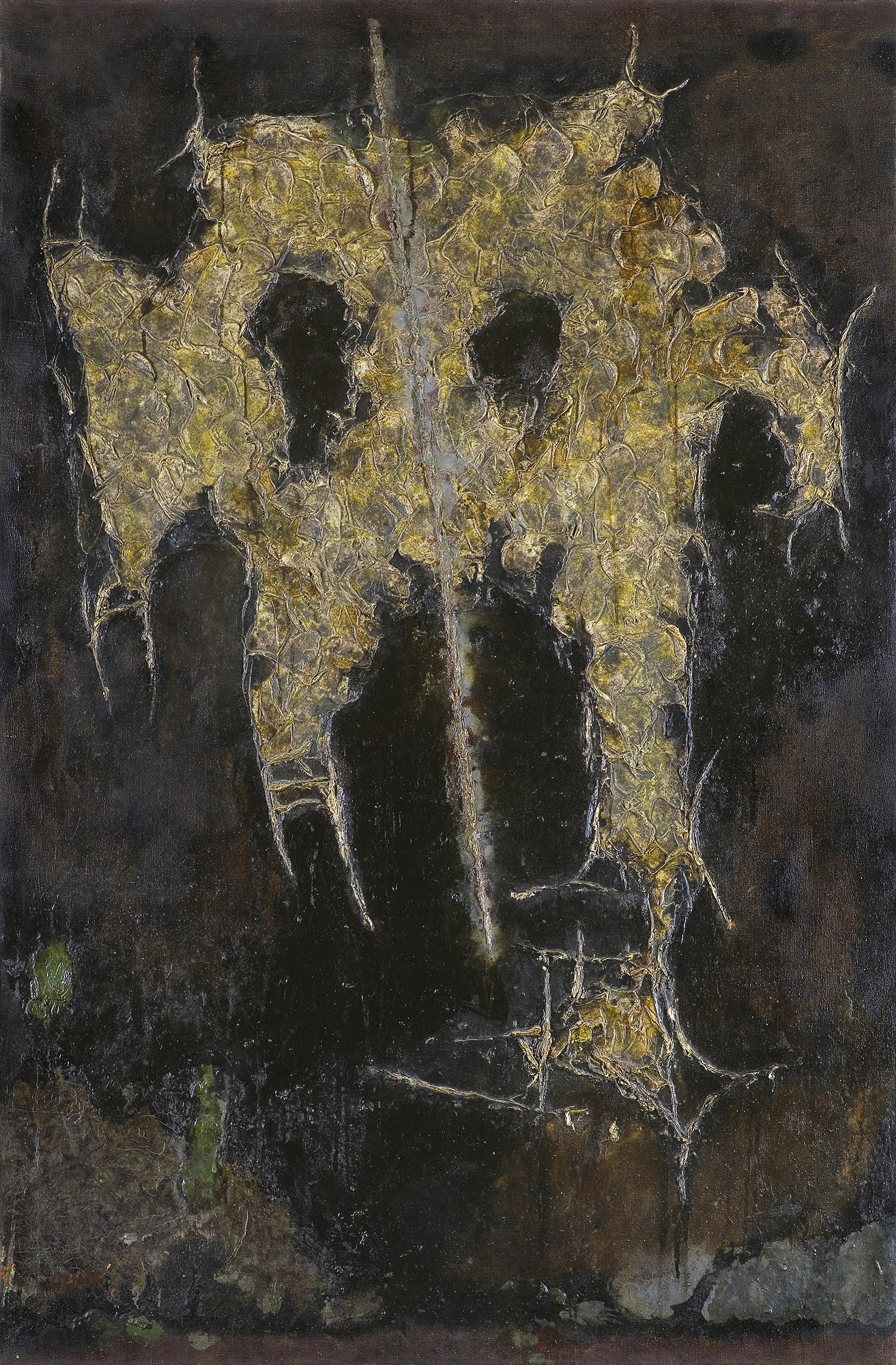
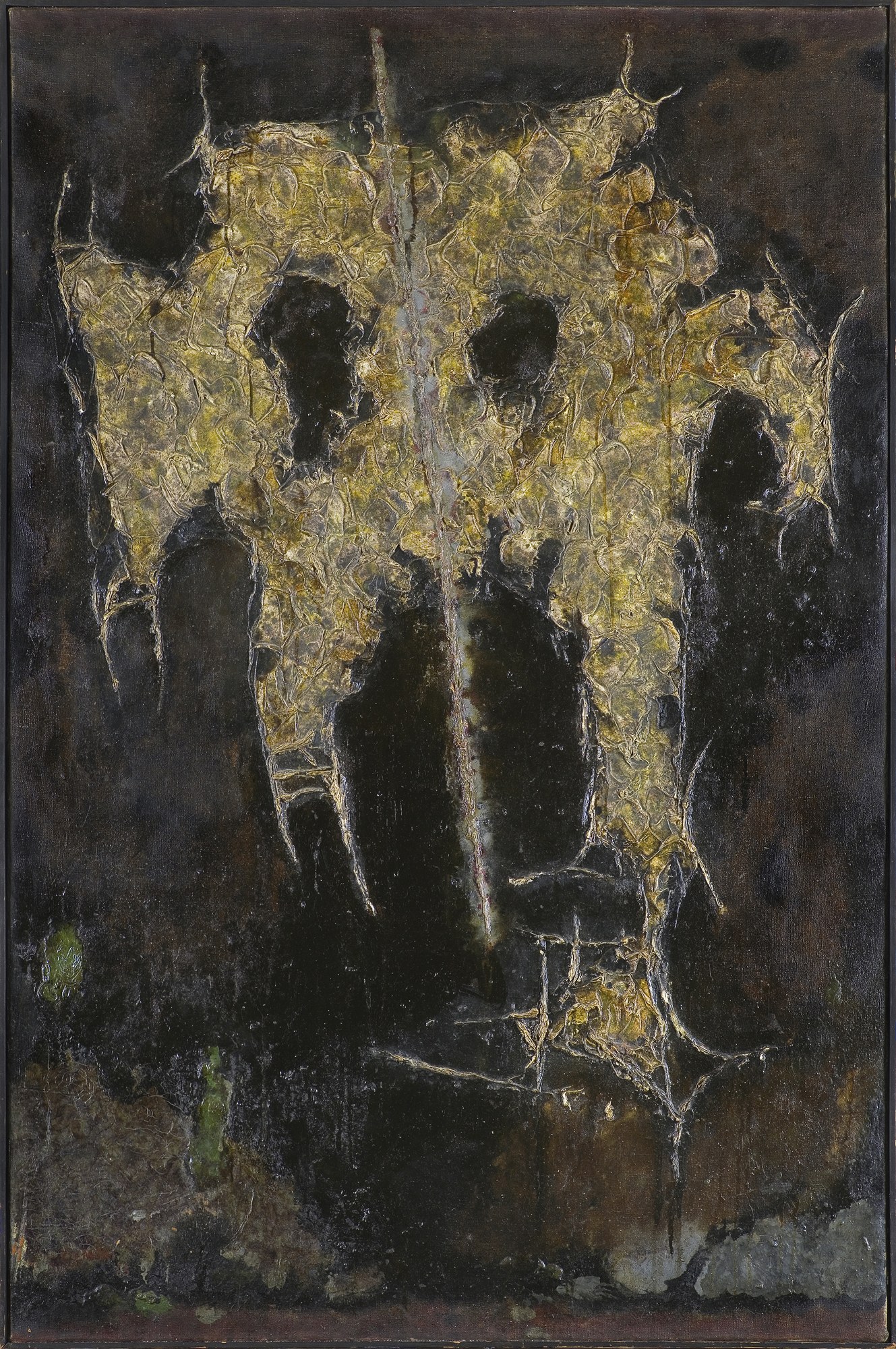
150,0 x 100,0 cm - oil, canvas signed l.d.: ZIEMSKI | 63
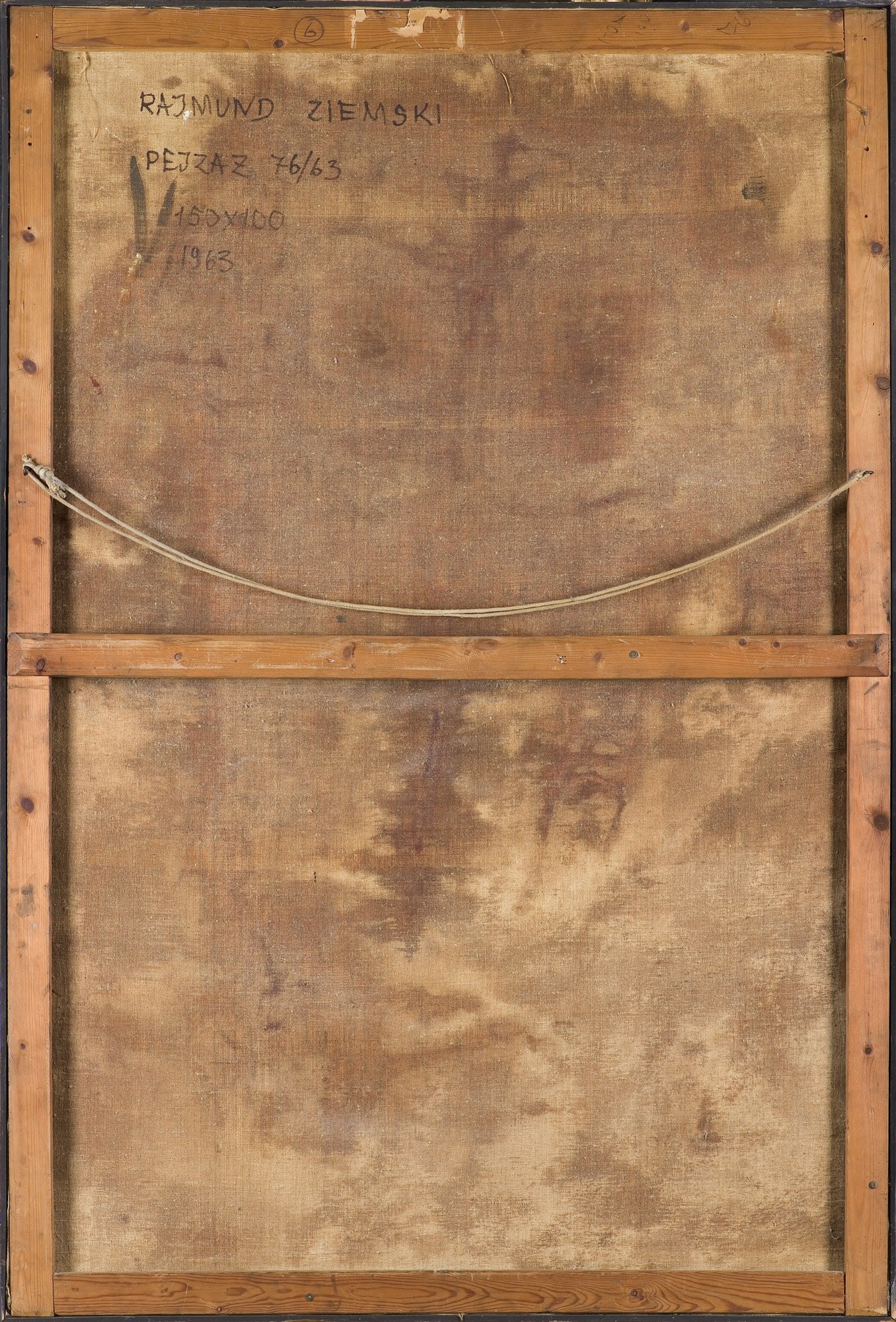
signed on the reverse l.g.: RAJMUND ZIEMSKI | PEJZAŻ 76/63 | 150 X 100 | 1963
on the g. strip of the loom l.: 6 [in a circle], next to it a fragment of a sticker, p.: 150 x | 100 | 76
Provenance:
- Property of Andrzej Wojciech Ożarek (1954-2024) - graphic artist and musician. According to a family account, the painting was a prize in a poster competition organized by "Zachêta".
- Heirs of A.W. Ożarek.
Reproduced image:
- Joanna Kania (compiled), Jola Gola, Maryla Sitkowska (collaboration), Rajmund Ziemski. Painting, ASP in Warsaw, Zachęta National Gallery of Art, Warsaw 2010, cat. no. 239, il. black and white (on accompanying CD - as not found, known from reproductions).
Rajmund Ziemski's paintings were described by critics as "interior landscapes." The painter was a student of Artur Nacht-Samborski and grew up in the Polish school of colorism, and his early landscapes still referred to the observed, sensually perceived image of nature. In his later years, Ziemski directed his painterly evolution toward an abstract approach to landscape, while still maintaining the order of spatial relations and the sensual experience of the varied matter existing in nature, even if the first impression from the viewer indicated that we were dealing with a set of purely abstract forms. At the same time, the paintings are extremely expressive in their emotional message.
The artist spoke about his "Landscapes" from the 1960s with his characteristic modesty and honesty, including in a published conversation with Jerzy Stajuda: About the paintings themselves I wouldn't like to say too much, I can't even. If they work - that's fine, they speak for themselves. If they don't work - we won't convince anyone here anyway. Where did they come from? When you do something for a long time, honestly, trying to make sure of all solutions to the issue (that's how I painted "Landscapes"), there comes a moment when you can put on the white shirt, white gloves. That is: you keep painting, but the anxiety is over. At the same time, however, you know that you have not painted at all what you intended to paint. The same sign appears in all "Landscapes." It was interpreted as a "threatening" sign. I wanted to paint not those distant, abstract threats, but those that can fall at once in any place, in the most innocent situation, "at the push of a button." (...) I had to rediscover the lost anxiety, and since gentle treatments didn't yield results, I sought something like cutting through the face with a razor blade.... Then it was possible to paint again in earnest. (Rajmund Ziemski. Painting..., p. 106)
♣ to the auctioned price, in addition to other costs, will be added a fee resulting from the right of the creator and his heirs to receive remuneration in accordance with the Law of February 4, 1994 - on copyright and related rights (droit de suite).
Rajmund Ziemski (Radom 1930 - Warsaw 2005) studied painting from 1949-1955 under Artur Nacht-Samborski at the Academy of Fine Arts in Warsaw. In his graduating year he took part in the National Exhibition of Young Visual Arts at the Warsaw Arsenal. Since 1958, he has been teaching at his alma mater, running a painting studio there, one of the most popular among students as a graduation studio. The professor who runs it is also an artistic authority, one of the most prominent representatives of the current of non-geometric abstraction in Polish postwar painting. In his early series "Birds" (1957-1958), he operated with highly simplified shapes, painted impasto on backgrounds that were usually dark and often richly textured. Beginning in the early 1960s, Ziemski's paintings took on the characteristic shape of an elongated rectangle, with allusive fields of color and texture spreading out in its fields like stretched, dramatic sheets. They bore titles suggesting connections with nature, but they were dominated by the painter's interest in color and matter, treated autonomously, in isolation from any object suggestions. These returned in a notable episode from the mid-1960s, when the artist incorporated photographic images of human faces into the structure of his paintings, then often combined into Triptychs. He later abandoned this practice in favor of further developing his color attempts, going in the direction of sharp contrasts and sometimes cacophonous juxtapositions. He remains committed to the method of titling and labeling his works, which was established back in the 1960s (the large "Landscapes" series, which is still painted today, with paintings numbered with a number broken by the annual date).













Nylig sett
Logg deg inn for å se en liste over objekter
Favorittobjekter
Logg deg inn for å se en liste over objekter