


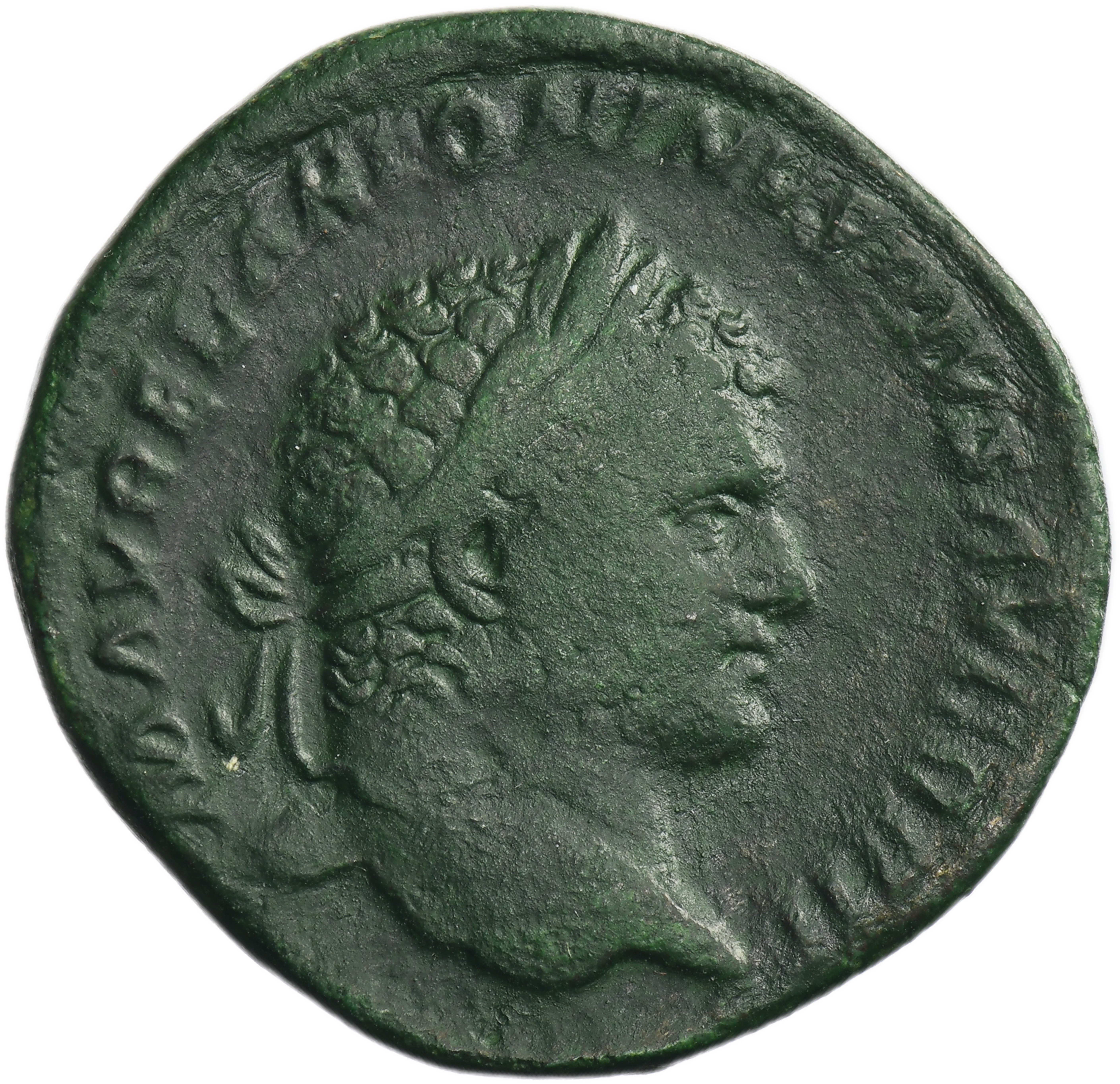
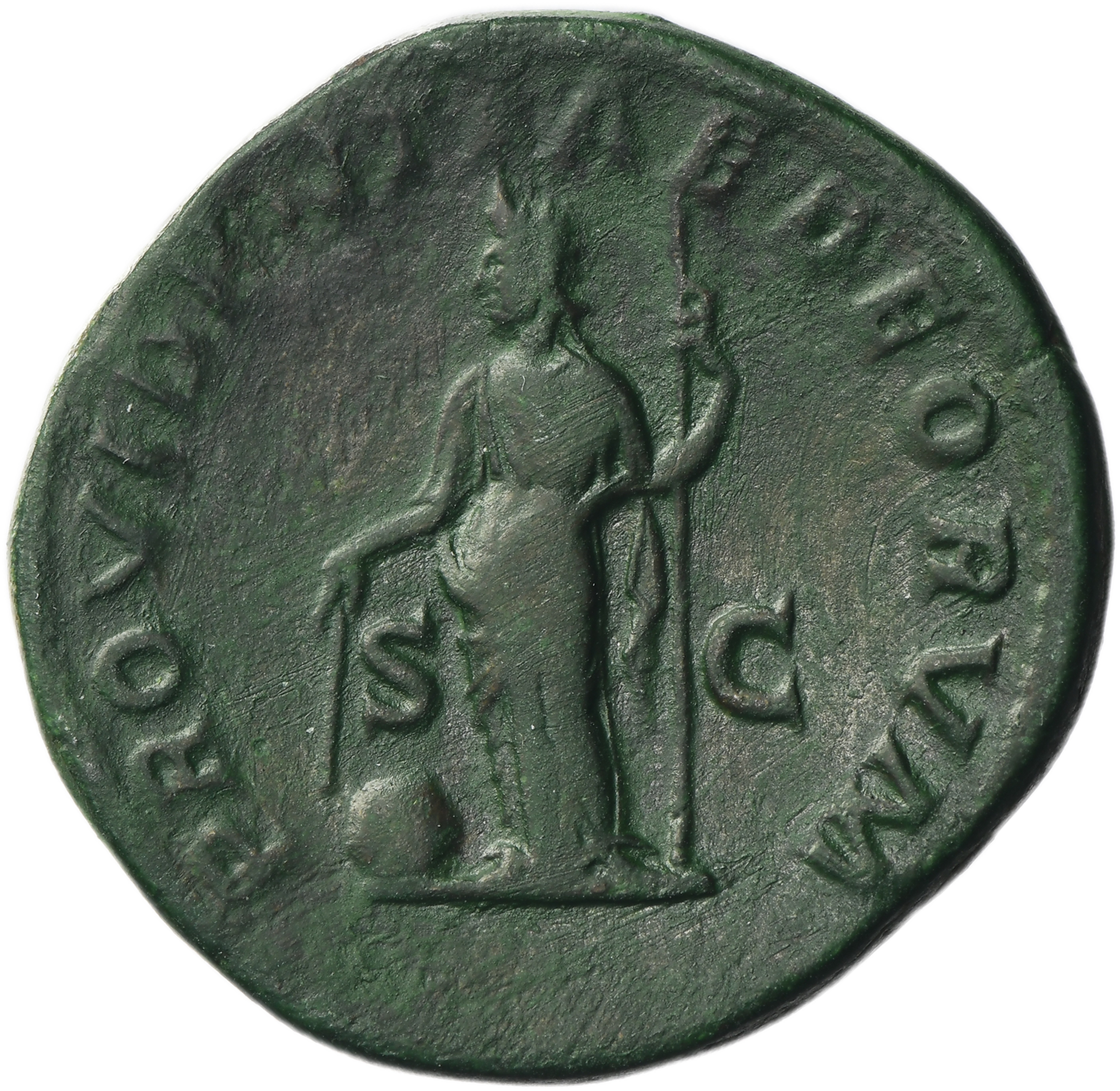


Sestertius of Caracalla (AD 188–217), struck at the Rome mint between AD 211–213, belongs to the early phase of his sole reign, immediately following the death of Septimius Severus. This period is marked by a strong emphasis on legitimizing imperial authority and invoking divine order within the visual language of coinage.
The obverse presents a laureate head of the emperor facing right, with the legend M AVREL ANTONINVS PIVS AVG BRIT, giving his full titulature along with the title Britannicus, adopted after the British campaigns conducted under his father.
The reverse depicts Providentia standing left, holding a sceptre (or lituus) and a cornucopia, with a globe at her feet, accompanied by the legend PROVIDENTIAE DEORVM and the letters S–C in the fields, indicating a senatorial issue. Providentia, as the personification of foresight and divine providence, here explicitly refers to the “providence of the gods,” reinforcing the notion of divine sanction for the emperor’s rule. The globe symbolizes dominion over the world, while the cornucopia conveys prosperity secured under stable governance.
The legend PROVIDENTIAE DEORVM belongs to a well-defined propagandistic repertoire of the early 3rd century, emphasizing that imperial authority operates in accordance with divine will. In the case of Caracalla, who assumed power amid a tense succession, this message carried particular ideological weight.
Roman Imperial
Caracalla (188-217), Sestertius 211-213, Rome mint
Obverse: laureate bust right
M AVREL ANTONINVS PIVS AVG BRIT
Reverse: Providentia standing left holding baton in right hand, sceptre in left, globe at her feet, S-C across fields
PROVIDENTIAE DEORVM
Diameter 30 mm, weight 23.97 g











