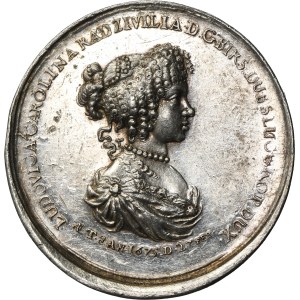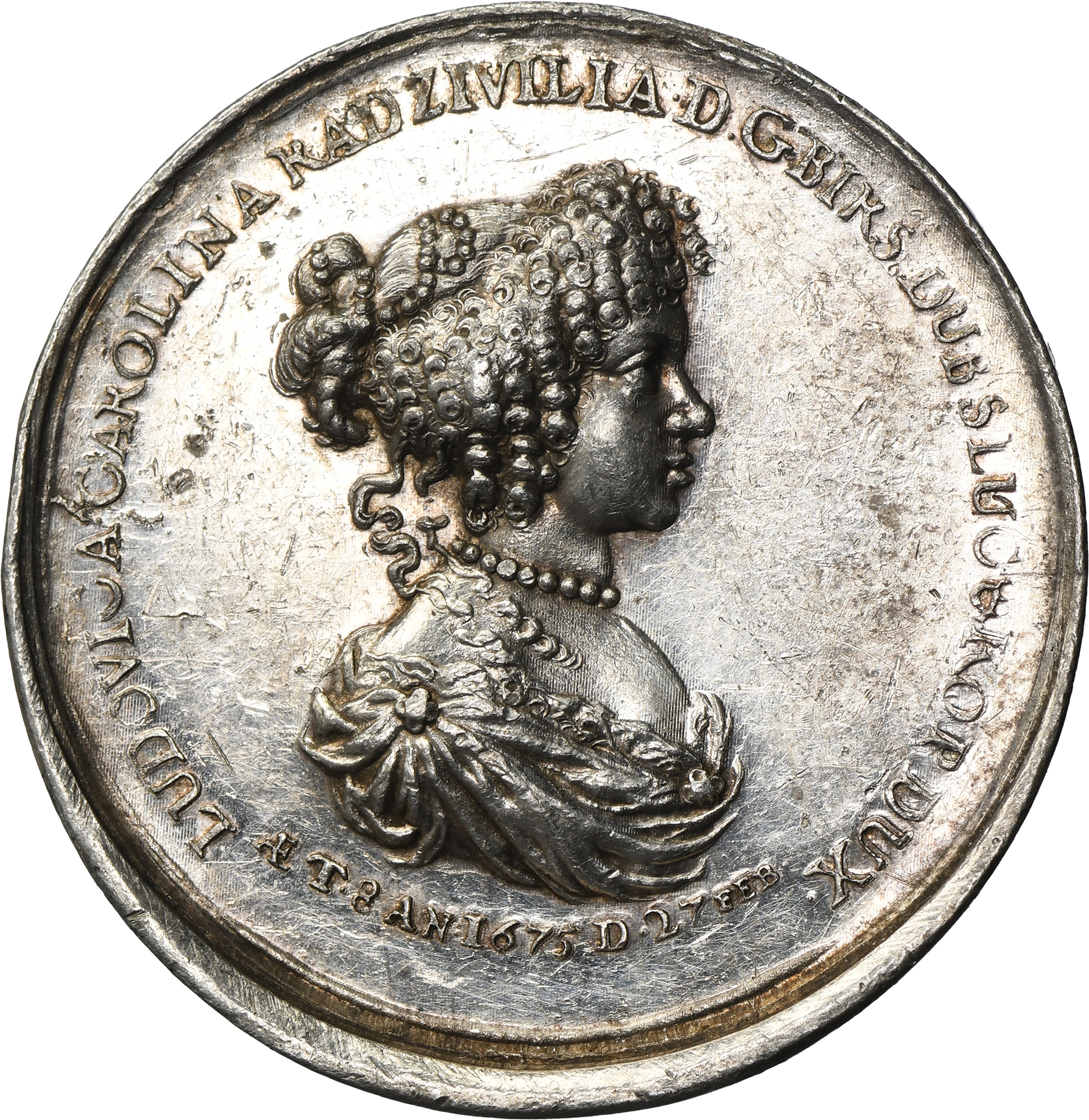
A rare commemorative medal dating from the reign of John III Sobieski, minted in connection with the orphaning of Ludwika Karolina Radziwillowna.
This young heiress of vast wealth, after the death of both her parents, was entrusted to the care of the Elector of Brandenburg, who in subsequent years led to her marriage to his son, a decision opposed by the Polish monarch.
A very interesting issue struck in several different varieties, as well as in silver and gold.
Attractive in appearance, this numismatic coin has an intense background luster. Background bruises and local cuts. Relief excellent.
A unique opportunity to come into possession of such a sought-after object with such an eye-pleasing presentation.
Obverse: bust of Ludwika Karolina Princess Radziwill to the right, with her hair neatly arranged, with a string of pearls around her neck, below an inscription ÆT 8 AN 1675 D 27 FEB (In the eighth year of her age 1675 on February 27)
LUDOVICA CAROLINA RADZIVILIA D G BIRS DUB SLUC ET KOP DUX (Ludwika Karolina Radziwillowna by God's grace Duchess of Birz, Dubinki, Slutsk and Kopyl)
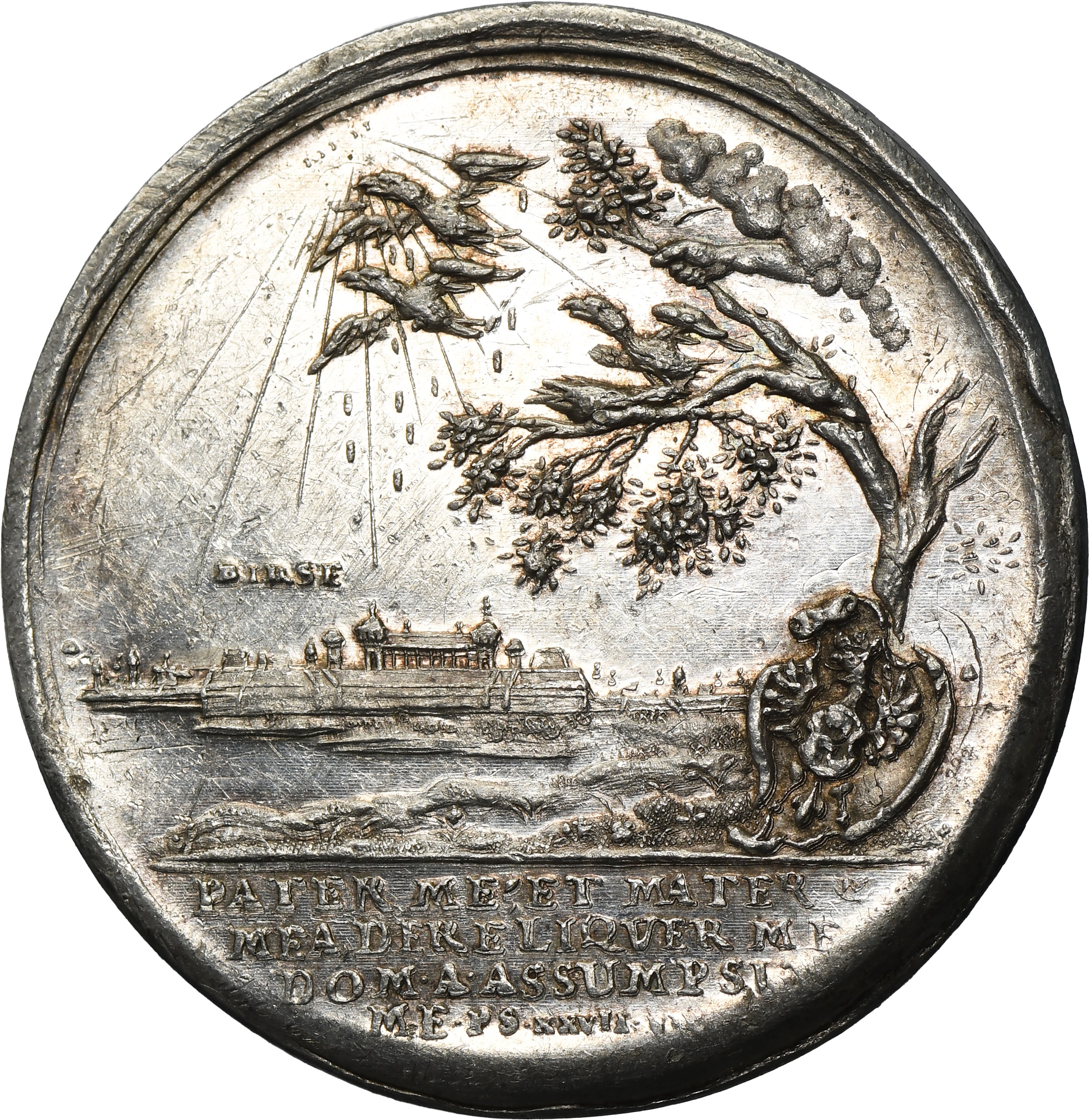
Reverse: a bird in the nest left, towards which a hand from the clouds brings a branch, making a shadow for it, when two other birds, that is, father and mother, fly away from it towards the sun, in the sun is the name of God, by the tree at the bottom is a shield with the Radziwill coat of arms, in the field one can see various edifices, over which is written BIRSE (the name of the Radziwill castle), in the segmentinscription PATER ME ET MATER ME A DERELIQVER ME DOM A ASSUMPSIT ME. PS XXVII V X (My father and my mother have forsaken me; but the Lord has accepted me. Psalm 27 (and according to the Catholic Bible 26) verse 10)
Silver, diameter 44 mm, weight 26.09 g
Edward Raczynski in his "Cabinet of Polish Medals" writes about this medal as follows: "We mentioned above Boguslaw Radziwil father of Ludwika Karolina, whom we see pictured here. The inscriptions on the medals under numbers 247 and 248 mention the orphaning of Princess Radziwill, who shortly after her birth lost her mother and two years later her father as well.
Ludwika Radziwillowna, heiress of immeasurable wealth, received her upbringing in Königsberg, under the tutelage of Frederick William Elector of Brandenburg, her guardian. The King of Poland, fearing that the vast possessions of this district of the House of Radziwill did not pass into the hands of a foreign Prince, while wishing to provide his own son with all the benefits attached to the hand of Ludwika Radziwill, wanted to win her hand for Prince James. However, since the Princess did not live in Poland, the King intended to enforce a law at the Sejm prohibiting her marriage to a foreigner. At that time the Elector of Brandenburg Frederick William anticipated the decision of the Polish Seym, for his son Ludwig, having won the heart of the Princess, married her in Königsberg (a); after living with her for four years, he left this world without an heir.
After his death, the Polish court began again to try to win the hand of Ludwika Karolina for Prince Jakob. Everything seemed to be going according to the wishes of John III. In 1688 Prince Jakob traveled to Berlin and there received a solemn promise from the Margravine widow that she would marry him, with the proviso that she would relinquish her property if the promise was not to be kept. After mutual gifts offered and accepted on both sides, the prince returned to Poland full of hope. Meanwhile, Prince Philip Neubursky, the third son of Friedrich Wilhelm Falcgraf Neubursky, secretly descended to Berlin and, hiding in the house of a French envoy, was able to persuade Ludwika Karolina to let go of her promise and immediately marry him.
It is difficult to express how this deed outraged the minds at the Polish court. Some advised that Prince Jakob should challenge Prince Neuburg to a duel; others said that Radziwill's property should be taken away in accordance with the bequest she had given; but John III found great difficulties in this regard. Some, motivated by their dislike of the King, others, captivated by donations, opposed all harsh intentions against Duchess Najburska, and for this reason turned public deliberations into null and void. Finally in the year 1691 Jadwiga Elisabeth, sister of the same Duke of Najbursk, who had almost refused to marry Prince Jakob, was married to the same Prince and on March 25 married in Warsaw.
Ludwika Karolina passed away from this world in the year 1695 leaving behind her from a second marriage one daughter, Elisabeth Augusta Joseph, who married Charles Emanuel Elector Falcgraf."