


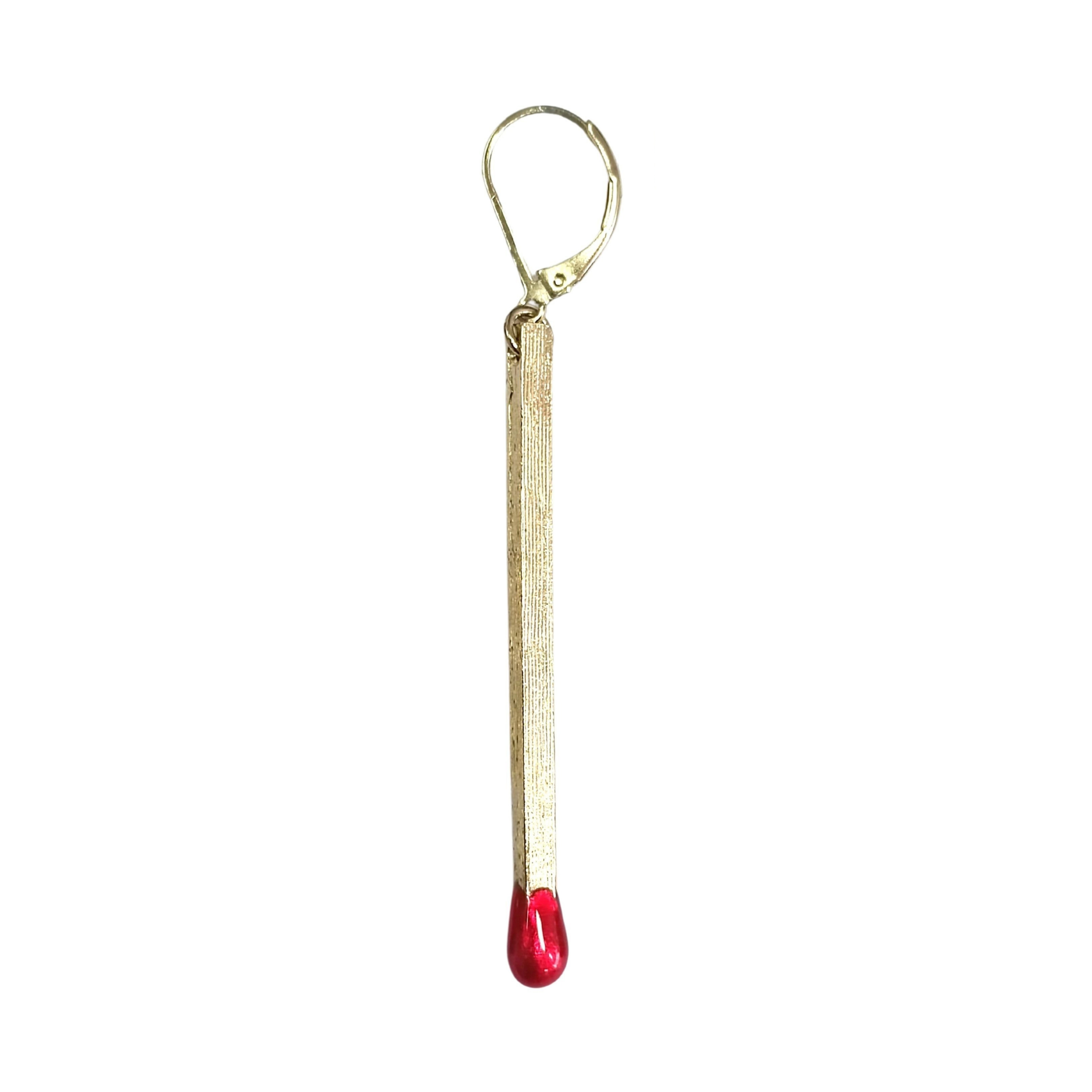
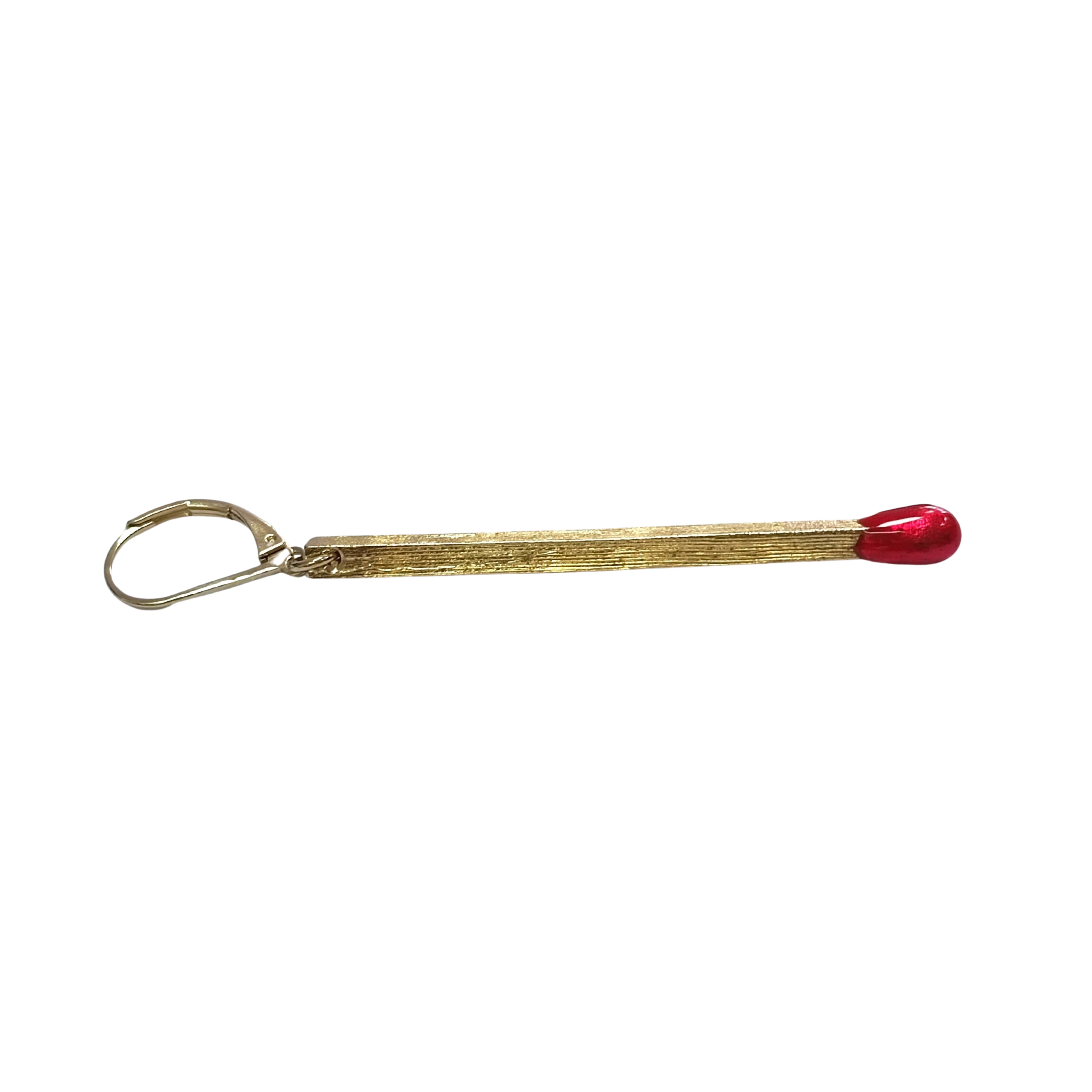
Gold-plated "Three Matches" earring / Marek Piekarczyk
An earring from the “Three Matches” collection, inspired by the TSA song of the same title. Created in collaboration between Marek Piekarczyk and RD-Bijoux (Paris).
Prototype.
Gold-plated, enameled.
Matchstick length: 5 cm.
***
The “Three Matches” collection was created by Roi Doré Bijoux, a French luxury costume jewelry brand inspired by various art forms, often created in collaboration with the artists themselves. The necklaces, earrings, bracelets, signet rings, cuffs, and brooches from the “Three Matches” collection were designed and crafted in the Parisian atelier of Roi Doré Bijoux.
The collection is a tribute to Marek Piekarczyk. This theme was chosen for the jewelry collection because of the song’s beauty—it is one of the most distinctive and beautiful rock ballads ever sung—as well as because of the song’s history and its place in Marek Piekarczyk’s body of work. It was with this very song that the artist’s career with TSA began, albeit in a somewhat surprising way: during a concert at the Forest Opera in Sopot on July 12, 1981, the artist was supposed to walk onto the stage and bow to the audience so they could meet the band’s new frontman. But Piekarczyk improvised—he sang “Three Matches” instead. He also bid farewell to TSA with this song at a concert in Gostyń in March 2018.
The song “Trzy zapałki” is thus a cult classic—an inseparable part of the legend of the artist himself, but also of the Polish music scene and rock music in general. Choosing “Three Matches” was therefore an obvious choice when creating jewelry for Marek Piekarczyk. But this collection also fits into the broader context of Roi Doré Bijoux’s work: from the artistic aspect to Polish-French relations.
The lyrics were written by Konstanty Ildefons Gałczyński, who actually translated them from French: the original text, titled “Paris at Night,” was written by Jacques Prévert, one of the most highly regarded French poets of the 20th century. It comes from the collection *Paroles*, published in 1946, which consists of a wide variety of texts—many of them protests against war and violence, others celebrating everyday life, and still others exploring the theme of love. The poem “Paris at Night” seemingly belongs to the latter category: it evokes an intimate scene between lovers who are discovering and memorizing each other’s bodies against the romantic backdrop of Paris by night—the city of lovers.
However, there is also a second, darker interpretation of these lines: the one lighting the matches is a soldier, while the one watching him is a sniper who, upon the lighting of the first match, spots his victim, aims at them with the second, and fires the third, after which “total silence” (“total darkness” in the original text) follows—death.
This ambiguous, moving, and beautiful text has inspired many artists: in addition to Gałczyński’s translation and Piekarczyk’s song, it has been interpreted by, among others, Yves Montand. The “Three Matches” collection is co-created with Marek Piekarczyk—and thus draws inspiration from two artistic sources: poetry and music. As such, it fits perfectly with the mission of Roi Doré Bijoux, a French luxury jewelry brand inspired by art in the broadest sense. In Roi Doré Bijoux’s interpretation, the titular three matches—a utilitarian object with a simple form but immense potential (matches can save lives, but they can also become a source of destruction) —retain their shape, though it is transformed in many ways.
The “Three Matches” collection exemplifies an extraordinary dialogue between various art forms—poetry and music—and the applied art of jewelry. The multifaceted meaning of the poem, which served as the starting point for the collection, lends it an additional, moving dimension. But above all, the collection consists of beautiful objects: surprising and universal in their simplicity, yet original and unique.









