


19th century – Sigismund III Vasa and Anna of Habsburg – embossed patriotic tray
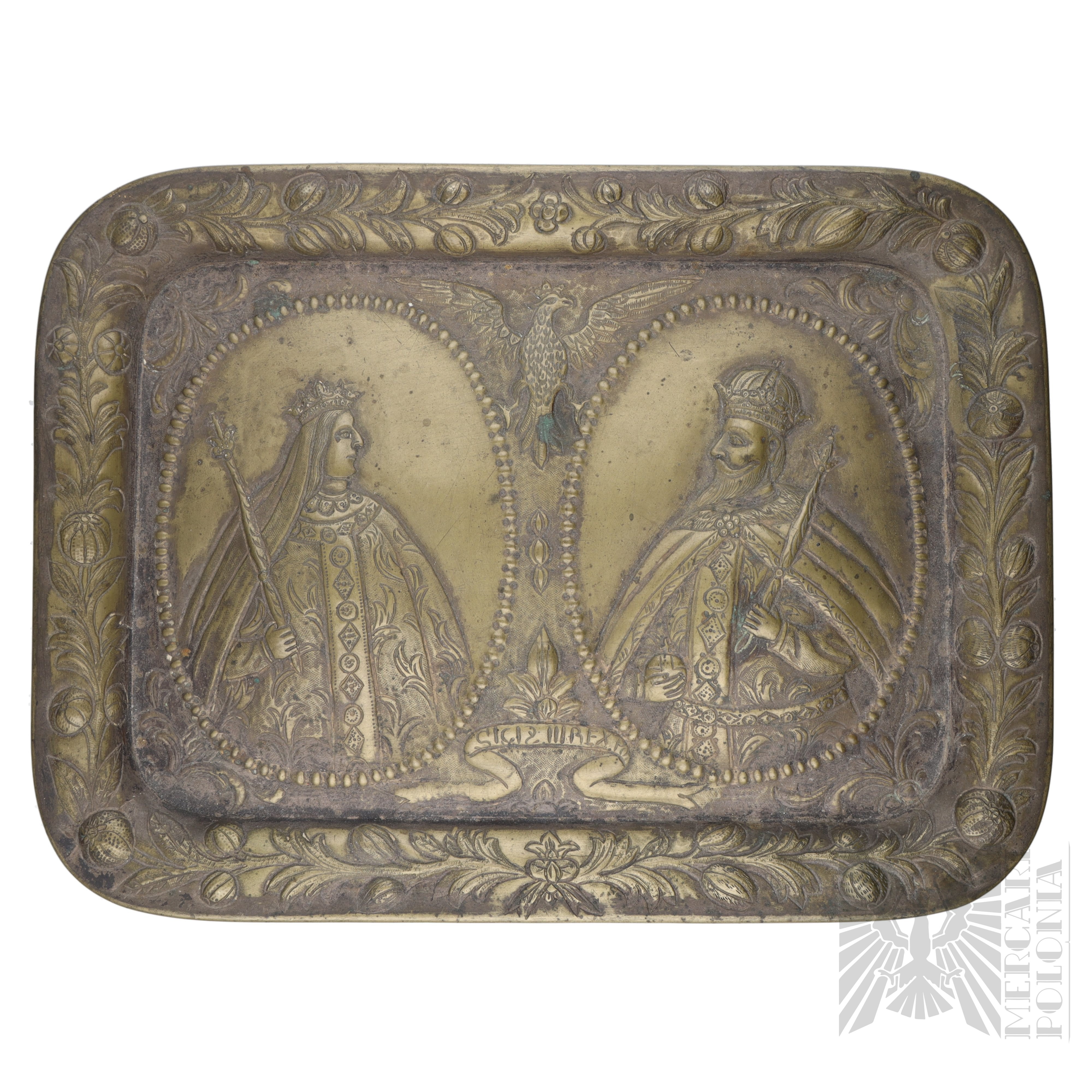
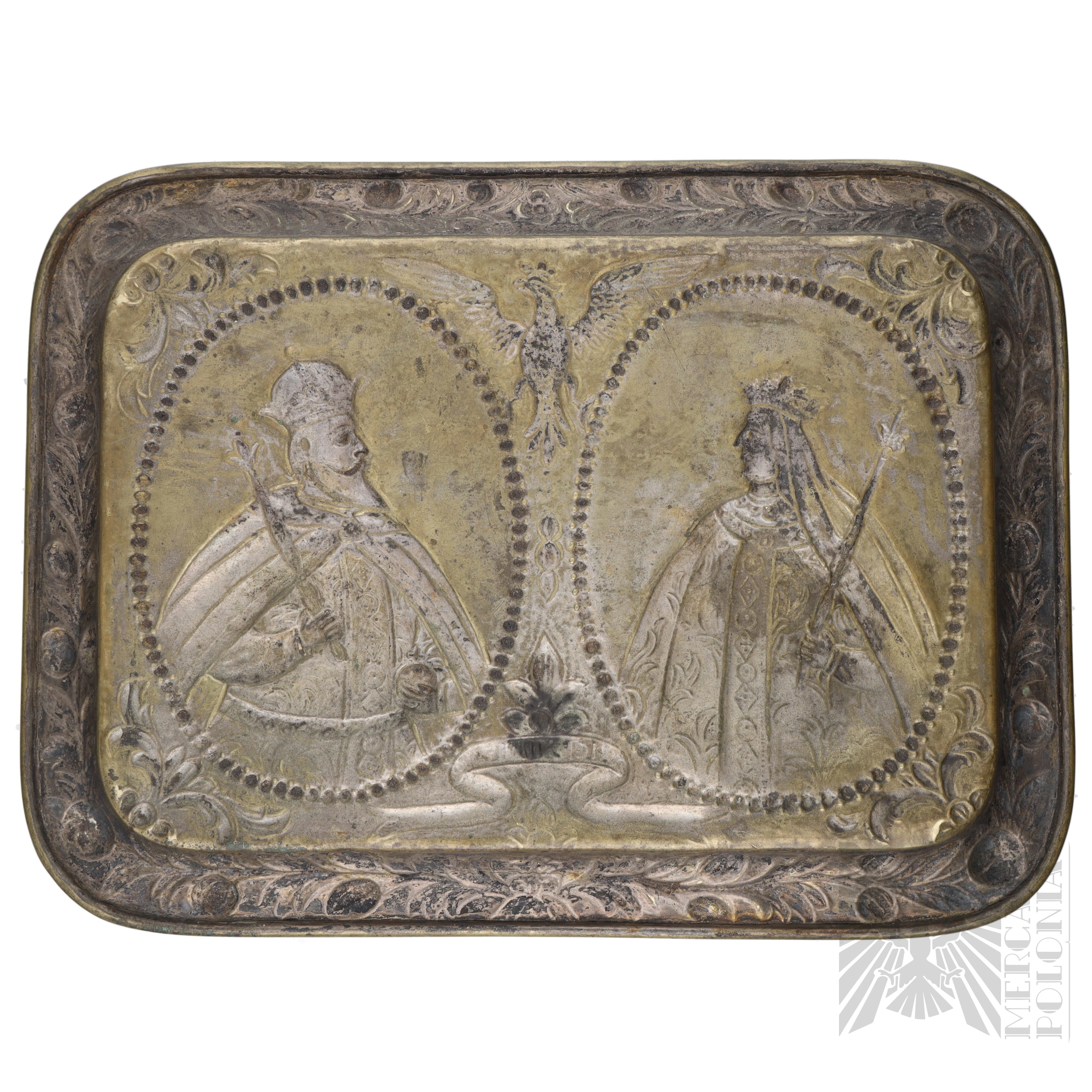
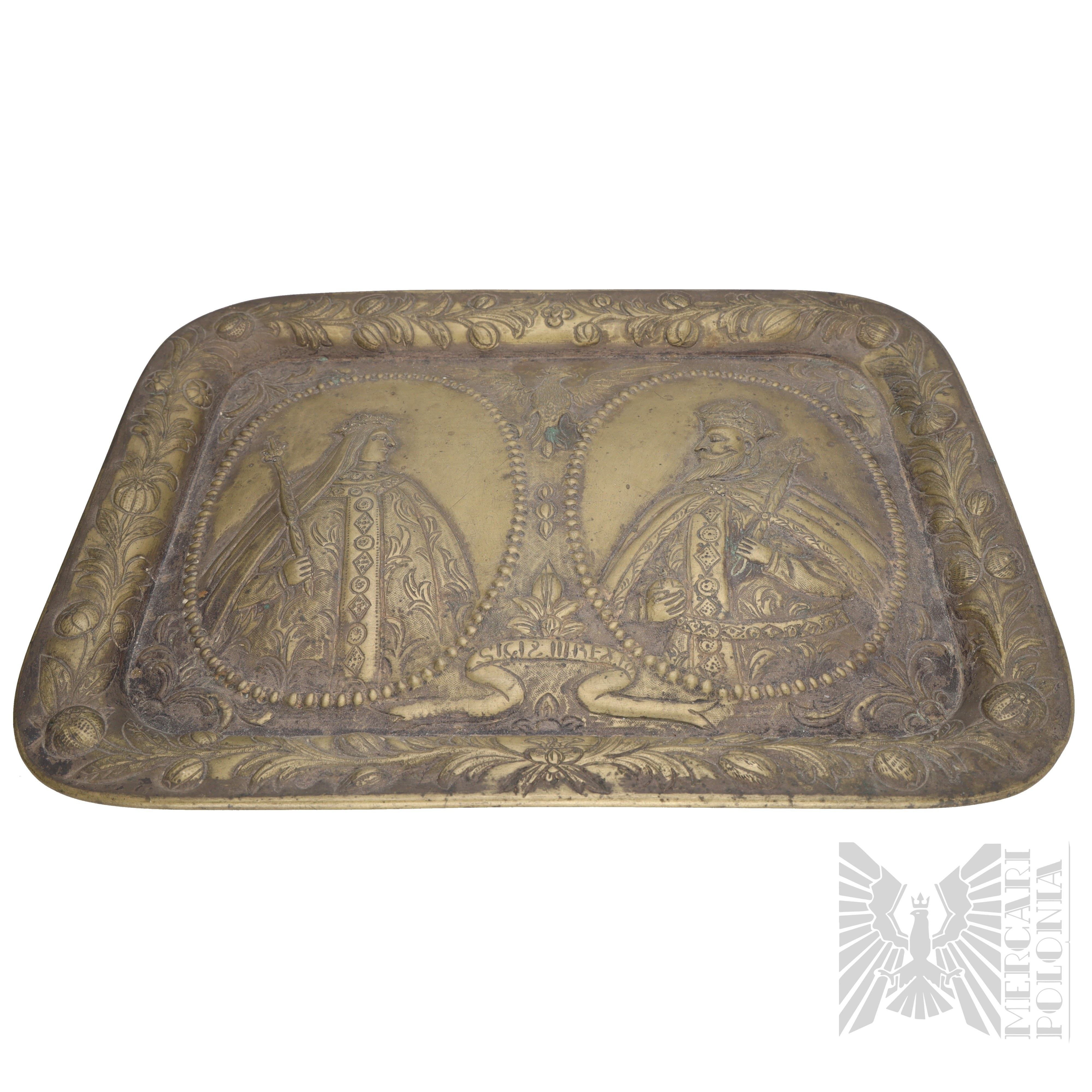
A rectangular decorative tray with rounded corners and a wide, slightly raised rim. Made of yellow metal sheet, likely brass, decorated using repoussé, embossing, and chasing techniques. The surface bears traces of silver plating or whitewashing in places; the exact composition of the alloy and the nature of the finish require material analysis.
The central section depicts half-length portraits of Sigismund III Vasa and his first wife, Anna of Habsburg, facing each other. The king is depicted with a beard, wearing a crown and richly decorated ceremonial attire, holding the royal orb and scepter. The queen, also wearing a crown and ceremonial robes, holds a scepter. The figures are placed within two adjacent oval fields, bordered by a pearl-like ornament. Between the medallions, in the upper part of the composition, is a White Eagle with outstretched wings, while below is a stylized cartouche with a partially erased inscription referring to Sigismund III.
The wide rim of the tray is filled with a continuous floral ornament consisting of winding stems, leaves, flowers, and fruits resembling pomegranates. The decoration of the corners is enriched by elaborate leaf motifs. The composition has a historicist character and draws on modern royal portraiture as well as Renaissance and early Baroque ornamentation. The reverse shows an inverted, concave negative of the repoussé depiction, making the arrangement of figures a mirror image of the obverse.
Sigismund III Vasa (1566–1632) was King of Poland and Grand Duke of Lithuania from 1587 and King of Sweden from 1592 to 1599. Anna of Habsburg (1573–1598), daughter of Archduke Charles of Styria and Maria of Bavaria, became his first wife in 1592; her ceremonial coronation took place on May 31 of that year at Wawel Cathedral. The depiction of the royal couple on this nineteenth-century artifact should be viewed in the context of the historicism characteristic of the era and the interest in the history of the former Polish-Lithuanian Commonwealth. Objects of this kind served primarily a decorative and commemorative function, and during the period of the Partitions, they could be interpreted as a manifestation of attachment to Polish historical tradition.
The photographs provided show no visible maker’s marks or signatures that would allow for the identification of the workshop or the exact place of manufacture. Significant surface wear is visible, along with localized loss of whitewash or silver plating, a dark and greenish patina, oxidation deposits, scratches, soiling, and slight warping of the metal sheet and edges. The relief is worn in places due to use and cleaning.
Dimensions: 29 × 21.5 cm.
Condition: as shown in the photos.











Nylig sett
Logg deg inn for å se en liste over objekter
Favorittobjekter
Logg deg inn for å se en liste over objekter