


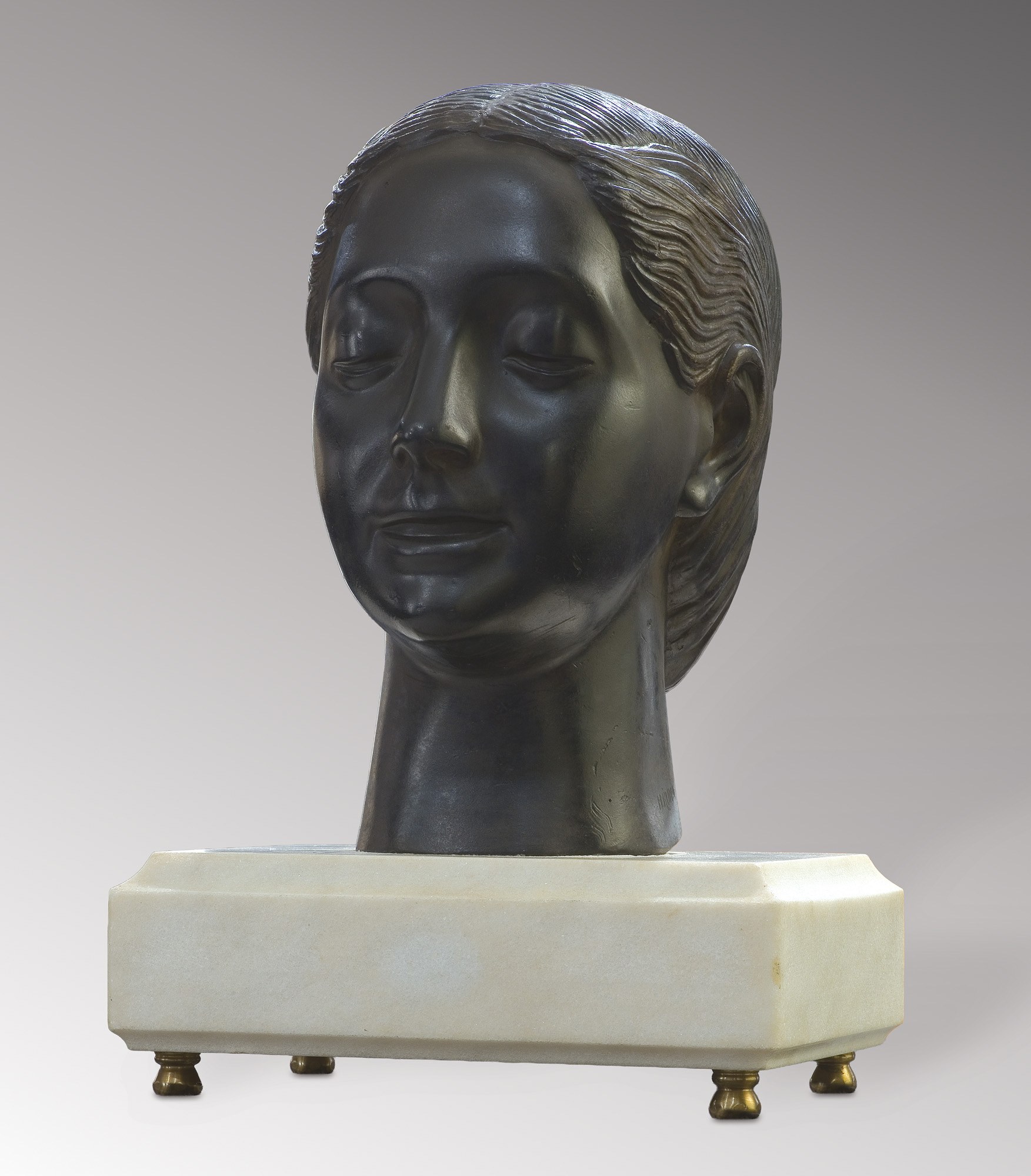
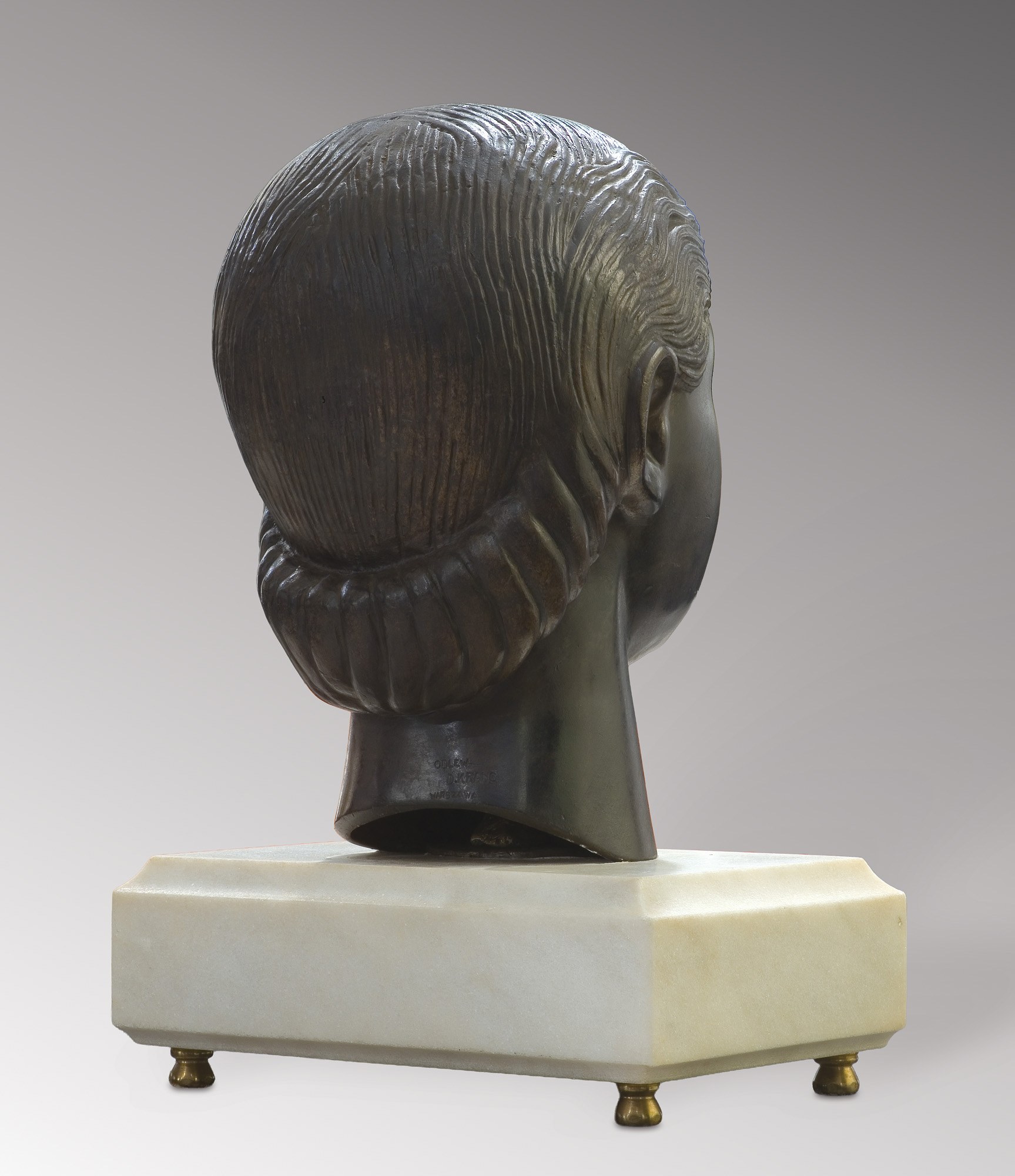
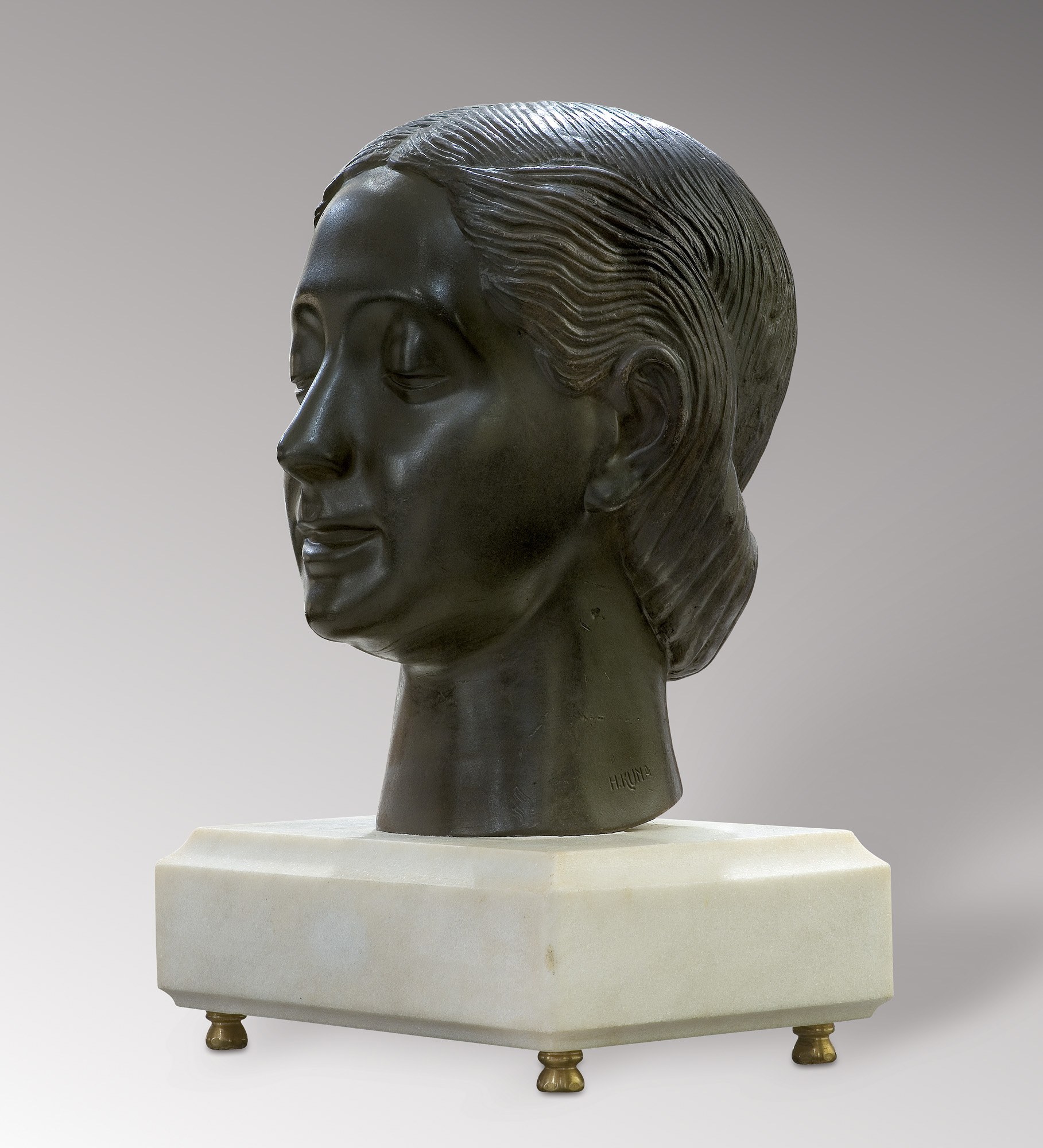
28.0 x 21.0cm - patinated bronze
bronze, casting, patination, base - marble (secondary)
height 28 x 21 x 13.5 cm
signed H. KUNA, D. KRANZ | WARSAW
Compare:
Mieczyslaw Wallis, Henryk Kuna, published by "Arkady", Warsaw 1959, cat. no. 9, ill. 30-31.
Henryk Kuna, after staying in Paris in 1911 and coming into contact with the work of Aristide Maillol, freed himself from the impressionistic style in which he initially worked, being influenced by the school of Auguste Rodin, whose propagator in Poland was Konstanty Laszczka, his master. His sculptures became an example of combining realism with idealizing, timeless classical beauty. The artist abandoned the non finito mannerism in favor of refined, sculptural fini, which brought him widespread recognition and a position as one of the leading representatives of the new classicism in Polish sculpture.
One of the first sculptures he created after returning from Paris was the marble Head of a Girl in a Hood, purchased by the authorities in Venice, now kept in the collection of the Galleria d'Arte Moderna there. Created in the following years, the series of female heads, with lowered eyelids and a faint, barely perceptible smile, is today one of the iconic sculptures of Polish art of the interwar period.
The artist executed his sculptures in a variety of materials - plaster, marble, wood, as well as cast in bronze. The marble Head of a Woman, which was probably the model for the bronze casting of the offered work, ended up in the collection of Professor Jerzy Jarnuszkiewicz after the war (cf. M. Wallis, op. cit.). The bronze was made by a Warsaw giser specializing in artistic castings, Dawid Krantz, who, after a couple of years in France, returned to Warsaw in 1934 (cf. M. Dubrowska, The bronze works of Krasnosielski, Wasilewski Krantz (aka Krantz) and their artistic castings, "Almanach Muzealny", 1997, p. 140).
The offered bronze is one of the few commissioned sculptures by the author himself that have survived to the present day. Hence, it undoubtedly constitutes a collector's rarity.
Henryk Kuna (Warsaw 1879 - Torun 1945) - one of the most outstanding Polish sculptors of the 20th century. He began his studies in the sculpture studio of Pius Weloński, and then continued them at the Academy of Fine Arts in Cracow under Konstanty Laszczka. He went to Paris for the first time in 1903 and at that time he was greatly influenced by Rodin's work. Later, he stayed there several times. In 1927 he had a solo exhibition in Paris, and received the French Legion of Honor for his artistic activity. He was a co-founder of the art grouping "Rhythm" (1922) and participated in all exhibitions. His sculpture of that title (1921) won the Grand Prix at the Exhibition of Decorative Arts in Paris four years later. In 1936 he took over the chair of sculpture at Stefan Batory University in Vilnius. During the war, he went into hiding in towns near Warsaw. Shortly after the end of hostilities in 1945, he was appointed professor of sculpture in Torun, death prevented him from assuming this position.
He was inspired by the art of antiquity and the Italian Renaissance - his subjects are usually female figures, torsos and heads with smoothed shapes, full of finesse and warmth. Over time, he introduced an element of expression, seen mainly in sculptures with religious themes.
Among his most famous works is "Rhythm" (1921)-a figure of a nude woman captured in a graceful pose, realized in several versions-and a small "Head of a girl in a hood" (1913) purchased for the Galeria Internazionale d'Arte Moderna in Venice, a sculpture of which another version is in the National Museum in Warsaw. The artist also created designs for monumental sculptures; in 1932 he won first prize in a competition for a monument to Adam Mickiewicz in Vilnius (not realized). He is also the author of the monument to Jozef Pilsudski in via Maresciallo in Rome (1938).






![Henryk Kuna (1879-1945), Dziewczyna, [1944]](https://img1.one.bid/img/366/53241_1w.webp)








Nylig sett
Logg deg inn for å se en liste over objekter
Favorittobjekter
Logg deg inn for å se en liste over objekter