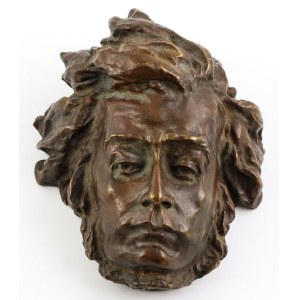
Bronze, 19 x 16 cm
Cast by Lopienski Brothers
Face of the poet taken from the monumental version "Mickiewicz awakening the genius of poetry". The bust of Mickiewicz from this work was offered at the 142nd Ostoya auction (16.05.2015, item 17)
Asking price 6000
Estimate 7000 - 8000
Antoni KURZAWA
He came from a poor rural family. His home-grown talent caught the attention of Mieczyslaw Weryh-Darowski, thanks to whom Kurzawa began studying sculpture with Parys Filippi in Cracow. Between 1863 and 1869, he studied at the Cracow School of Fine Arts and with Franz Bauer in Vienna. In the early 1870s, he stayed in Lviv, where he worked together with Julian Markowski on tombstones in the Lychakiv Cemetery. In 1876-1877, he studied in Paris under Henri Chapu. After returning from France, he lived and worked in Cracow, and from about 1880 in Warsaw, while doing many commissions in the provinces. In addition to sepulchral sculpture, he also undertook subjects inspired by folklore and the world of fairy tales and history. Kurzawa's best-known work is the sculptural group Mickiewicz awakening the genius of poetry, the prototype of which was created in 1889. That year the artist submitted this work in plaster to the annual competition of the Society for the Encouragement of Fine Arts in Warsaw. Confident of winning, he broke down after the announcement of the jury's verdict awarding him only the third prize and committed a desperate act - he stormed into the exhibition and smashed his own work. This fact reverberated and was widely commented on in the press of the time. Over time it became a symbol of the tragic fate of unappreciated artists. On the drama of Kurzawa's life, (who died in a shelter for the poor) many themes of Young Poland literature are based, including Henryk Sienkiewicz's novella Lux in tenebris lucet. The offered sculpture is a reproduction of a fragment of this sculptural group for the bust (which was the only one that was not destroyed). The statue was reconstructed in 1890 by T. Skonieczny and Kurzawa himself made a reduced replica. In 1895, a bronze casting was made by the Lopienski Brothers (now in the National Museum in Warsaw). Wojciech Lipczyk and Anna Lopienska-Lipczyk, who now run the Lopienski Brothers company, confirm that the offered object was made by the Lopienski Brothers foundry. According to the company's records, it made several fragmentary studies from Kurzawa's work. The 29th Auction of the Ostoya Auction House offered the Mask of Adam Mickiewicz, also a fragment of Mickiewicz awakening the genius of poetry made at the Lopienski Brothers.