


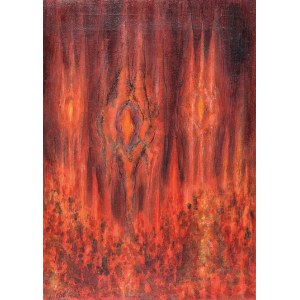
oil, acrylic, canvas; 70 x 50 cm;
Signed and dated l. d.: J.Tchórzewski '83;
Inscribed on the reverse: J.Tchórzewski / 83 / "SIGNALS" / acrylic - oil;
on the reverse, on the painter's loom, a sticker from CBWA Zachęta from the 1980s with a handwritten note: Rostocki / Jerzy Tchórzewski / supplication b - signals.
Image exhibited: Jerzy Tchórzewski. Painting; 21.11-30.11. 1980, CBWA Zachęta, Warsaw.
"I think that the role of a painter is to evoke life, to transform passive plastic matter into an organism pulsating with life. There is something of the primordial process of starting a fire, when a spark gushed from two cold, dead logs of a tree, an element was created. The man who caused this element was initially alone in the face of inanimate things. He only had within himself the energy and the need, the necessity to evoke another energy. When this ejaculated he was faced with something that henceforth lived its own separate, intense life. He had a strong partner for passionate play from that moment on. Similarly with painting. When I set to work, there is in me at first only an impatient desire to evoke life from this dead plastic substance I have at my disposal at the moment, an irresistible need to break the tragic circle of loneliness that surrounds me like any human being, a need for a dialogue partner. Always equally intimidated and preoccupied, as if I were tempted to do so for the first time, and always equally impatient, I fail to remember at any given moment all the rules of art, all the commandments of my profession. I clash the dead material with me, I urge it with my fever to start breathing. When life is born - a moment always equally astonishing - I begin to carefully rekindle it. I am still stronger, I attempt to mold it, I want to give it a rhythm that matches the rhythm of my life, I want to give it maximum strength. I am slowly losing my edge. I am facing something that has its own laws. We debate with each other. When he convinces me, I stop painting. Often we part without agreement and look at each other reluctantly." [Jerzy Tchórzewski statement from 1962].
In 1983 Jerzy Tchórzewski paints very little, in contrast to 1982, when more than a dozen gouaches are created as an artistic reaction to the introduction of martial law on December 13, 1982 by Gen. Jaruzelski. The painter, who was involved in the Solidarity movement, was an expert of the NSZZ National Commission (the so-called Geremek Commission) for the reform of universities. After December 13, as A. Wojciechowski, after several weeks of silence he took to painting intensively. The titles of the 1982 gouaches are characteristic: three works with the title "Predator" and two with the title "Beast." In 1983, two oil works "Hanging Forms" and "Signals" (dimensions 69.5x49.5) are created. The small size of these works shows that he painted them with "suitcase exhibitions" in mind. The underground "Solidarity " called for a boycott of all official exhibitions and bore in mind organizing shows in private homes and churches. This boycott encompassed almost the entire circle of artists associated with the Academy of Fine Arts in Warsaw and Cracow, who responded to the appeal of the Independent Solidarity Culture Committee by exhibiting in numerous exhibitions held in churches throughout Poland. Among others, Jerzy Tchórzewski showed "Signals" already at the first exhibition at the Church of the Divine Mercy on Żytnia Street in Warsaw in 1983. This exhibition was called "Sign of the Cross" and entailed dozens more until 1989, just to name : "Apocalypse - light in darkness 1984", "New heaven and new earth 1985", "Between heaven and hell 1986". As Dorota Jarecka writes in a comprehensive study titled "Janusz Bogucki, Polish Szeemann" "...in a similar sacred space the names of outstanding participating artists recur: J. Bereś, J. Kalina, J. Tchórzewski, S. Gierowski, J. Sempoliński...".


![Jerzy Tchórzewski (1928-1999), Kot, [lata 50-te]](https://img1.one.bid/img/366/53194_1w.webp)










Nylig sett
Logg deg inn for å se en liste over objekter
Favorittobjekter
Logg deg inn for å se en liste over objekter