


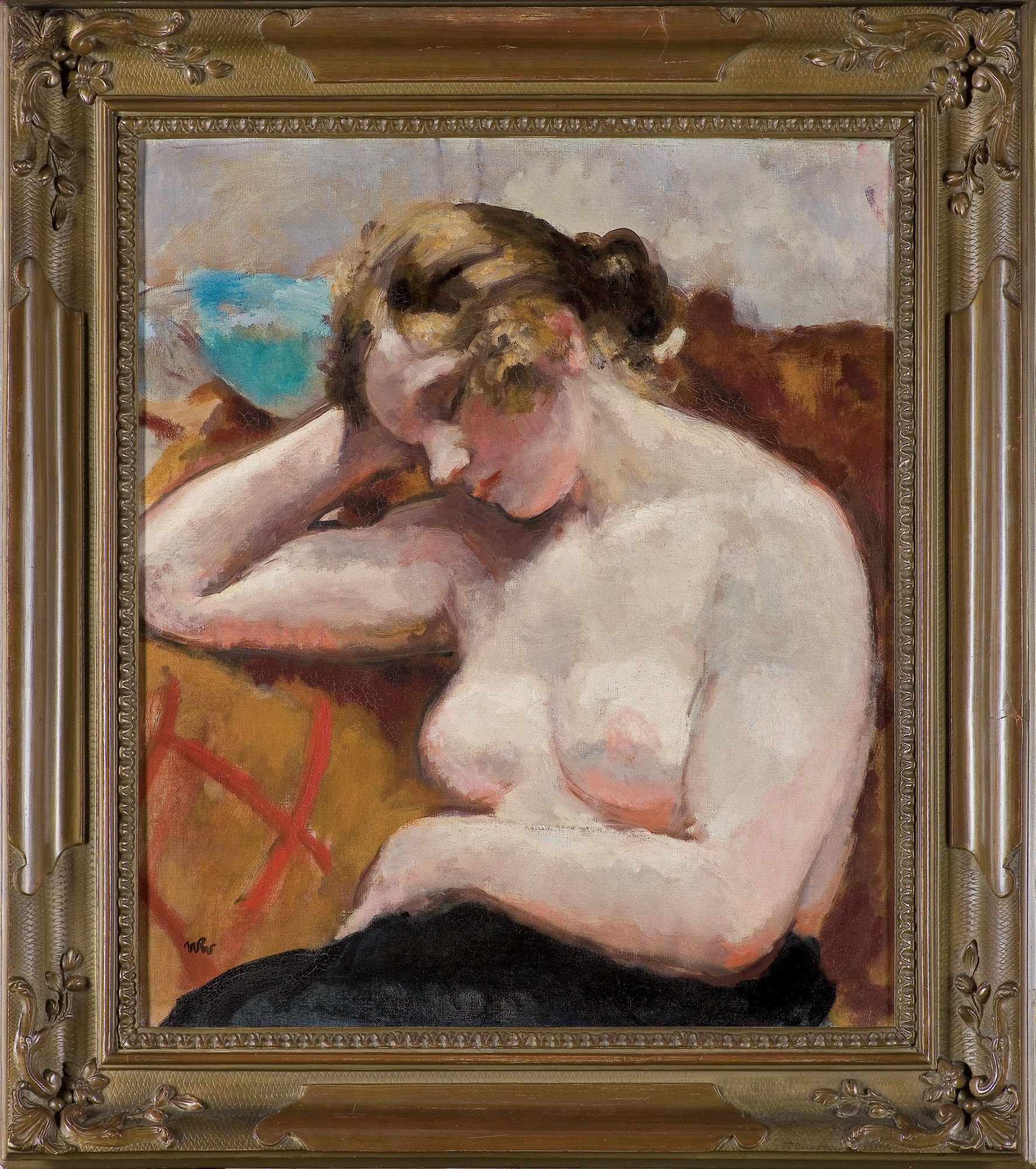
64,8 x 55,4cm - oil, canvas
signed l.d.: WW
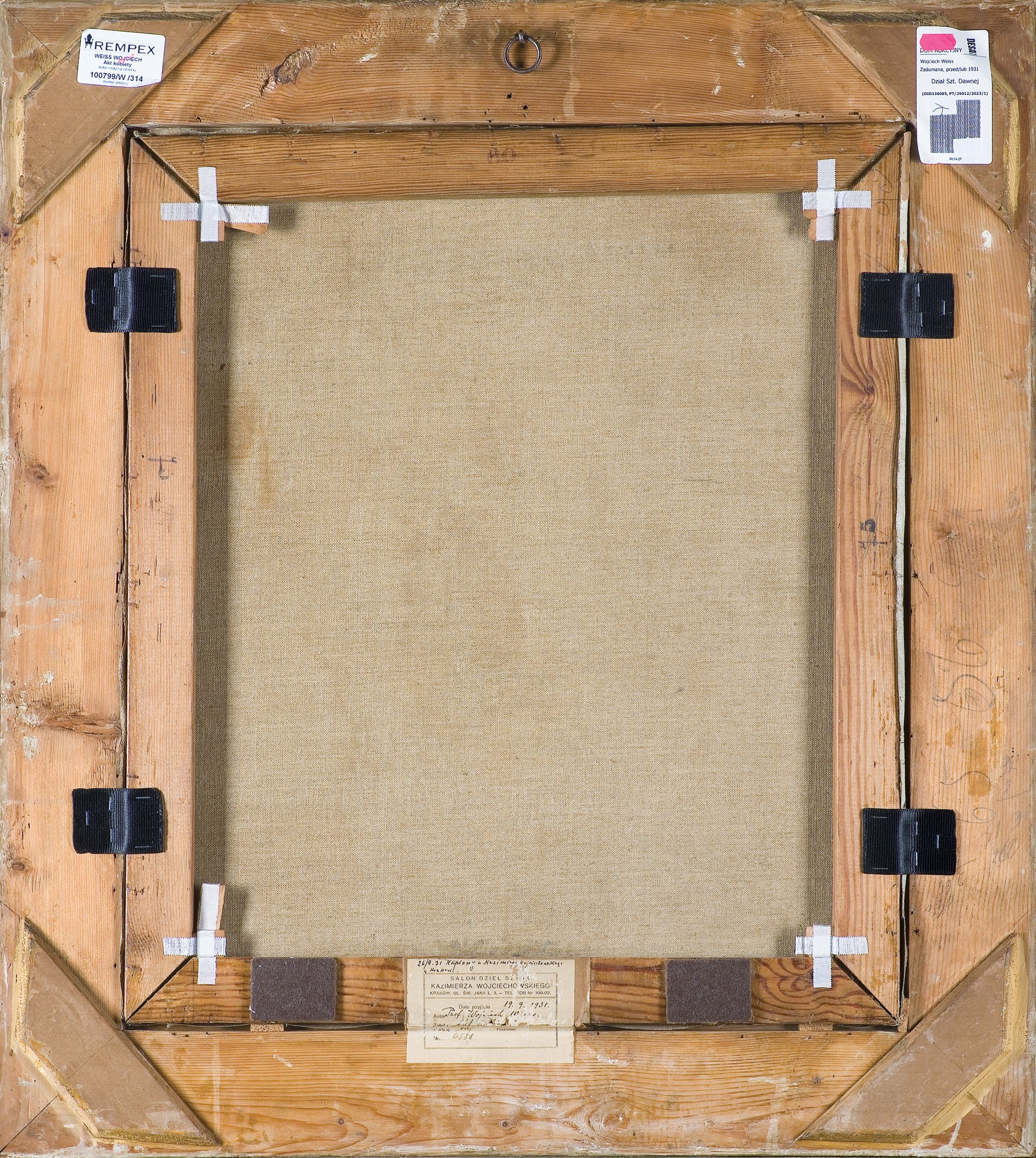
On the reverse, on the lower loom strip, two stickers (one on top of the other) of Kazimierz Wojciechowski's Cracow salon of works of art (print, ink): 26/9.31 Bought at Kazimierz Wojciechowski's in Cracow | SALON DZIEŁ SZTUKI | KAZIMIERZA WOJCIECHOWSKIEGO | KRAKÓW, UL. ŚW. JANA L.3. - TELEFON No. 100-02. | Date accepted 19.9.1931 | Author Prof. Wojciech Weiss. | Title Nude of a woman | Type oil Size | No. 6558; also on the slats of the loom numbers relating to the size of the canvas.
The Sleeping Model is an excellent example of Wojciech Weiss's impressionistic and colorful painting. His workshop was brilliantly assessed and explained by Stanislaw Swierz in "Fine Arts".
This is how he wrote about Weiss in 1925: Instead of discussing the "goals of art," instead of considering what painting should be like - Weiss painted. He painted nudes, figures, portraits, still lifes, landscapes, and combined them together in what others call composition: as if composition were not seen in still life or portraiture. Like any true painter - he was attracted to the nude above all. - Zola once wrote about Courbet, calling the painter from Ornans: "Le faiseur de chair".
If anyone in Polish painting rightly deserves this name: it is certainly to Weiss. We have always had more illustrators than painters of temperament, sensitive to the matter of painting. This painting matter most luminous and most sensitive, most changeable and dependent on the environment - is: the body! The eternal and wonderful source of study! In the delicate life of the epidermis, in the passages of elusive reflections of the body, the painter can sink all the way down and fill his whole life with it! Only as long as this sensual delight does not dampen! not to impose anything on it! - to preserve the simple and clear meaning of nature! - That's why Weiss does not dictate the model's pose, does not bend and twist his members, in search of unusual movements. She looks at him. He observes him. He is inspired by him. Beauty is always natural. The most immortal poses are those created by nature itself. - Often during a pause, when a bored model is flipping through a newspaper, not paying attention to whether anyone is looking at him, Weiss takes a piece of paper - and starts sketching in the corner.... This is how Weiss' happiest nude inspirations were created, where the arabesque, the ornament of the body, dictates its own melodious rhythms. Weiss seeks in the nude neither philosophical meditations, nor geometric considerations, nor architecture.... he doesn't turn women into columns - he simply wants to paint them with the radiance of their bodies - like a flower picked, like a ripe fruit thrown between clouds of matter on the whiteness of batiste! Like a jewel among still life! To create ever new orchestrations of flesh colors and harmonize them together with their drapery surroundings! - Like Tintoretto or Tintoretto - illuminate the background of your paintings with the pearl of the reclining body. - Bring out the transparency of the epidermis laserings, running the gamut of tones from dark, brown, golden or red, infused with blood, to bright, silvery, phosphorescent white.... Paint the white bodies of Venus lying down, emerged from the whiteness of the sea foam! From these movements of the recumbent, lazy and soft, from the rest of the bodies slender and flexible, tossed carelessly on the whiteness of the sheets or tucked into the corner of the couch, from the nonchalance of the carelessly curved thighs and hips, from the provocation of the small, round, thrust forward breasts, from the coquetry of the legs pressed under each other - Weiss brought out an infinite richness of motif.... Of these, perhaps the most famous Politics - this busy arabesque of arms and legs, supported by a taut arc of stoves, pressed into the white of the cushions. And when he touches this favorite subject of the 18th century - the intimate temple of a woman, the bed: he triumphs - the painter, contrasting the cold whites of the pillows, with the pinkness of the transparent body, with the dark wave of hair.
S. Swierz, Wojciech Weiss, "Sztuki Piękne", Kraków 1925, pp. 151-155
Wojciech Weiss (Leorda, Bukovina, Romania 1875 - Kraków 1950) - painter and graphic artist; studied at the School of Fine Arts in Kraków from 1890-1899, initially with Jan Matejko, Władysław Łuszczkiewicz, Florian Cynk, Józef Unierzyski, and later also with Leon Wyczółkowski and Julian Fałat. He completed his studies with a gold medal; later he continued his education in Paris and Italy. Since 1897 he was a member of the Society of Polish Artists "Sztuka", in 1906 he became a member of the Vienna "Secession". From 1907 he taught at the Academy of Fine Arts in Cracow - from 1910 as an associate professor; from 1913 as a full professor. He also served as the university's rector twice - in 1918/19 and 1933-1936. He was one of the most outstanding Polish painters of the Young Poland period and the interwar period. In his early period he painted symbolic figural scenes, often with fantastic themes, and later also portraits, nudes and landscapes. He also worked in printmaking and sculpture.













Nylig sett
Logg deg inn for å se en liste over objekter
Favorittobjekter
Logg deg inn for å se en liste over objekter